

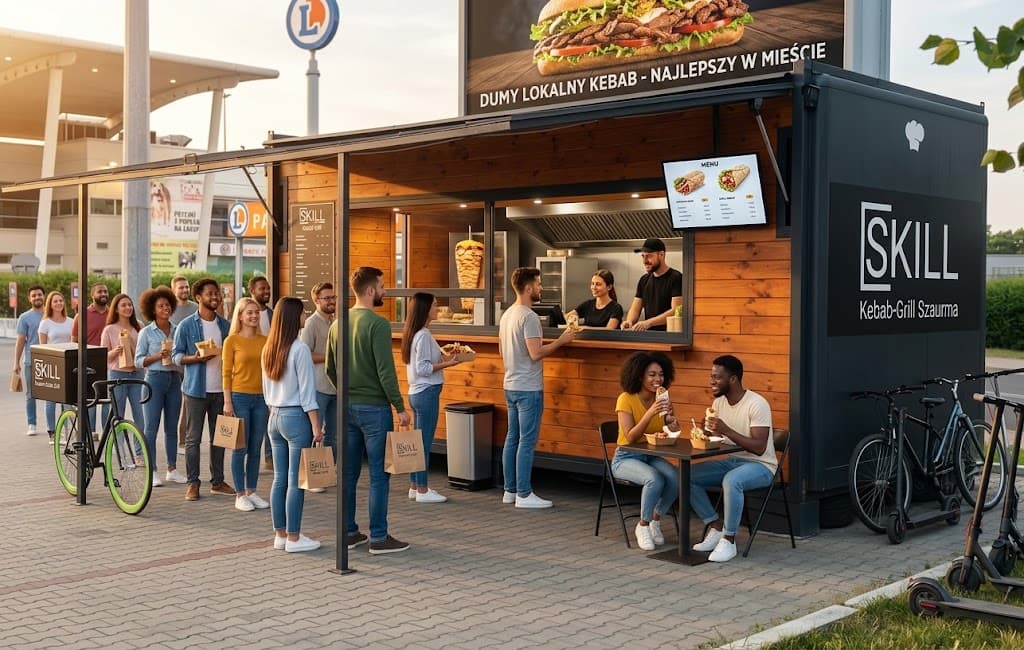
Skill Kebab is a local kebab shop in a major city business district — 4 staff, 60-item menu, 300–400 orders per week. For over a year owner Dariusz handled delivery only through Wolt and Bolt Food. In March 2025 he decided to change that.
Below is a detailed account of what he did, what worked, what did not — and the numbers after 3 months.
Starting point — before implementation
Operational data (January–February 2025)
| Parameter | Value |
|---|---|
| Monthly delivery revenue | ~€9,000 |
| Wolt share of delivery | 62% |
| Bolt Food share | 31% |
| Own channel share | 7% (phone) |
| Wolt commission | 30% |
| Bolt commission | 28% |
| Monthly commission cost | ~€2,600 |
| Google Maps reviews | 89 (4.2★ rating) |
Main problems Dariusz reported:
- "I pay Wolt over €2,500 a month and have no idea who orders from me"
- "Phone orders are chaotic — staff make mistakes when busy"
- "I cannot send promotions because I have no customer contacts"
Decision and rollout plan
Dariusz did not want to quit Wolt and Bolt immediately — too risky. The plan: build an own channel and gradually move returning customers.
He chose RESTOBOT for three reasons:
- Registration and setup via Telegram (no technician)
- Wolt Drive integration — own orders, Wolt couriers
- Telegram bot as the main channel for returning customers
Setup took one business day. Dariusz did it himself, after closing.
What was launched:
- Telegram bot with full menu, categories, and photos
- Website on subdomain (kebab.restobot.pro)
- Wolt Drive as courier provider
- Loyalty card in Apple/Google Wallet
- Google reviews collection module
Month 1: launch and first results
How Dariusz promoted the own channel
He spent nothing on ads. He used what he had:
Receipts: Every receipt got a QR with: "Order directly via our Telegram bot — delivery without middlemen. Get -15% on your first order."
Staff: At pickup and checkout one line: "We have our own bot — order there, it is cheaper and faster."
Takeaway packaging: QR sticker on every kebab box.
Instagram: 3 posts in the month about the bot and first-order discount.
Results after month 1
| Parameter | Value |
|---|---|
| New Telegram bot users | 312 |
| Orders via own channel | 143 (up from 7% to 18% of total) |
| First orders with 15% discount | 89 |
| Same-month returns | 41 (29% of new bot users) |
| New Google reviews | 34 (previously 3–4/month) |
Dariusz: "I knew it would work, but not this fast."
Month 2: optimization and scaling
In month 2 Dariusz made two changes:
Loyalty card: Point program — €1 = 1 point, 100 points = free drink or add-on. Every customer after first bot order got an automatic message with Apple/Google Wallet card link.
Post-delivery messages: 25 minutes after delivery the bot sent: "How was your order? 5★ — share a Google review. Feedback? Message us here." 5★ ratings redirected straight to Google Maps.
Results after month 2
| Parameter | Value |
|---|---|
| Orders via own channel | 248 (29% of total) |
| Active loyalty cards | 187 |
| Repeat bot orders | 89 (+117% vs M1) |
| New Google reviews | 67 |
| Current Google rating | 4.6★ (up from 4.2★) |
| Monthly commission cost | ~€2,200 (down €400) |
Month 3: own channel starts to dominate
In month 3 something unexpected happened. Dariusz did nothing new — but the snowball effect kicked in.
Loyalty card holders order regularly. The bot itself is a retention channel — once a customer orders via Telegram, they get promo notifications and always have the card handy.
At the same time growing reviews (after 2 months Skill Kebab had 168 new reviews at 4.7★) improved Google Maps visibility. More customers find the profile organically — some order immediately via the Telegram link in the Google Business description.
Results after month 3
| Parameter | Value |
|---|---|
| Monthly delivery revenue | ~€12,500 (+40% vs January) |
| Orders via own channel | 412 (47% of total) |
| Wolt + Bolt orders | 53% (down from 93%) |
| Commission cost (Wolt/Bolt for new customers only) | ~€1,750 (down 33%) |
| Monthly savings vs baseline | ~€850 |
| Google reviews (total) | 257 (4.8★ rating) |
| Active loyalty cards | 431 |
Summary after 3 months
| Metric | January 2025 | April 2025 | Change |
|---|---|---|---|
| Monthly delivery revenue | €9,000 | €12,500 | **+39%** |
| Commission cost | €2,600 | €1,750 | **-33%** |
| Own channel share | 7% | 47% | **+40 pp** |
| Google reviews | 89 (4.2★) | 257 (4.8★) | **+168 reviews** |
| Telegram customer base | 0 | 890 users | — |
What Dariusz would do differently
Asked about mistakes, he names one: "I should have started the loyalty card in M1 — I only activated it in M2. If I had started in M1, the base would be even bigger."
Second lesson: "I did not realize how much reviews affect Google Maps visibility. Going from 89 to 257 reviews in 3 months brought traffic I did not have before — new customers, not just returns."
Takeaways for restaurant owners
Skill Kebab's story shows several things:
First, moving to an own channel does not mean quitting Wolt — it is a hybrid strategy where aggregators acquire new customers and your channel keeps them.
Second, Google reviews are not just reputation — they are SEO. Going from 4.2★ to 4.8★ with triple the review count changed local search position.
Third, scale is not required. Skill Kebab is a small venue with 4 staff. The system works the same for a 20-location chain or a single shop.
Start the same way: www.restobot.pro — Telegram registration in 5 minutes, setup in 1 day, first 30 days free.