

If you're losing a significant percentage of every third-party order to commissions, the fastest fix is switching to a commission-free subscription platform that lets you take orders directly through your own website, with no per-order cut to anyone. You keep the margin. You keep the customer's name, phone number, and order history. And you control the branded experience from the first click to the last bite.
Here's what that gets you right away:
- Higher margin per order since you're paying a flat monthly fee instead of a percentage that scales with your sales.
- Full ownership of customer data, so you can email, text, or push loyalty offers without a marketplace standing between you and your regulars.
- A consistent branded experience across your website, delivery, and reservations, instead of a generic marketplace listing next to five competitors.
- Direct POS integration, so orders land in your kitchen workflow without a second tablet or manual re-entry.
Your next move: pull your menu file, confirm what POS and payment system you're running, and book a demo with a platform like RESTOBOT to see how fast you can get a branded ordering page live.
Key Takeaways
Commission-free platforms convert into real margin because a flat subscription fee stays fixed regardless of order volume, unlike a percentage-based marketplace cut that scales against you.
| Point | Details |
|---|---|
| Know your monetization model | Confirm whether a vendor charges subscription, per-order fees, or true zero commission before comparing prices. |
| Run the real math | Compare a $25 average order across marketplace commission, subscription, and zero-commission scenarios using your own volume. |
| Own your customer data | Choose a platform that lets you export customer contacts freely instead of locking them behind the vendor. |
| Verify integrations before signing | Confirm POS compatibility, payment processor rates, and PCI compliance during the demo, not after. |
| RESTOBOT as the recommended path | RESTOBOT combines zero-commission ordering, same-day website launch, POS integration, and built-in CRM in one subscription. |
Table of Contents
What Does Commission-Free Online Ordering Actually Mean?
Commission-free online ordering means the platform doesn't take a percentage cut of every sale. Instead, it charges one of three ways: a flat monthly subscription, a flat per-order fee, or, in true zero-commission setups, nothing at all beyond your subscription tier. The vendor's business model determines everything downstream, from what you pay in a slow month to who legally owns your customer list.
A few terms restaurant owners regularly mix up:
- Commission: a percentage of each order's value taken by the platform, common on marketplaces that often charge a substantial commission.
- Delivery fee: what the customer pays a courier for the drive, separate from anything the restaurant owes the platform.
- Payment processing fee: the cut a company like Stripe or PayPal takes to move money, unrelated to platform commission and unavoidable no matter which ordering system you use.
- Service fee: an add-on some marketplaces charge customers on top of commission, often without the restaurant seeing a cent of it.
Ownership matters most here. On a marketplace, the platform owns the customer relationship. On a subscription model, you do, which means you can remarket to them without paying for the introduction twice.
How Much Can You Actually Save With Commission-Free Ordering?
Run the math on a $25 average order and the gap becomes obvious fast. On a typical marketplace charging a high commission rate, plus VAT or sales tax on that commission, your effective cut can be significantly reduced, leaving you with substantially less per order after fees. A commission-free subscription platform charges a flat monthly rate, often well under what a single week of marketplace commissions would cost a mid-volume restaurant. A true zero-commission model takes nothing per order at all. That difference compounds fast: process several hundred orders a month at an average price point, and a high-percentage marketplace cut costs you thousands, versus a fixed monthly subscription fee that stays flat whether you sell many orders or just a few.
Before you sign anything, check the contract for these hidden costs:
- Per-order fees disguised as "technology" or "platform" charges
- Payment-processing markup above standard processor rates
- Card terminal or hardware rental fees
- Onboarding, setup, or integration charges
- Mandatory marketing or advertising spend baked into the contract
- Chargeback and refund policies that quietly favor the platform
| Comparison dimension | Marketplace (high commission) | Commission-free subscription |
|---|---|---|
| Pricing model | Percentage per order, plus service fees | Flat monthly fee, no per-order cut |
| Customer data ownership | Platform owns it | Restaurant owns it |
| POS & payment integrations | Limited, platform-controlled | Direct integration with your POS and processor |
| Delivery support | Bundled, commission-based | Optional third-party courier, paid by customer |
| Setup time | Days to weeks, dependent on approval | Often same-day to a few days |
Elevated food and labor costs are already squeezing restaurant margins, which makes cutting a large commission line one of the highest-leverage moves available to an owner right now. Copy the $25-order math above into your own spreadsheet with your real order volume, and the annual savings usually speak for themselves.
What Should You Ask Before Choosing a Vendor?
The single most important thing to evaluate isn't the sticker price. It's total cost of ownership combined with three questions: who owns your data, what integrates with your existing systems, and what support looks like after you sign. A cheap platform that can't talk to your POS or locks your customer list is more expensive than it looks.
Run through this checklist on every demo call:
- Does it integrate directly with your POS, such as Dotykacka or Syrve, without middleware or a second tablet?
- Which payment processor does it use, and can you confirm the rate in writing? Providers like Stripe, PayPal, and Authorize all publish standard processing rates you should compare against what the vendor quotes.
- Is the platform PCI-compliant, and who holds liability for a payment dispute?
- Does it support delivery integration with couriers you already trust?
- Can you export your customer data at any time, in a usable format?
- What marketing and loyalty tools come standard versus as a paid add-on?
- What's the guaranteed uptime, and is there a written SLA?
- How long does onboarding actually take, and is a live trial or demo available before you commit?
Red flags worth walking away from: vague or "custom" per-order fees that aren't spelled out, contracts with long auto-renewal terms and steep cancellation penalties, no POS integration for your specific system, and any sales rep who can't clearly explain how payouts and PCI compliance work.
Pro Tip: *Ask every vendor to send you a sample monthly invoice and a signed merchant statement before you sign anything. If they hesitate or can't produce one, that hesitation is your answer.*
How Long Does It Take to Launch Direct Ordering?
A fast launch takes one to two weeks. A full rollout with staff training and marketing assets typically runs four to six weeks. Either way, the order of operations looks the same:
- Choose your vendor and confirm POS and payment compatibility (1 to 3 days).
- Import your menu, pricing, and tax settings (1 to 2 days).
- Test integrations between your POS, payment processor, and delivery courier (2 to 5 days).
- Train staff on the new order flow and dashboard (1 to 3 days).
- Soft launch to a segment of regulars before a full public push.
Have these ready before you start: menu files with photos, current pricing, tax configuration, your POS system details, a payment processor account, and signage or social copy announcing the switch. It also helps to add an ordering link to your Google Business Profile so search traffic lands on your branded page instead of a marketplace listing.
One distinction worth keeping straight: a courier delivering your direct orders charges the customer a delivery fee, not you a commission. That's a fundamentally different cost structure than a marketplace taking a cut of the food price itself.
Why RESTOBOT Fits the Commission-Free Model
RESTOBOT runs on a zero-commission model: a flat subscription instead of a percentage cut, with the site, ordering system, and POS integration bundled in rather than sold as add-ons. Website creation happens automatically the moment your application is approved, often within the same day, which puts branded ordering in front of customers faster than most marketplace onboarding processes.
Here's how the feature set lines up against what you should be evaluating:
- Pricing model: flat monthly subscription, no per-order commission ever taken.
- Data ownership: the restaurant keeps full customer data through the built-in CRM and analytics dashboard.
- POS and payment integrations: direct POS integration with systems like Dotykacka and Syrve, plus multiple payment methods including cryptocurrency.
- Delivery support: coordinated through third-party couriers like Wolt Drive, with delivery fees paid by the customer, not deducted from the restaurant's order total.
- Setup time: same-day website and ordering system activation after approval.
- Marketing and loyalty: digital loyalty cards built for Apple and Google Wallet, plus automated review boosting on Google and TripAdvisor.
Every order placed through a branded page instead of a marketplace listing is margin the restaurant keeps and a customer relationship the restaurant owns outright. That is the entire case for switching.
If you're booking a demo with any commission-free vendor, RESTOBOT included, ask specifically about POS mapping for your system, payment processor payout timing, and how fast your menu can go live. Those three answers tell you more than any pricing page will.
A Restaurant Operator's View on Making the Switch
I moved off marketplace apps because the math stopped making sense once volume grew. Margin per order improved immediately, and having actual customer phone numbers instead of anonymous marketplace IDs let me bring people back with a text instead of paying for their attention twice. Kitchen flow got simpler too, with orders landing in one place instead of three tablets. The tradeoff: you still have to put in some marketing effort to pull customers toward your own page instead of the marketplace habit they're used to.
Ready to Drop the Commission and Keep the Order?
RESTOBOT gets a branded ordering site live the same day your application is approved, with zero commission taken on any order, ever. Book a demo and the walkthrough will cover your menu import, a check of your current POS and payment setup, and a realistic timeline for going live. Support during onboarding is included, not billed separately, so you're not troubleshooting integrations alone. Start by creating your restaurant's ordering site and see how quickly you can move your first order off a marketplace and onto a page you actually own.
Sources
Restaurant owners researching this decision may also want the Restaurant Economic Insights report on rising operating costs, Stripe's and Authorize.Net's payment processing documentation, and RESTOBOT's blog of restaurant operations guides. For margin benchmarks to sanity-check projected savings, the Restaurant Operating Margin Benchmarks guide is a useful reference.
FAQ
What Does "Commission-Free" Mean for a Restaurant?
It means the platform doesn't take a percentage of each sale. You instead pay a flat subscription or per-order fee, or in a true zero-commission model like RESTOBOT's, nothing per order at all.
How Much Do Marketplace Commissions Typically Cost?
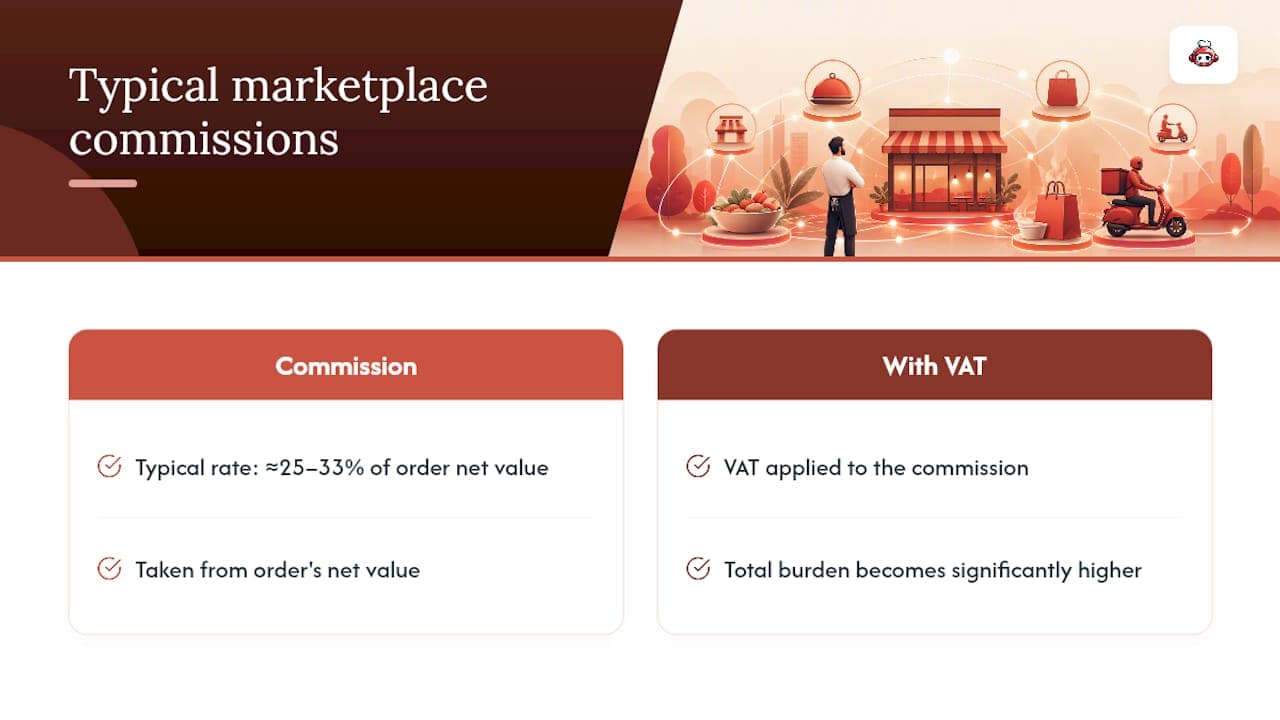
Marketplace commissions typically run around a quarter to a third of the order's net value, and with VAT applied to that commission, the total burden on the restaurant can be significantly high.
Do Commission-Free Platforms Still Charge Payment Processing Fees?
Yes. Payment processors like Stripe and PayPal charge standard transaction fees regardless of the ordering platform, so factor that rate into your total cost calculation separately from platform commission.
How Fast Can a Restaurant Launch Direct Ordering?
A fast launch takes one to two weeks, while a full rollout with staff training and marketing assets typically takes four to six weeks. RESTOBOT can generate a live branded website within the same day an application is approved.
Who Owns Customer Data on a Commission-Free Platform?
On a subscription-based platform like RESTOBOT, the restaurant owns its customer data outright, including order history and contact details managed through its own CRM and analytics dashboard.
Do Delivery Fees Count as a Commission?
No. A delivery fee is what the customer pays a courier, such as Wolt Drive, for the drive itself. It's separate from a platform commission and doesn't reduce what the restaurant earns on the order.