

For most independent restaurants, the smartest starting point is a hybrid model: keep an aggregator like Uber Eats or DoorDash for new-customer discovery, but push repeat orders onto a commission-free or flat-fee owned channel. A 30-day pilot moving even a quarter of repeat orders to a direct channel, backed by aggregator commissions running 15% to 30% nominal, is the single move that protects margin fastest. Some platforms exist specifically to make that direct channel cheap to run.
***
TL;DR:
>
- Most restaurants benefit from a hybrid delivery approach, combining aggregator platforms for new customers with direct channels for repeat orders to maximize margins. - Operating costs depend heavily on your order value, order volume, and delivery fees, with flat monthly fees often breaking even quicker than paying commission rates on each order. - A delivery management system integrating order, POS, and courier dispatch reduces food temperature issues and improves on-time delivery performance. - Testing and measuring key metrics such as contribution margin, repeat customer migration, and delivery punctuality over 30 to 90 days determines the most profitable delivery setup for your restaurant. - Legal and safety regulations vary by location, requiring careful review of permits, liability, and packaging standards before launching or expanding your delivery service.
***
Table of Contents
- What Does "On-Demand Delivery" Mean for a Restaurant?
- Which Delivery Model Actually Fits Your Restaurant?
- What Does Delivery Actually Cost You Per Order?
- What Tech Stack Do You Actually Need?
- How Do You Keep Delivery Quality Consistent?
- Which Model Actually Fits Your Restaurant, and When Do You Test It?
- What Does a Commission-Free Delivery Setup Look Like?
- What Legal Rules Apply to On-Demand Delivery?
- A Manager's Take on Picking the Right Delivery Model
- Sources
- FAQ
What Does "On-Demand Delivery" Mean for a Restaurant?
On-demand delivery is any system that lets a customer order food and get it brought to their door within an hour or two, as opposed to scheduled catering or next-day meal kits, as explained in The Role of Online Food Ordering for Restaurants and Customers. It sits inside your broader off-premise sales mix alongside pickup, curbside, and drive-through, but it solves a different problem: convenience for someone who wants to eat now without leaving home.
The buyer's job here has three parts:
- Acquisition — reaching new customers who search apps or maps for "food delivery service" near them
- Convenience — fulfilling an order fast enough that quality holds up on arrival
- Retention — turning a one-time delivery customer into a repeat direct-order customer
Pickup and curbside skip the courier entirely; subscription meal models skip the "on demand" part by scheduling deliveries in advance. On-demand delivery restaurant operations need both speed and logistics working at once, which is exactly where the model choice starts to matter.
Which Delivery Model Actually Fits Your Restaurant?
Every on-demand setup boils down to four structures, and most restaurants end up running two of them at once.
- Marketplace/aggregator. Apps like Uber Eats, DoorDash, or Grubhub supply discovery and logistics in one package. Commission typically runs 15% to 30% of the order, and the real cost often lands higher once you count in-app ad placements, promo funding, and processing fees.
- First-party/owned channel. Your own website or app takes the order directly. You pay a flat subscription or per-order fee instead of a percentage, and you keep the customer's contact data, order history, and full margin on the sale.
- Courier-on-demand. Services such as Wolt Drive or DoorDash Drive plug in as pure logistics: you take the order on your own channel, then request a driver for that single trip. No marketplace commission, just a delivery fee usually passed to the customer.
- Hybrid. Most operators end up blending all three: aggregators for new-customer reach, an owned channel for anyone who has ordered before, and courier-on-demand as the delivery engine behind that owned channel.
A simple rule of thumb: route first-time customers through the aggregator where they're already searching, and route anyone in your loyalty database or Telegram list to the direct channel. That single routing decision is where most restaurants recover margin without losing new-customer volume.
What Does Delivery Actually Cost You Per Order?
Four numbers drive every delivery decision: average order value (AOV), food cost percentage, commission rate, and payment processing fees. Run those four through your own numbers before picking a model, not someone else's case study.
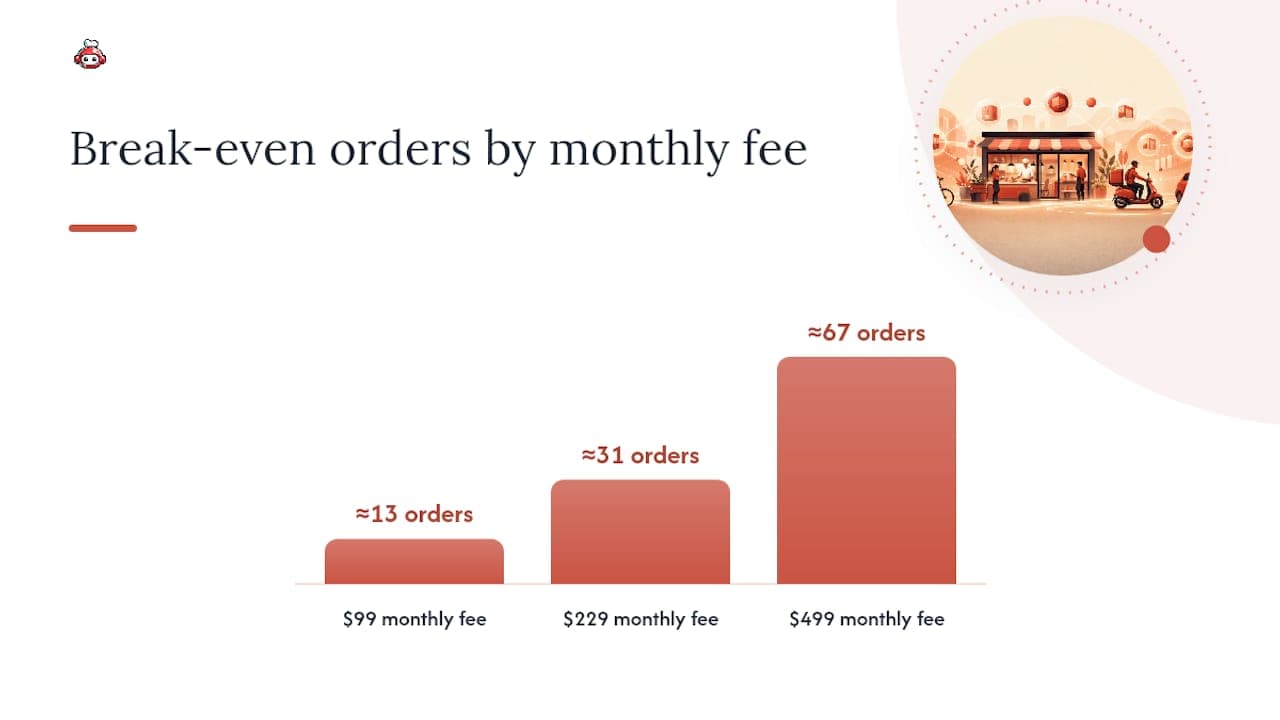
Here's the math that matters. On a $30 order with a 25% aggregator commission, you lose $7.50 before food cost or labor even enter the picture. Run 400 delivery orders a month at that rate and you've handed over $3,000 in commission alone. Compare that against a flat-fee direct channel priced between $229 and $499 a month, and the break-even point arrives fast.
Break-even math: Break-even order count = monthly flat fee ÷ (commission rate × average order value). At a $99 monthly platform fee, a 25% commission, and a $30 AOV, you only need about 13 orders a month funneled to the direct channel to come out ahead. Every order past that is pure margin recovery.
The trap is treating the nominal commission rate as the real cost. Once you add co-funded promotions, sponsored placement fees, and penalty charges for late acceptance, effective commission can climb to 30% to 45% on paper aggregator rates that started at 20%. A commission-free ordering setup avoids that creep entirely because there's no percentage to inflate.
What Tech Stack Do You Actually Need?
Four pieces have to talk to each other for on-demand delivery to work without chaos in the kitchen: an ordering site or app, a POS integration, a payment processor, and a courier API or dispatch connection.
Real-time order status matters more than most owners assume. Without a manager dashboard showing exactly where each order sits, food sits cold on a counter waiting for a driver who's five minutes out, or a courier arrives before the kitchen has even started the ticket. A delivery management system that ties ordering, POS, and courier dispatch into one view cuts that dead time.
You have two implementation routes: a turn-key SaaS platform that bundles ordering, payments, and courier integration out of the box, or a middleware/custom build that stitches together separate vendors. The turn-key route gets you live in days; custom builds can take months and need ongoing developer support.
Before launch, test:
- A live order end-to-end, from checkout through kitchen ticket to courier pickup
- Payment processing across every method you plan to accept, including any card decline scenario
- Courier API response time during a simulated rush
- Dashboard accuracy against what's physically happening in the kitchen
Pro Tip: *Run your integration test during your actual dinner rush, not during a quiet Tuesday afternoon. Systems that work fine at low volume often choke exactly when you need them most.*
How Do You Keep Delivery Quality Consistent?
Delivery complaints almost always trace back to timing, not food quality. Synchronizing kitchen prep with courier pickup windows reduces both cold food and driver wait times, and it's a scheduling problem more than a cooking problem.
A few operational habits fix most of it:
- Start high-heat items (fries, seared proteins) only after a courier is confirmed nearby, not the moment the order fires
- Pack hot and cold items in separate compartments to stop steam from turning fries soggy
- Track on-time delivery percentage, complaint rate per 100 orders, and delivery cost per order weekly, not monthly
- Cross-train at least one line cook per shift to bag and stage delivery orders during rushes so dine-in tickets don't slow down
If your on-time delivery rate dips below a high threshold, the issue is almost always related to pickup timing rather than food quality. Fix the sync before you touch the recipe.
Which Model Actually Fits Your Restaurant, and When Do You Test It?
Run this checklist before committing to any single model:
- Density — do you have enough delivery orders per square mile to justify your own drivers, or does courier-on-demand make more sense?
- Monthly online sales — are you clearing the break-even order count for a flat-fee direct channel?
- Margin per order — what's left after food cost, packaging, and delivery fees on your average ticket?
- Retention — what percentage of delivery customers order again within 60 days?
For the pilot itself, give it 30 to 90 days. Set a target of migrating 25% to 40% of repeat orders to your direct channel, offer a first-order discount to nudge aggregator customers over, and measure weekly.
| Metric | Target by day 90 | Stop/go signal |
|---|---|---|
| Contribution margin per order | Positive after all delivery costs | Go if positive by week 6 |
| Repeat-order migration | 25%–40% of repeat customers | Go if trending upward monthly |
| On-time delivery rate | 90%+ | Stop and fix ops if below 85% |
What Does a Commission-Free Delivery Setup Look Like?
When you evaluate any commission-free platform, check four things: how fast the site and menu go live, which courier services it connects to, whether it charges anything per order, and whether staff can collect tips without a cut taken. RESTOBOT's approach, for example, creates a live website and menu automatically once an application is confirmed, usually within minutes of approval, and connects delivery through third-party couriers like Wolt Drive rather than running its own driver network.
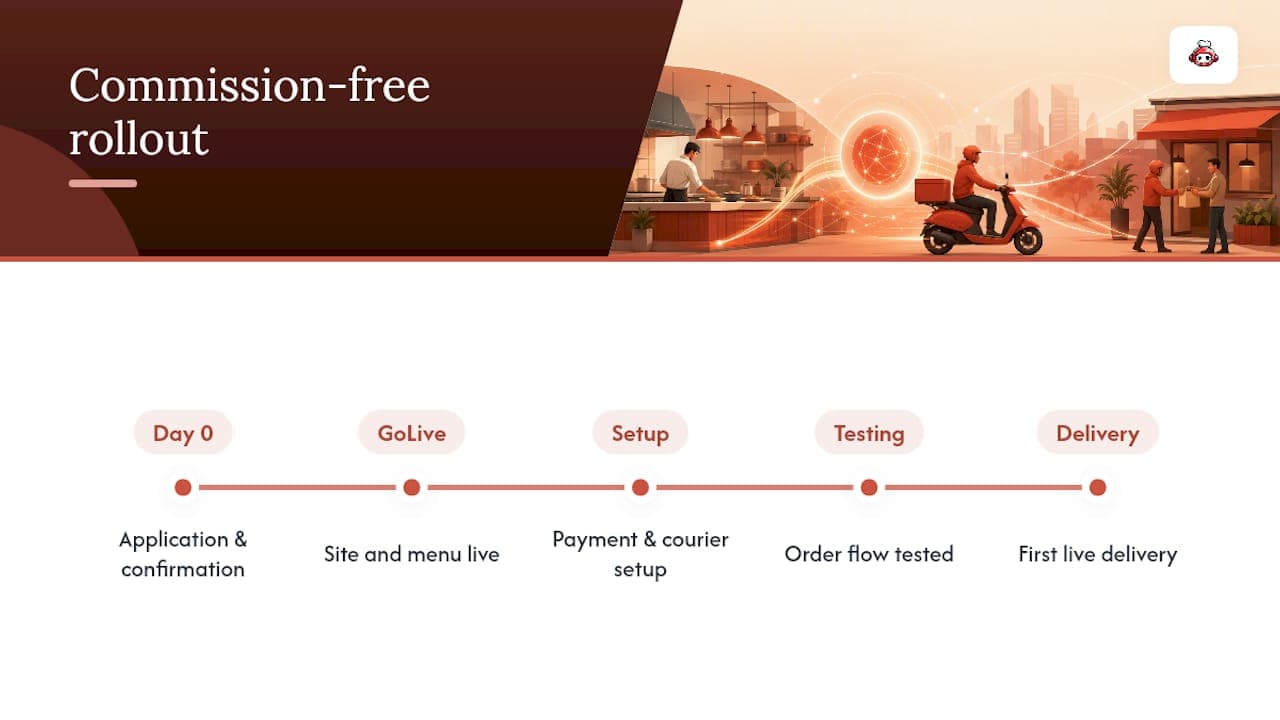
A realistic day-0-to-30 timeline looks like this: application and confirmation on day 0, site and menu live within minutes after that, payment methods and courier integration configured over the following days, and full order flow tested before the first live delivery order goes out.
Before signing anything, verify in writing: payment processing fees (these come from the processor, not the platform), courier delivery fees (usually passed to the customer, not the restaurant), and any setup fee, which on platforms like RESTOBOT is commonly zero unless you're paying separately for training or consultation.
What Legal Rules Apply to On-Demand Delivery?
Food safety and permitting rules for delivery vary significantly by jurisdiction, so treat this section as a starting checklist, not a substitute for checking with your local health department.
Most jurisdictions require your existing food service permit to cover delivery, but some add requirements specific to off-premise sales, such as tamper-evident packaging or temperature-holding standards during transit. Confirm with your local health authority whether delivered food needs additional labeling, especially for allergens, since the customer isn't present to ask questions the way they would in a dining room.
Liability splits differently depending on the model. When you use a marketplace aggregator, the platform's driver is typically an independent contractor of the aggregator, and disputes over damaged or late food usually route through that platform's customer service and insurance. When you use courier-on-demand services like Wolt Drive on your own ordering channel, liability terms are spelled out in that courier service's business agreement, so read the fine print on who's responsible if a driver causes an accident or the food arrives spoiled.
If you run your own delivery staff instead of contracting a courier, most jurisdictions require commercial auto insurance riders, not just personal auto coverage, and some require specific licensing for drivers depending on vehicle type. Alcohol delivery adds another layer entirely. Many jurisdictions require a separate permit and age-verification process at the door, distinct from your on-premise liquor license. None of this is optional paperwork to skip during a busy launch. Check with your state or local licensing authority before your first delivery order goes out the door.
A Manager's Take on Picking the Right Delivery Model
The hybrid model wins for one reason: it lets you keep aggregator reach without letting aggregator math eat your margin. Owners who chase either pure marketplace volume or pure DIY delivery both end up guessing at profitability instead of measuring it. Track contribution margin per order from day one, run a real pilot before committing budget, and let the numbers, not the sales pitch, decide your mix.
*— ADMIN*
Sources
For deeper numbers behind the commission math and operational benchmarks referenced above, see aggregator vs. first-party margin analysis, verified restaurant ordering platform pricing, kitchen-to-courier synchronization research, and the 2025 restaurant delivery commission report.
FAQ
What Is On-Demand Food Delivery?
On-demand food delivery is an order placed for immediate fulfillment, typically arriving within one to two hours, rather than a scheduled or subscription-based delivery. It covers everything from marketplace apps to a restaurant's own ordering site paired with a courier service.
What Is the 30/30/30 Rule for Restaurants?
Definitions of this rule vary across the industry, and no single standardized version dominates. Rather than repeat an unverified figure, focus on the metrics that actually matter for delivery: contribution margin per order, repeat-order rate, and on-time delivery percentage.
Is a Regional Aggregator Cheaper Than a National One Like Uber Eats?
Commission structures vary by platform and region, so a direct dollar comparison depends on your specific contract terms with each service. What's consistent across aggregators generally is that nominal commission often runs 15% to 30%, with effective costs climbing higher once in-app promotions are factored in.
What Is the Highest-Paying Delivery Service for Restaurants?
There's no single service that pays restaurants more across the board. The channel that "pays" best is the one with the lowest cost per order for your specific volume, which is usually a flat-fee direct channel once you clear the break-even order count described earlier in this article.