


The fastest way to cut restaurant chargebacks is a three-part fix: use a billing descriptor customers actually recognize, send an itemized order confirmation the moment payment clears, and turn on CVV and AVS checks for every card-not-present order. Together, those three moves eliminate the majority of "I don't recognize this charge" disputes, which is the single most common reason code hospitality businesses fight. Everything else, from CE3.0 evidence packets to alert networks, matters, but it matters less than getting these basics right first.
***
TL;DR:
>
- Recognizing charges through a familiar billing descriptor, providing instant itemized confirmations, and enabling CVV and AVS checks can eliminate most restaurant disputes. - Most chargebacks stem from customer confusion about charges, not fraud, making clarity and communication critical to prevention. - Tag and analyze disputes by cause to ensure targeted prevention, focusing on operational practices before investing in advanced fraud software. - Layered fraud controls like AVS, CVV, 3D Secure, and fraud scoring help reduce high-risk, card-not-present order disputes without overly hindering legitimate sales. - Building strong evidence with detailed order records and timely responses helps effectively win disputes and reduce overall costs.
***
Table of Contents
- What Chargebacks Restaurant Owners Actually Face
- Operational Prevention Checklist Restaurants Can Implement This Week
- Payment and Fraud Controls for Delivery, Online, and Phone Orders
- Building Compelling Evidence and Using CE3.0 to Win Disputes
- The Operational Playbook: Policies, Training, and Simple Audits
- Metrics That Tell You When to Fight and When to Refund
- A Restaurant Operator's View From RESTOBOT
- Best Practices for Communication That Reduces Disputes
- Why Prevention Beats Reactive Dispute Work
- Where RESTOBOT Fits Into Your Chargeback Prevention Plan
- Sources
- FAQ
What Chargebacks Restaurant Owners Actually Face
A chargeback costs a restaurant far more than the disputed ticket. Stripe puts the average direct cost at around $128 per chargeback once processor fees are added, not including the manager's time pulling receipts, the lost food cost, or the risk of tripping your processor's dispute-rate threshold and losing your merchant account entirely.
Not every chargeback comes from the same problem, so the fix depends on which cause dominates your dispute log:
- Criminal fraud: a stolen card used for takeout or delivery, often flagged by mismatched billing and delivery addresses.
- Friendly fraud (first-party misuse): a legitimate customer disputes a charge they authorized, sometimes out of confusion, sometimes deliberately.
- Merchant error: duplicate charges from a keyed retry, wrong tip amount, or a POS glitch during a busy Friday rush.
- Delivery/non-receipt disputes: the order never arrived, arrived wrong, or arrived so late the customer refused it.
Pull your last 90 days of disputes and tag each one by cause before you spend a dollar on new tools. Restaurants that skip this step tend to buy fraud software for a problem that was actually a receipt problem.
Operational Prevention Checklist Restaurants Can Implement This Week
Most restaurant chargebacks trace back to something a customer didn't recognize on their statement, not a scam. Fix the recognition problem first.
- Set and test your billing descriptor. Your statement name should match the name on your storefront, your Google listing, and your website, not the LLC name on your lease. A recognizable descriptor is one of the highest-leverage fixes available, and it costs nothing to change through your payment processor's dashboard. Place a test order yourself and check what shows up on your own card statement.
- Send a real confirmation, not just a receipt. Every online, phone, or delivery order should trigger an email or text with the order ID, an itemized list, the amount charged, and a direct support link or phone number, as explained in the role of online food ordering for restaurants and customers. This single message resolves a huge share of "what is this charge" confusion before it ever reaches a bank.
- Put refund and cancellation terms where people actually look. State your policy at checkout and repeat it in the confirmation message, in plain language: how long a refund takes, how to cancel a reservation deposit, what happens with a no-show fee.
- Tighten your POS to stop duplicate charges. Train staff to wait for the terminal response before retrying a swipe, and set your POS to flag or block a second charge on the same ticket within a short window.
Pro Tip: *Print your support phone number and email on the receipt in a font size a person over 40 can actually read without their glasses. A surprising number of "fraud" disputes are just someone who couldn't find how to call you.*
Payment and Fraud Controls for Delivery, Online, and Phone Orders
Card-not-present orders, phone-ins, delivery apps synced to your POS, and web checkout, carry the highest fraud exposure because nobody swipes a physical card. Layer your controls instead of picking one:
- AVS (Address Verification System) checks the billing address against what's on file with the card issuer. Require a match for delivery orders above a dollar threshold you set.
- CVV confirms the person entering the card has it in hand. Never disable this to save a few seconds at checkout.
- 3DS (3D Secure) adds a bank-side verification step for online payments. It's worth turning on for higher-ticket catering or private-event deposits, but it adds friction, so skip it on a $14 lunch order.
- Velocity checks flag the same card or device attempting several orders in a short window, a classic sign of card testing.
- ML-based fraud scoring, built into tools like Stripe Radar, scores each transaction in real time and can auto-block the riskiest ones before authorization.
- Alert networks like Verifi, Ethoca, and Visa's Order Insight flag an incoming dispute before it becomes a formal chargeback, giving you a window to refund quietly and protect your dispute ratio.
The trade-off is real: too much friction on a $20 dinner order kills conversions faster than the fraud it prevents. Monitor your false-decline rate as closely as your fraud rate, because a rejected legitimate order costs a hospitality business more, relative to margin, than it does most retail categories.
Building Compelling Evidence and Using CE3.0 to Win Disputes
Winning a dispute is a matching exercise: identify the reason code, then gather the exact evidence type that code calls for, then submit it before your acquirer's deadline. Most acquirers give merchants 10 to 35 days to respond, and the full dispute process can stretch to 120 days, so treat the clock as urgent from day one.
Match your evidence to the code you're fighting:
- Unauthorized transaction: AVS/CVV match results, IP address and device ID at time of order, delivery confirmation with signature or photo.
- Non-receipt/service issue: courier tracking timestamps, delivery photo, POS timestamp showing the order left the kitchen, customer communication log.
- Cancellation or duplicate charge: your cancellation policy shown at checkout, the original transaction ID next to the disputed one, refund confirmation if one was already issued.
For first-party misuse disputes specifically, Visa's CE3.0 standard lets you shift liability back to the cardholder if you can show two prior undisputed transactions from the same customer, between 120 and 365 days old, sharing at least two matching data points, one of which must be device ID or IP address. Keep those records archived and searchable; you won't have time to hunt for them once a dispute lands.
The Operational Playbook: Policies, Training, and Simple Audits
Most merchant-error chargebacks are preventable with three habits, not new software.
- Write your refund and cancellation policy in one paragraph of plain language, then post it at checkout, on your website footer, and in every confirmation email.
- Give staff a script and an escalation limit. A frustrated customer who gets a real answer from a manager within a set dollar threshold rarely calls their bank. Fast, visible customer service consistently converts would-be disputes into in-house resolutions.
- Reconcile daily, not monthly. A five-minute check of the day's transactions against your POS log catches a duplicate charge before the customer even notices it, let alone disputes it.
Metrics That Tell You When to Fight and When to Refund
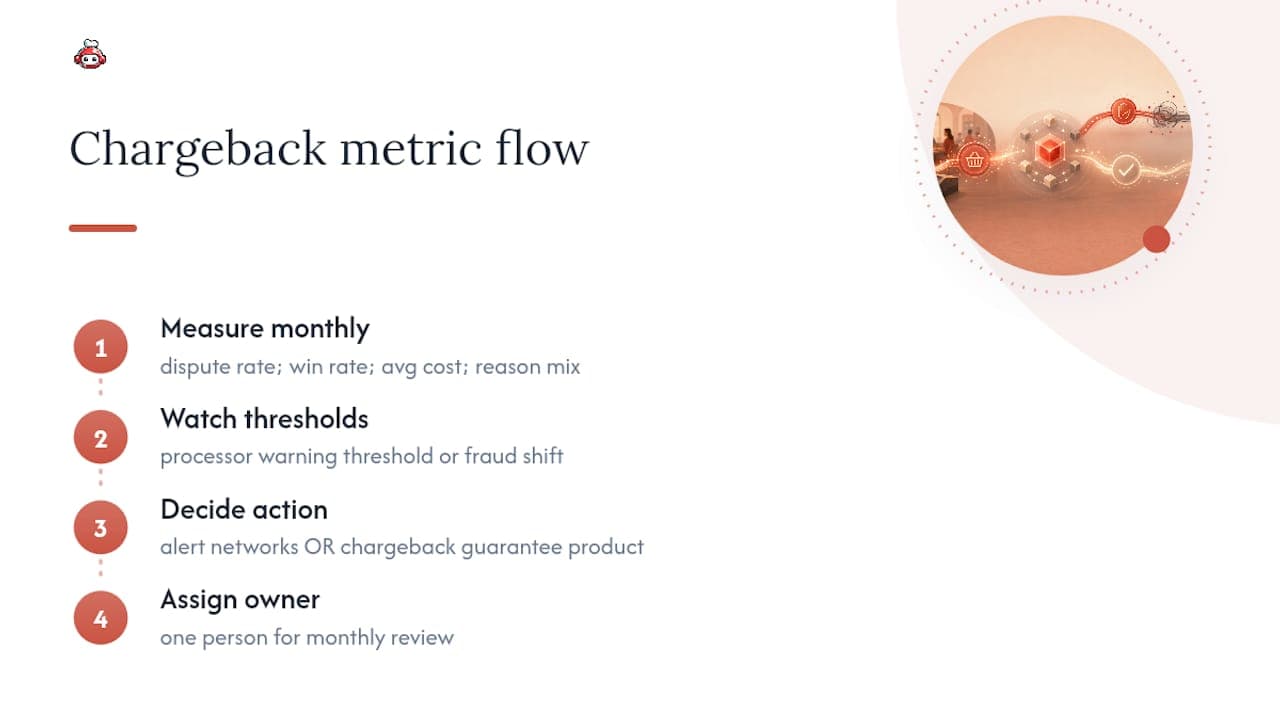
Track four numbers monthly: your dispute rate (disputes divided by total transactions), your win rate on disputes you contest, your average cost per chargeback, and your reason-code mix. If your dispute rate creeps toward your processor's warning threshold, or fraud-coded disputes start outnumbering friendly-fraud ones, that's your signal to invest in alert networks or a chargeback guarantee product rather than keep fighting cases one by one. Assign one person, even part time, to own a monthly review of these numbers. Disputes that fall to nobody in particular get ignored until they're a pattern.
A Restaurant Operator's View From RESTOBOT
RESTOBOT works with restaurants running in-store, delivery, and phone-order channels, and the pattern repeats: a table order paid by QR code rarely disputes, a phone order keyed manually with no confirmation text disputes often, and a third-party delivery order with no tracking link disputes most of all. The fix scales with the risk.
Best Practices for Communication That Reduces Disputes
Every dispute you prevent through communication is one you never have to fight, and that math favors talking to customers early over building an evidence file later. Confirm every order the moment payment clears, not an hour later when the customer has already forgotten placing it. Use language a person recognizes: your restaurant's actual name, not a payment processor's internal merchant ID.
When something goes wrong, get ahead of it. If a delivery is running 25 minutes late, a text saying so and offering a discount code costs you a few dollars and usually keeps the customer from disputing the full order later. Silence is what pushes a customer toward their bank instead of your support line.
Make it easy to reach a real person. A support email that takes three days to answer guarantees some percentage of customers give up and call their card issuer instead, because a bank refund is faster than waiting on you. Put a phone number or live chat option somewhere obvious, not buried three clicks deep on a contact page.
Follow up after refunds, too. A short note confirming a refund was processed and naming the timeline it will show up on their statement closes the loop and stops a customer from disputing a charge that was already being reversed. That single message resolves more confusion-based disputes than any fraud-scoring tool ever will, because the problem it solves isn't fraud. It's a customer who didn't know what happened to their money.

Why Prevention Beats Reactive Dispute Work
Chargeback tooling gets a lot of attention, but the return on a clear billing descriptor and a same-minute order confirmation beats almost any dispute-management platform on the market. Those two fixes cost nothing to implement and address the reason code that dominates most restaurant dispute logs: simple non-recognition. Fix that before you buy anything else.
*— ADMIN*
Where RESTOBOT Fits Into Your Chargeback Prevention Plan
Most of what stops a chargeback is paperwork you should already have: an itemized receipt, a consistent statement name, a delivery timestamp, an order history you can pull in seconds instead of digging through a POS export at 11 p.m. RESTOBOT centralizes that evidence automatically. Every order placed through your website or messaging channels generates an itemized confirmation with an order ID, QR table ordering cuts keyed-entry errors that cause duplicate charges, and delivery coordination through third-party partners gives you a tracking record if a non-receipt dispute ever lands. Fix your operational basics first, then look at the MENU and FULL plans to see which feature set matches your order volume, or check the Online tips page if service-charge disputes are part of your problem too.
Sources
FAQ
Is there a way to prevent chargebacks?
Yes. Restaurants that use a recognizable billing descriptor, send instant itemized confirmations, and enable CVV and AVS checks prevent the majority of disputes before they start. Layering on alert networks like Verifi or Ethoca catches most of what slips through.
What happens if you chargeback a restaurant?
The restaurant's payment processor pulls the disputed funds back from the merchant account immediately, often before the restaurant even sees the claim, and adds a dispute fee on top. That fee plus lost food cost and staff time averages around $128 per chargeback.
Can I go to jail for chargebacks?
Filing a false chargeback for something you actually received can qualify as fraud, but criminal prosecution is rare and usually reserved for large, repeated, deliberate cases. Most friendly-fraud disputes get resolved through the card network's dispute process, not the courts.
Why do businesses hate chargebacks?
Chargebacks cost more than the disputed sale because they add processor fees, staff time gathering evidence, and lost inventory on top of the refunded amount. A high dispute rate can also put a restaurant's merchant account at risk with its payment processor, which is a far bigger problem than any single dispute.