

Size your delivery zone by drive time, not miles, and split it into two or three tiered rings, each with its own menu limits and fees calibrated to break even. Most kitchens should cap the core zone around 10 to 15 minutes, extend a standard ring to 20 to 30 minutes, and hand anything past that to a third-party courier or cut it off entirely. A restaurant management dashboard can support this kind of tiered setup alongside commission-free ordering, which changes the break-even math in your favor.
***
TL;DR:
>
- Drive-time zones should be capped around 10 to 15 minutes for the core, with standard and extended rings extending to 20-30 minutes, depending on cuisine. - Use isochrones and geocoded address validation to accurately map drive-time zones and exclude tricky streets before launching or adjusting zones. - Self-delivery is most profitable within high-density core and standard rings, while outer zones should rely on third-party couriers to manage costs. - Set minimum fees or order thresholds based on actual delivery costs, with example break-even fees ranging from $8 to $12 for a 20-minute round trip at $18/hour. - Regularly review zone performance metrics like cost per delivery and repeat orders, especially after menu or staffing changes, to optimize zone sizes and profitability.
***
Table of Contents
- Why Delivery Zones Restaurant Owners Draw by Radius Are Wrong
- Building Tiered Restaurant Delivery Boundaries That Actually Work
- How to Draw and Enforce Your Delivery Map for Food Orders
- Self-Delivery vs. Marketplace Coverage: Splitting Your Zones
- The Break-Even Math Behind Every Delivery Zone Fee
- Reviewing and Adjusting Zones Without Losing Customer Trust
- A Two-Week Rollout Checklist for Drive-Time Zones
- Setting Up Zone-Based Delivery With RESTOBOT
- Sources
- FAQ
Why Delivery Zones Restaurant Owners Draw by Radius Are Wrong
A five-mile circle looks tidy on a map and means almost nothing on the road. One direction might hit a highway on-ramp in six minutes; the opposite direction crosses three school zones and a bridge that backs up at 6 p.m. Straight-line radius ignores actual traffic, road grids, and one-way streets, which is exactly why drive-time zones (isochrones) have become the standard for serious delivery planning.
Different cuisines tolerate different transit times before quality drops. Industry benchmarks compiled by RadiusMapper show most restaurants stick to 20 to 30 minute drive-time zones, with real variation by category:
- Sushi and cold plates: 15 to 25 minutes, since texture and temperature degrade fast.
- Plated hot entrees (pasta, stir-fry, burgers): roughly 20 to 30 minutes.
- Sandwiches and packaged items: closer to 30 minutes, since they hold up better.
- Ghost kitchens built for delivery-first menus: 30 to 45 minutes, because the whole operation is engineered around transit.
Building Tiered Restaurant Delivery Boundaries That Actually Work
A single flat zone forces you to either overcharge nearby customers or lose money on far ones. Tiered rings fix that by matching fees and menu availability to actual delivery cost.
- Core ring (roughly 0 to 10 minutes). Full menu, lowest or no delivery fee, tightest promised delivery window. This is where self-delivery is almost always the right call.
- Standard ring (roughly 10 to 20 minutes). Full or slightly trimmed menu, a modest fee or a minimum order requirement, a wider time window to account for traffic variance.
- Extended ring (roughly 20 to 30 minutes, sometimes further for ghost kitchens). Trim the menu to items that travel well, raise the minimum order, and consider routing these orders to a third-party courier instead of your own drivers.
Show the fee and estimated window before checkout, not after. Customers tolerate a $4 fee they saw up front far better than the same fee that appears as a surprise at the last screen.
How to Draw and Enforce Your Delivery Map for Food Orders
Start with a mapping tool that generates drive-time polygons, not circles. RadiusMapper builds isochrones at set intervals so you can see exactly what a 10, 20, or 30-minute zone looks like from your kitchen door, while Zapiet Eats lets you draw custom polygons by hand, set radius or driving-distance rules, and exclude specific streets or complexes that cause delivery headaches.
- Generate isochrones at 10/20/30/40 minutes, then trace or import the resulting polygon into your ordering platform.
- Validate every address at checkout: geocode it, test it against your saved polygon, and only then show the fee and window.
- Manually test a handful of known tricky addresses (gated communities, one-way corridors, highway-adjacent blocks) before launch.
Pro Tip: *Pull your last 90 days of delivery addresses and plot them against your new polygon before you go live. You'll usually find a cluster of loyal customers sitting just outside the line, and that's worth a manual exception more than a rigid cutoff.*
Self-Delivery vs. Marketplace Coverage: Splitting Your Zones
Commission on marketplace orders typically runs high enough that your outer rings stop being profitable the moment you add a driver's wage on top. Many independent restaurants solve this by defining two overlapping zones: a tight core zone served by self-delivery with higher margins, and a wider zone handled via third-party couriers or marketplaces, which cover some delivery costs and commissions.
- Keep self-delivery where average ticket size and order density are highest, usually your core and standard rings.
- Hand off zones where driver capacity runs thin or order volume doesn't justify a dedicated route.
- Weigh commission percentage against your own per-delivery cost before deciding where the line sits.
- Tell customers plainly which zones are self-delivered and which route through a courier partner, since delivery windows differ between the two.
The Break-Even Math Behind Every Delivery Zone Fee
Calculate break-even the same way for every ring: take the round-trip drive time, multiply by your driver's hourly cost plus fuel or mileage cost, then divide by orders per trip if you batch deliveries. Add your target margin on top, and that number is your minimum fee or minimum order threshold for that zone.
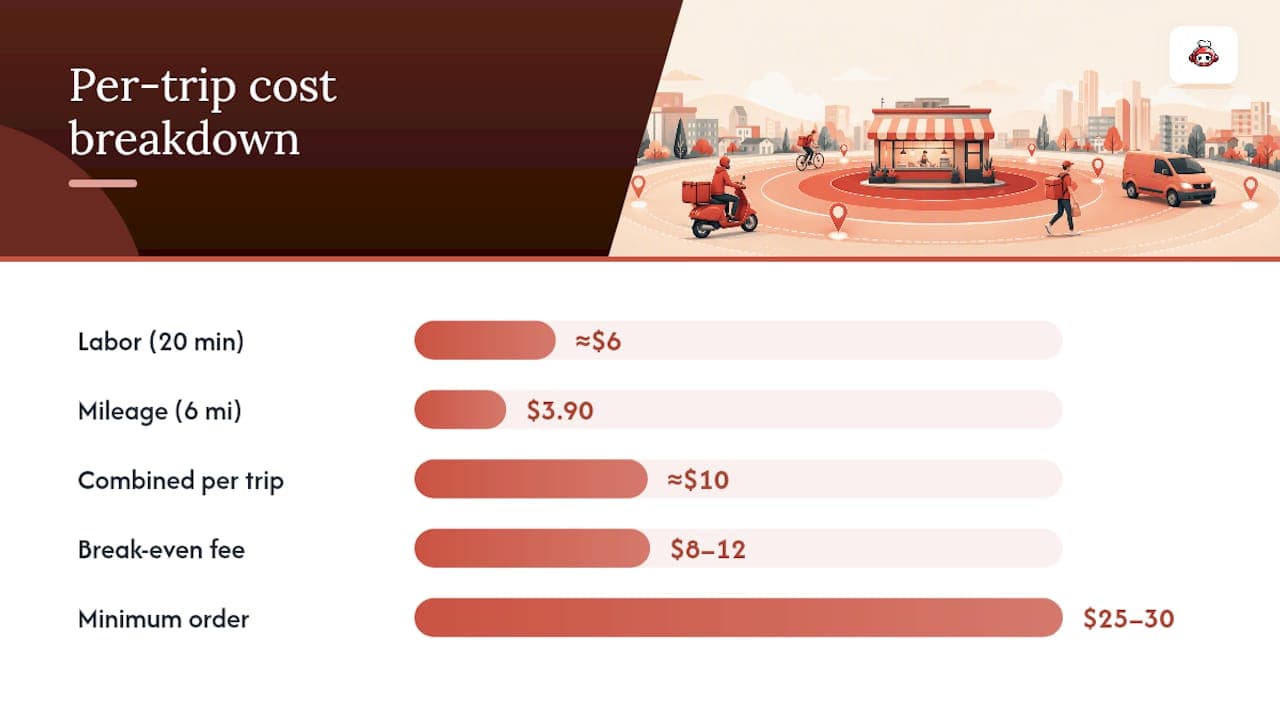
A rough example: a 20-minute round trip at $18/hour driver cost plus $0.65/mile for a 6-mile round trip runs about $10 in labor and mileage combined. If you want even a small margin on a single-order trip, your break-even fee sits somewhere around $8 to $12, which is exactly why many restaurants either add a delivery fee in that range or set a $25 to $30 minimum order for that ring instead.
Watch these metrics by zone, not just overall:
| Metric | Healthy range |
|---|---|
| Drive-time accuracy (promised vs. actual) | Within 10 minutes on most orders |
| Cost per delivery | Below 15% of average ticket in core zone |
| Repeat-order rate by zone | Within 10 points of your best-performing ring |
| Route density (stops per driver hour) | 2 to 3 stops per hour minimum |
If cost per delivery in your outer ring runs double your core zone, that ring is quietly eating your margin.
Reviewing and Adjusting Zones Without Losing Customer Trust
Check zone performance monthly for the first quarter after launch, then move to a quarterly review once the data settles. Menu changes, staffing shifts, and seasonal demand (think holiday rushes or summer patio season) all justify an off-cycle look sooner.
- Test shrinking your outer ring during peak hours only, then compare reorder rates against the always-open version.
- Try swapping a flat fee for a minimum order requirement in one ring and measure abandonment before rolling it out everywhere.
- Watch for red flags: an outer zone with a repeat-order rate well below your core zone, a rising number of refund requests, or a driver logging fewer than two stops per hour.
A Two-Week Rollout Checklist for Drive-Time Zones
You don't need a quarter to fix a delivery map that's been guessing for years. Map your 10/20/30-minute polygons in week one, and pull a list of common customer addresses to test against them. Compute break-even fees for each ring, then set minimums where the math demands it. By week two, configure address validation at checkout, publish honest delivery windows, and watch your first week of cost-per-delivery and repeat-order data before making a second adjustment.
*— ADMIN*
Setting Up Zone-Based Delivery With RESTOBOT
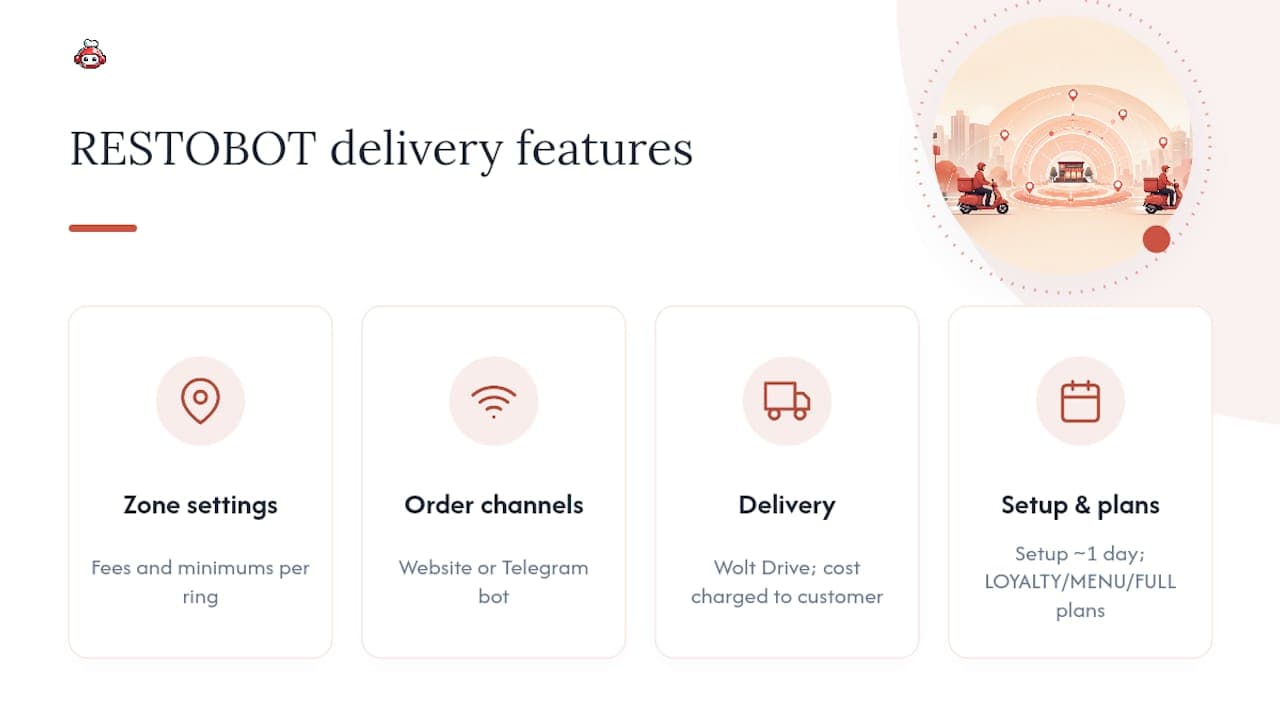
RESTOBOT gives you the operational backbone to run tiered delivery zones without paying a marketplace commission on every order. The management dashboard supports zone-based settings so you can align fees and minimum orders to each ring, orders come in through your own website or Telegram bot, and delivery itself coordinates through courier partners like Wolt Drive, with the delivery cost passed to the customer rather than deducted from your revenue. Setup typically takes about a day, so you can go from flat-fee guesswork to tiered zones without a drawn-out rebuild. Check the LOYALTY, MENU, and FULL plans to see which fits your current order volume, and if your staff wants a commission-free way to collect tips independent of the zone they're delivering to, the tips feature runs on its own regardless of your plan.
Sources
Start with RadiusMapper's restaurant delivery area guide for drive-time benchmarks by cuisine, then use its zone planning walkthrough to build your own break-even isochrones. Zapiet's delivery zone documentation covers polygon drawing and checkout validation in more technical detail, while Uber's merchant guide explains how platform-side zone enforcement works if you're weighing marketplace coverage. For broader context on what local delivery expectations look like from the customer side, Wild Foodz's overview of local food delivery is worth a read.
FAQ
What Are Delivery Zones for a Restaurant?
A delivery zone is the geographic area a restaurant commits to serving, ideally drawn by drive time rather than straight-line distance. Most operators use 20 to 30 minute drive-time boundaries as a baseline, then adjust based on cuisine type and staffing.
What Is the 30/30/30 Rule for Restaurants?
There's no single agreed-upon "30/30/30 rule" in restaurant delivery, and definitions vary depending on who's using the term. If you've seen it referenced for delivery timing, treat it as a rough shorthand rather than an industry standard, and rely on your own break-even and drive-time data instead.
What Is the Highest-Paying Delivery Platform?
Pay varies by market, order volume, and courier availability, so there's no fixed answer that holds everywhere. What matters more for your margin is the commission structure: platforms that take a large cut per order change your break-even calculation, while a commission-free system like RESTOBOT keeps delivery revenue split between the food cost and the courier fee rather than a marketplace cut.
Which Delivery Service Is Best for Restaurants?
The right choice depends on your zone: self-delivery tends to work best in your core, high-density ring, while third-party couriers make more sense for extended zones where staffing a dedicated driver isn't cost-effective. Many restaurants run both at once, splitting coverage by ring rather than picking one system for everything.
How Do I Know if My Delivery Zone Is Too Big?
Watch cost per delivery and repeat-order rate by ring. If your outer zone's cost per delivery runs noticeably higher than your core zone, or its repeat-order rate lags well behind, that ring is likely too large or priced too low for what it actually costs to serve.