

A hybrid approach wins for most restaurants: use marketplaces for discovery and your own direct channel for repeat, high-margin orders. Marketplaces solve the acquisition problem; direct ordering solves the ownership and profit problem. Your first move is a 30-day audit: pull last month's marketplace payouts and calculate your average net per order before deciding how hard to push direct.
***
TL;DR:
>
- Running a regular 30-day payout audit helps determine whether your direct channel can outperform marketplace margins after accounting for all costs. - Converting repeat customers from marketplace orders to direct orders can significantly increase profit margins, especially on high-value or catering orders. - Marketplaces retain significant leverage through customer data ownership, search rankings, and fee adjustments, making it essential to diversify your channels. - A commission-free platform like RESTOBOT simplifies launching and managing a direct ordering site, providing tools for loyalty and delivery without adding extra costs. - Regularly review and renegotiate your marketplace contracts, focusing on excludability and data rights, to protect your margins and customer relationships.
***
Table of Contents
- Direct Ordering vs Marketplaces: What Each Channel Is Built For
- What Direct Online Ordering Actually Gives You Back
- Which Orders Belong on Marketplaces vs Direct?
- The Full Cost Stack: What a $50 Order Actually Nets You
- Where Fulfillment and Staffing Get Complicated
- How to Convert Marketplace Guests Into Direct Regulars
- Your 30-Day Hybrid Rollout Checklist
- How a Commission-Free Platform Fits This Playbook
- The Power Imbalance Behind Marketplace Fees
- Reading the Fine Print Before You Sign
- Why Owners Who Skip the Audit Regret It Later
- Ready to Build Your Direct Channel?
- Sources
- FAQ
Direct Ordering vs Marketplaces: What Each Channel Is Built For
Third-party marketplaces exist to solve a discovery problem. They put your menu in front of people who have never heard of you, and they often bundle delivery logistics so you don't need your own drivers. That combination makes marketplaces genuinely useful for new locations, low foot-traffic areas, or filling delivery radius gaps you can't staff yourself.
The trade-off shows up in the fee structure, which runs deeper than the headline commission:
- Commission on the order subtotal, frequently landing near 30% before tax
- Payment processing baked into that commission rather than itemized
- Marketing or "boost" placement fees for better search visibility
- Chargebacks and refund handling that often still hit your payout
A key figure to know: industry reporting shows marketplace volume keeps growing faster than general ecommerce, which is exactly why they remain a strong discovery engine even as their economics stay tough for operators.
What Direct Online Ordering Actually Gives You Back
Direct ordering means the order flows through your own website, app, or Telegram bot instead of a third-party app. You keep the customer's phone number and order history, you set your own prices without markup rules, and you control the entire experience from menu photos to the confirmation message.
The costs are real but different in kind:
- Payment processing, typically a few percent per transaction
- A subscription or platform fee for the ordering software itself
- Delivery costs only if you're managing couriers yourself
- Marketing spend to drive traffic to your own channel
Direct ordering platforms give restaurants control over branding, pricing, and customer data that marketplaces don't share back, according to Shopify's ecommerce guidance, and that data is exactly what lets you turn a one-time buyer into a repeat customer.
Pro Tip: *Track lifetime value by channel, not just order count. A direct customer who orders monthly for a year is worth more than five one-off marketplace orders, even if the marketplace orders looked bigger on the day.*
Which Orders Belong on Marketplaces vs Direct?
Treat every order as either an acquisition order or a retention order, not just revenue. A marketplace order from someone who's never tried you is doing its job. A marketplace order from your third repeat customer is doing your competitor's job for them, at your expense.
- New customer, first order: let marketplaces handle it. That's what the fee is buying you.
- Repeat customer, second order onward: push toward direct with an incentive, since you already have their attention.
- Catering, large group, or high-ticket orders: always direct. Margin erosion on a $200 order is expensive.
- Delivery-only zones you can't staff: keep marketplace coverage as a floor.
Track new-customer share versus repeat-customer share by channel monthly. If your marketplace repeat-order share climbs significantly, you're bleeding margin on customers who'd order direct if asked. This is where BCG's research on B2B marketplaces applies just as well to restaurants: marketplaces are a channel for acquisition, not a substitute for owning the customer relationship.
The Full Cost Stack: What a $50 Order Actually Nets You
Commission rate alone is a misleading number. The comparison that matters is contribution per order, meaning what's left after every real cost, and Kitch's analysis makes the same point: compare full contribution, not the fee headline.
Line items to include on both sides: food cost, packaging, labor to prepare and pack, channel fee or subscription cost, delivery expense, refund and chargeback losses, and payment processing.
Illustrative math on a $50 order (ranges, not platform-specific):
- Marketplace path: roughly $15 to $20 in commission and related fees, $12 to $15 in food and packaging cost, leaving somewhere around $15 to $23 in contribution.
- Direct path: roughly $1.50 to $2 in payment processing, $12 to $15 in food and packaging, leaving $33 to $36 in contribution before any delivery cost you manage yourself.
That's a gap that can run $15 to $20 per order. Shift even 20 orders a week from marketplace to direct and you're looking at a substantial amount in recovered margin annually, a range consistent with what operator case studies report after running structured conversion campaigns.
Where Fulfillment and Staffing Get Complicated
Marketplaces bundle everything: their app handles the order, their driver handles delivery, their support line handles the complaint. Direct ordering means all of that responsibility, and that flexibility, sits with you.
Practical fixes that prevent chaos in the kitchen:
- Route every incoming order, direct or marketplace, into one printer or one tablet queue so the kitchen never checks three screens
- Sync your ordering system with your POS so inventory and reporting stay accurate automatically
- Train front-of-house staff on the handover script for both channels, especially refund and "order never arrived" situations
- Decide upfront whether in-house drivers or a flat-fee courier partner like Wolt Drive makes more sense for your delivery radius
Pro Tip: *In-house drivers make sense past a certain order density; below that, a flat-fee courier partner usually costs less than paying a driver to wait around between deliveries.*
Don't kill your marketplace listings the moment your direct channel launches. CloudKitchens advises keeping marketplace presence as a revenue floor while your direct experience gets tested and refined.
How to Convert Marketplace Guests Into Direct Regulars
The second order is the target. If a marketplace customer's next order comes through your own channel instead, you've converted them, and conversion should be trackable weekly, not guessed at quarterly.
- Slip a QR code into every delivery bag offering a discount or free item on their first direct order.
- Send a post-order text or email within a day or two, pointing straight to your direct ordering link with a small incentive attached.
- Reserve one or two menu items or loyalty perks exclusively for direct customers, giving them a reason beyond price.
Set a conversion target (a meaningful share of marketplace first-timers placing a direct second order within a couple of months) and track three numbers weekly: conversion rate, cost to convert per customer, and incremental contribution from converted orders. Field results collected by Wehanda show these tactics moving a meaningful share of repeat orders inside a 30 to 90 day window when they're run consistently, not as a one-off promotion. Loyalty mechanics that reinforce this, like digital loyalty card programs, tend to compound the effect over several months.
Your 30-Day Hybrid Rollout Checklist
Start with the audit, not the incentive. Guessing at your gap wastes the first month.
- Pull the last 30 days of marketplace payouts and calculate net payout per order after all deductions.
- Estimate what the same order would net direct, using payment processing only as the deduction.
- Set a conversion target for marketplace repeat customers moving to direct (start conservative, around 10 to 15%).
- Add QR cards to every order bag and put your direct ordering link at the top of every social bio and post.
- Launch one direct-only incentive, whether a discount, free side, or points bonus.
- Train the staff member handling handoffs to mention the direct option verbally at pickup.
Pro Tip: *Review these numbers monthly, not annually. Margin leaks compound quietly, and a small monthly check catches the drift before it becomes a bad quarter.*
Scale up direct investment once conversion holds steady above your target for two consecutive months. Keep marketplace listings active in any zone where you still lack organic direct traffic. A step-by-step website launch plan makes the direct side of this checklist faster to execute than most owners expect.
How a Commission-Free Platform Fits This Playbook
An all-in-one platform maps cleanly onto the checklist above without requiring separate tools stitched together. RESTOBOT builds a working website with embedded ordering the same day an application is confirmed, which removes the biggest excuse owners have for delaying a direct channel launch.
Features that line up directly with the audit and rollout steps:
- Omnichannel ordering through your website and a Telegram bot, so guests order from wherever they already found you
- Digital loyalty cards built into Apple and Google Wallet for the repeat-order incentive step
- Delivery coordination through courier partners like Wolt Drive, with delivery cost paid by the customer rather than deducted from your payout
- A management dashboard with real-time order visibility, useful for tracking the conversion metrics from your weekly review
Because RESTOBOT runs on a flat monthly subscription with no commission on orders, the contribution-per-order math on your direct channel simplifies to food, labor, and payment processing, nothing extra layered on top.
The Power Imbalance Behind Marketplace Fees
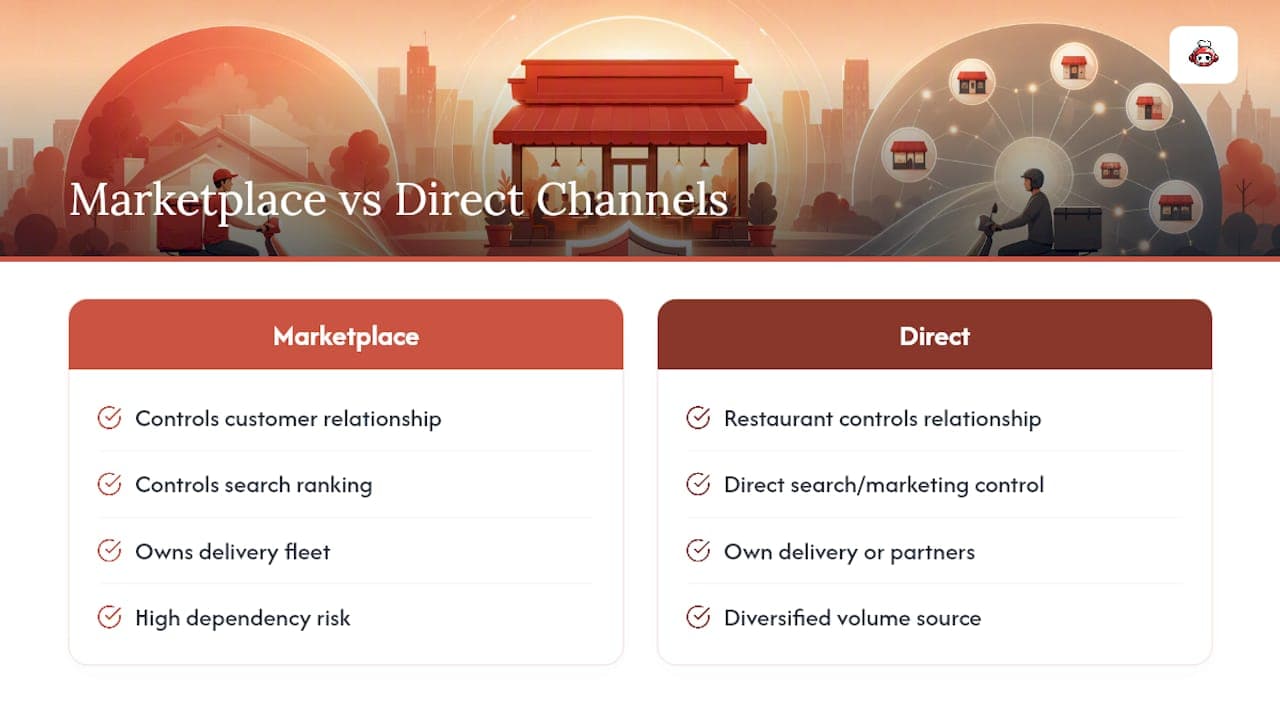
Marketplaces hold more leverage than most owners want to admit. When a marketplace controls the customer relationship, the search ranking, and the delivery fleet, it sets the terms, and restaurants that depend on that single channel for the bulk of their volume have very little room to push back on fee increases or policy changes.
This dynamic isn't new to hospitality. Any business selling through a dominant intermediary faces the same squeeze: the platform can adjust commission tiers, change how search results are ordered, or introduce new paid placement tiers, and a restaurant with no direct channel has no leverage to walk away. The broader shift toward marketplace growth means this concentration of power is likely to deepen rather than ease.
The practical response isn't boycotting marketplaces. It's making sure they're never your only channel. A restaurant that splits volume between marketplace discovery and a direct channel keeps a floor under its economics even if a marketplace changes terms overnight.
Owners who negotiate anything with a marketplace, whether it's a promotional placement or a temporary fee reduction, tend to get further when they can show the marketplace isn't their only source of orders. Leverage in these conversations comes from having somewhere else to send volume, not from complaining about the fee structure itself.
Reading the Fine Print Before You Sign
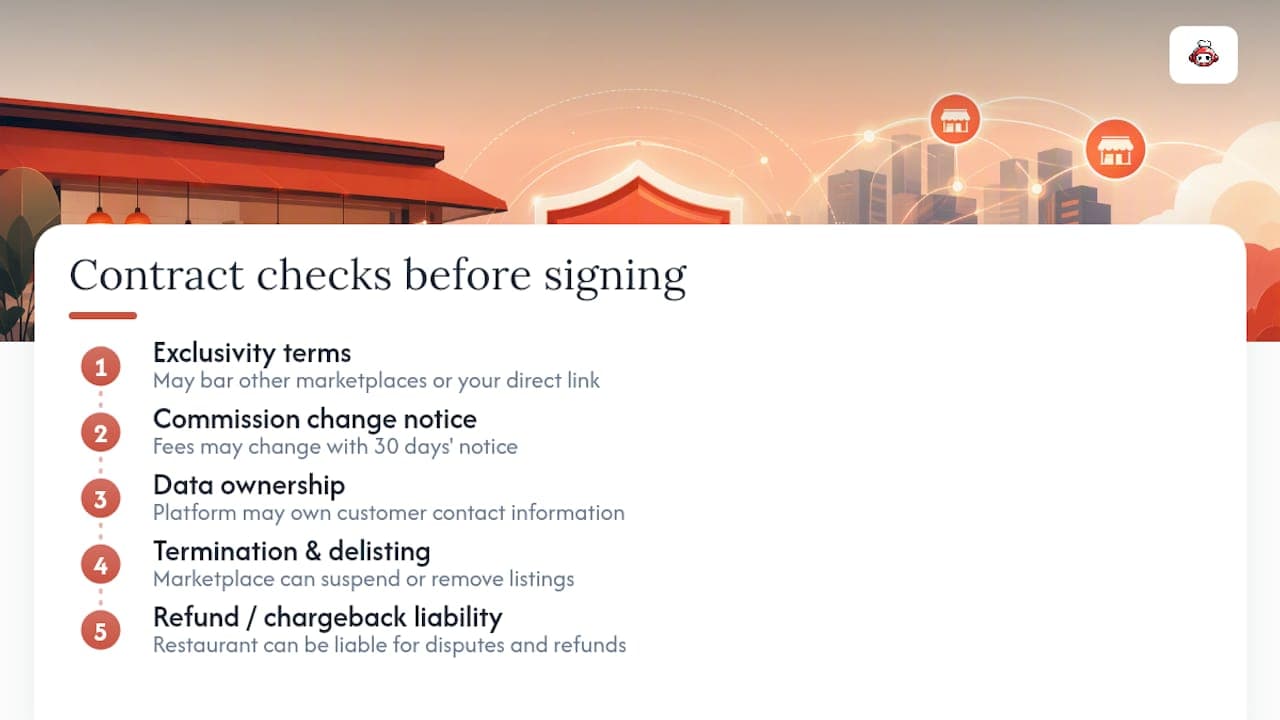
Marketplace contracts are rarely negotiated line by line for an independent restaurant, but a few clauses deserve attention before you sign anything. Exclusivity terms are the first flag: some agreements restrict you from listing with other marketplaces or discourage promoting your own direct ordering link within the marketplace's app. Read that section carefully, since it can quietly limit the exact hybrid strategy this article recommends.
Commission change notice periods matter too. Most marketplace agreements reserve the right to adjust fees with limited notice, sometimes as little as 30 days. Know what that notice period is and build it into your planning rather than discovering a rate increase on your monthly statement.
Data ownership clauses are worth a careful read. Many marketplace agreements are explicit that customer contact information collected through the platform belongs to the marketplace, not the restaurant, which is precisely why direct channels matter for building a customer list you actually control.
Termination terms and delisting policies also carry real consequences: some agreements allow the marketplace to suspend or remove your listing for customer complaint thresholds or late order rates, sometimes without much recourse. And refund or chargeback liability clauses determine who absorbs the cost when a customer disputes a charge; in many agreements, that liability defaults to the restaurant even when the marketplace processed the payment.
None of this means avoid marketplace contracts. It means read them the way you'd read a lease, and keep a direct channel running so no single contract term can shut down your revenue.
Why Owners Who Skip the Audit Regret It Later
The mistake I see most often isn't picking the wrong channel. It's letting a marketplace become the default channel by inertia, never running the numbers, and waking up a year later wondering where the margin went. Marketplaces are a tool for finding customers, not a business model to lean on permanently.
The habit worth building is simple: run the 30-day payout audit every month, not once. Margins drift quietly, and a monthly five-minute check catches the shift before it becomes a real problem.
*— ADMIN*
Ready to Build Your Direct Channel?
Marketplaces will keep sending you first-time customers, but converting them into direct regulars requires a channel worth owning. RESTOBOT gets a restaurant's own branded ordering site live the same day an application is confirmed, with zero commission on every order that comes through it, whether from your website or your Telegram bot.
The platform also covers the loyalty and staff-facing pieces this playbook depends on, including digital loyalty cards and a standalone tips feature hospitality workers can use even without their employer on the platform. Check RESTOBOT's plans, starting at €49 a month for the LOYALTY tier, and see which fits your rollout checklist.
Sources
FAQ
Is Amazon a Marketplace or a Retailer?
Amazon operates as both: it sells its own inventory as a retailer and hosts third-party sellers as a marketplace. In the restaurant world, the equivalent split is a platform like Uber Eats or Glovo acting purely as a marketplace connecting diners to independent restaurants, rather than owning the food itself.
What Are the Top Online Marketplaces for Restaurants?
The largest food delivery marketplaces globally include Uber Eats, DoorDash, Glovo, and Deliveroo, depending on region. Each functions primarily as a discovery and logistics layer, charging commission in exchange for access to their existing customer base.
Is an Online Marketplace Profitable for a Restaurant?
Marketplace orders can be profitable when priced correctly, but the commission structure often leaves a thinner margin than a direct order of the same size. Profitability depends on whether you've adjusted menu pricing for the fee and whether the order represents a genuinely new customer rather than a repeat guest who would have ordered direct.
What's the Difference Between a Marketplace and an Aggregator Model?
A marketplace connects buyers and sellers and typically handles payment and logistics, while an aggregator model mainly compiles listings or options for comparison without always handling the transaction itself. Most food delivery apps function as full marketplaces since they process payment, manage delivery, and often set customer-facing policies on refunds.
How Much Does RESTOBOT Cost Compared to Marketplace Commission?
RESTOBOT charges no commission on orders, running instead on a flat monthly subscription starting at €49 for the LOYALTY plan, €99 for MENU, and €199 for FULL. That structure means your per-order cost stays fixed regardless of order volume, unlike marketplace commission that scales with every sale.