

Use this restaurant onboarding checklist to move a new hire from a signed offer to full productivity through a structured 90-day program. The checklist runs preboarding through day one, week one, and 30/60/90 milestones, with role-specific training tasks for servers, cooks, bartenders, and hosts. Most new hires hit core competence within the first week and full ownership of their role by day 90. Copy/paste templates follow so you can start today.
***
TL;DR:
>
- A well-executed preboarding process ensures all paperwork, accounts, and logistics are completed before day one, reducing onboarding time and stress. - During the first week, shadowing, menu drills, and daily feedback help new hires develop muscle memory and reach independent performance. - Role-specific checklists for servers, cooks, bartenders, and hosts focus training on key tasks, with laminated cards aiding retention and cross-training opportunities. - Milestones at 30, 60, and 90 days, coupled with manager check-ins, track progress toward full ownership and identify early intervention needs. - Automating account setup via tools like RESTOBOT can prepare training systems in advance, minimizing administrative delays and supporting faster onboarding.
***
Table of Contents
- Preboarding Checklist: What To Finish Before Day One
- Day One Checklist: Orientation Walkthrough And Welcome Script
- Week 1 Checklist: Supervised Practice And Menu Drills
- Role-Specific Checklist: Training Tasks By Position
- 30-60-90 Day Milestones And Manager Check-Ins
- Compliance And Certifications Every Manager Must Track
- Tools And Systems New Hires Should Learn
- Common Onboarding Mistakes And Quick Fixes
- Quick Templates Managers Can Copy
- Why Onboarding Is An Investment, Not A Formality
- Get Your Restaurant Running Without The Admin Load
- Sources
- FAQ
Preboarding Checklist: What To Finish Before Day One
The gap between a signed offer and a first shift is where most restaurants waste time. Handle logistics before the new hire ever puts on an apron, and day one becomes about people instead of paperwork. A good preboarding checklist also sets up the 90-day timeline that follows, since accounts and paperwork have to exist before training can start.
Send a short welcome message within 24 hours of the signed offer. Include the first-week schedule, a map or parking note, dress code, and the name of the manager they'll report to. Confirm arrival time and who greets them at the door. Nothing kills first-day energy faster than a new hire standing at a locked entrance at 9:00 AM wondering if they're in the right place.
Preboarding tasks to complete before day one:
- Collect tax forms (W-4 or local equivalent), ID for work eligibility, and direct-deposit information, and set a deadline for anything outstanding.
- Build the payroll profile and confirm uniform sizing or locker assignment.
- Provision POS login, scheduling app access, reservation dashboard, and ordering system accounts so the new hire isn't watching someone else log in on day one.
- Assign a buddy or mentor and put an initial shadow shift on the calendar.
- Confirm any state-specific paperwork with a quick check against Department of Labor wage and hour guidance.
Who owns what:
- Manager: welcome message, schedule, buddy assignment.
- HR or owner: tax paperwork, payroll setup, ID verification.
- Shift lead: system provisioning and uniform logistics.
Assign a deadline to each item. A checklist with no owner and no date is just a wish list.
Day One Checklist: Orientation Walkthrough And Welcome Script
Day one sets the tone for the entire employment relationship, and it works best as a script, not an improvisation. Run it the same way for every new hire so nothing gets skipped when the restaurant is slammed.
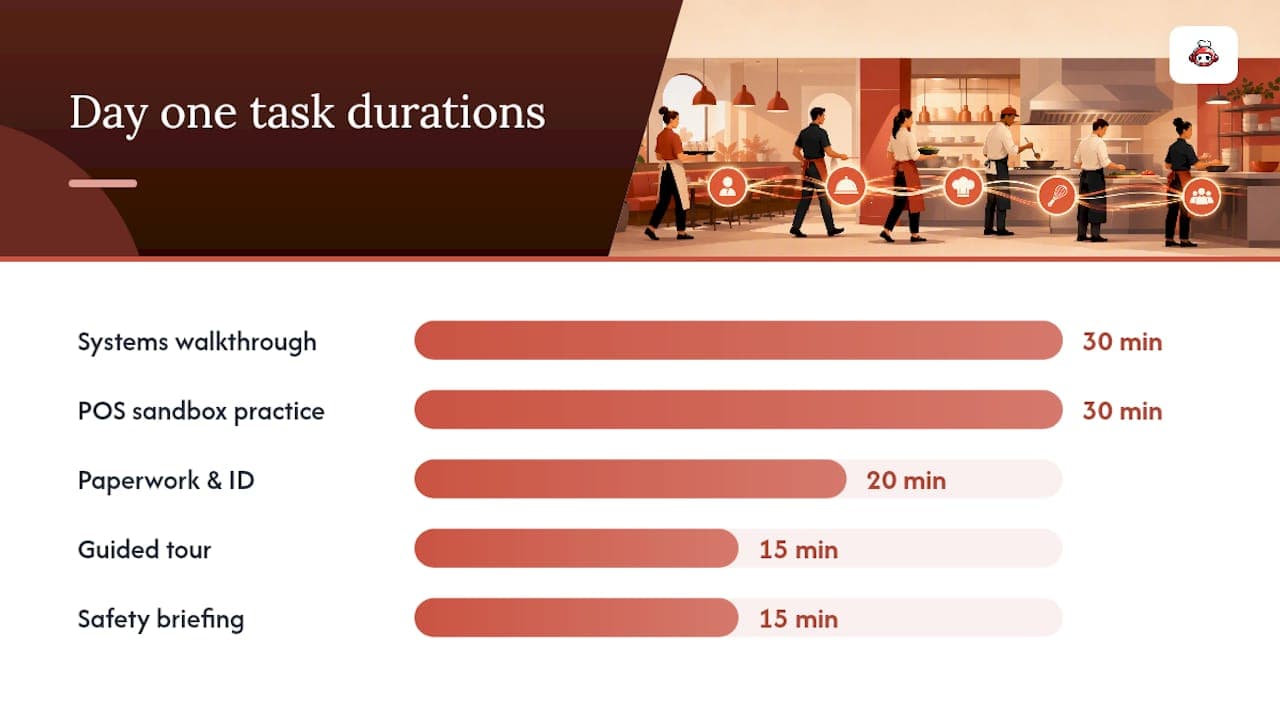
- Manager welcome (10 minutes). State the mission in plain terms, name the service standards you actually enforce, and tell them what success looks like in 30 days.
- Guided tour (15 minutes). Walk the full floor plan, front of house and back, introducing everyone by name and role, not just title.
- Paperwork and ID verification (20 minutes). Finish anything not completed during preboarding; verify identification where local law requires it.
- Systems walkthrough (30 minutes). Cover the schedule, punch-in process, tip policy, and dress and grooming rules in one sitting so there's a single reference point.
- POS sandbox practice (30 minutes). Let them ring practice orders in a training mode before a guest is ever involved.
- Safety briefing (15 minutes). Cover fire exits, first aid location, knife handling basics, and the incident reporting process.
- End-of-day check-in (10 minutes). A short manager form: what went well, what confused them, what to cover tomorrow.
Pro Tip: *Keep the day-one paperwork block under 20 minutes by pushing everything possible into preboarding. New hires remember how they were treated on day one far longer than they remember the tax form they filled out.*
Role-specific onboarding built on this kind of phased structure consistently produces faster ramp times than throwing someone straight onto the floor.
Week 1 Checklist: Supervised Practice And Menu Drills
Orientation gives a new hire information. Week one turns it into muscle memory. This is the phase where shadowing, repetition, and daily feedback do the actual training.
- Run daily 10 to 15 minute check-ins with the manager or buddy, and keep a log of recurring questions so you catch training gaps early.
- Build a shadowing schedule by station, with a clear expected outcome for each shift, not just "watch Sarah for a while."
- Drill menu knowledge on the top 10 to 20 items first, since those account for most guest orders and most allergen questions.
- Progress practice shifts from partial shadow, to supervised solo sections, to a full independent shift by the end of the week.
- Confirm enrollment dates for any required compliance courses so certifications don't slip past their deadline.
Teaching how orders actually move through the kititchen, not just isolated tasks, tends to produce better decisions under pressure than drilling single skills in a vacuum. A server who understands why the kitchen calls "all day" on a ticket handles a rush more calmly than one who only memorized POS buttons.
By the end of week one, a new hire should be able to run a section or a station with light supervision. If they can't, that's a signal to extend shadowing rather than push them into an unsupervised shift.
Role-Specific Checklist: Training Tasks By Position
Generic training misses the details that actually separate a good shift from a bad one. Each role needs its own short list.
Servers
- Section management and table timing across a full rotation.
- Order accuracy and correct use of POS modifiers for substitutions and allergies.
- Allergy protocol: how to flag a ticket and confirm with the kitchen before it fires.
- Guest recovery: what a server can comp or fix without pulling in a manager.
Cooks
- Station setup and mise en place standards before service starts.
- Portion control against the recipe card, not by eye.
- Ticket flow and timing across multiple stations during a rush.
- Re-fire rules: when to remake versus when to check with a manager first.
- Equipment safety, particularly fryers, slicers, and hot holding.
Bartenders
- Recipe consistency using a standardized spec sheet, not memory.
- ID checks on every guest who appears under 30, no exceptions.
- Speed benchmarks for well drinks versus specialty cocktails.
- Sanitation of shakers, strainers, and garnish stations between uses.
Hosts
- Reservation system logic, including how to handle overbooked slots.
- Waitlist management and accurate wait-time estimates.
- Phone etiquette, since the host often makes the guest's first impression before they ever walk in.
- Reading the room to seat sections evenly instead of dumping tables on one server.
Pro Tip: *Print each role's checklist on a single page and laminate it. A new hire glancing at a card between tables retains more than one who was handed a 12-page binder on day one.*
Once someone hits consistent competence in their primary role, start cross-training on an adjacent station. A server who can also host, or a cook who can also run the service window, gives you scheduling flexibility when someone calls out.
30-60-90 Day Milestones And Manager Check-Ins
Structured milestones turn onboarding into something you can measure instead of just hoping it's going well. Each checkpoint should have a short scorecard and a real conversation attached to it.
- 30 days: basic competence, reliable attendance, safety compliance. Scorecard items: order accuracy rate, punctuality, completion of required certifications.
- 60 days: independence on the primary station, noticeably fewer errors, readiness to train on a second station. Scorecard items: speed against benchmark, guest complaint count, peer feedback from the buddy.
- 90 days: full ownership of the role. This is the formal review point where you decide on a raise, added responsibility, or a development plan.
Sample scorecard fields:
- Attendance and punctuality record
- Accuracy metrics (order errors, comps, remakes)
- Guest feedback mentions, positive or negative
- Manager notes and next-step actions
If someone is behind at the 30-day mark, don't wait for 60 to intervene. Add a shadow shift, pair them with a different buddy, or extend the sandbox practice on the POS. A phase-based structure like this, built around clear 30/60/90 milestones, gives you an early warning system instead of a surprise at the three-month review.
Compliance And Certifications Every Manager Must Track
Skipping compliance paperwork is the fastest way to turn a good hire into a legal headache. Keep a simple record for every employee and check it against local rules.
- Food handler certification, and ServSafe or an equivalent manager-level certification where your jurisdiction requires it.
- Responsible alcohol service training for anyone pouring or serving drinks.
- Payroll and tax forms, verified against federal wage and hour standards and whatever your state or country adds on top.
- A written tip policy, with tip reporting documented the same way for every employee.
Restaurant turnover runs high across the industry, and the cost of replacing an employee includes far more than the job posting. Recruiting, retraining, and lost productivity all stack up, which is exactly why clean compliance recordkeeping matters. A missing certification found during an audit costs more than the ten minutes it takes to file it correctly the first time.
Keep every document in one folder, digital or physical, per employee, and assign one person to own the update schedule.
Tools And Systems New Hires Should Learn
A new hire can't move fast if they're learning the POS, the reservation system, and the loyalty program all in the same rushed hour. Pre-provisioning accounts during preboarding, the same step covered earlier, means training time goes to practice instead of setup.
- POS system: for order entry, modifiers, and payment processing.
- Reservations dashboard: for managing bookings and walk-ins in real time.
- Online ordering and menu tools: for handling delivery and pickup orders alongside dine-in.
- Loyalty program: digital cards guests keep in their phone wallet instead of a paper stamp card.
- Tip collection tools: individual profiles where staff receive guest tips directly.
RESTOBOT provisions a restaurant's website, ordering, and reservation setup automatically within moments of an application being confirmed, which means a new hire's sandbox accounts can exist before their first shift instead of getting built on the fly. Its digital loyalty cards sync to Apple and Google Wallet, so training on loyalty enrollment takes minutes, not a lecture. When the admin work is already handled, the buddy assigned to a new hire spends that first week coaching instead of hunting down login credentials.
Common Onboarding Mistakes And Quick Fixes
Most bad onboarding experiences trace back to the same handful of errors, and each one has a cheap fix.
- Sink-or-swim scheduling: replace it with staged shadowing and a written checklist instead of throwing someone into a Friday rush.
- Overloaded first day: move paperwork into preboarding so day one is about people and practice.
- Skipped mentorship: assign a buddy and protect their time, since mentorship speeds up how fast a new hire feels part of the team.
- No feedback loop: add a daily 10-minute check-in log so small confusions don't turn into bigger mistakes by week two.
Pro Tip: *If a new hire quits in the first two weeks, ask what happened during onboarding before you assume it's a hiring problem. Most early exits trace back to a rough first shift, not a bad candidate.*
Quick Templates Managers Can Copy
Keep every template short. A one-page document gets used; a five-page one gets ignored.
- Welcome email: "Welcome to the team, [name]! Your first shift is [date] at [time]. Attached: schedule, dress code, and parking info."
- Day-1 agenda block: paste the seven-step orientation list from earlier directly into a calendar invite with time stamps.
- 30/60/90 scorecard: paste the milestone fields (accuracy, attendance, guest feedback, manager notes) into your notes app or LMS and fill them in at each checkpoint.
Assign an owner to each template so it actually gets used every time, not just for the first new hire.
Why Onboarding Is An Investment, Not A Formality
Good onboarding isn't paperwork you rush through so someone can start clocking in. It's the cheapest retention tool a restaurant has. A structured first week costs a few hours of manager time; a bad one costs you the hire entirely, plus the comps, remakes, and firefighting that come from undertrained staff mid-shift.
I've seen the same pattern across restaurant guides and turnover research alike: the restaurants with the fewest surprises three months in are the ones that wrote the checklist down instead of winging it. Adapt these templates to your own floor plan and menu. The structure matters more than the exact wording.
*— ADMIN*
Get Your Restaurant Running Without The Admin Load
An onboarding checklist works best when the systems behind it are already built, not assembled on the fly during a new hire's first week. RESTOBOT provisions a restaurant's website, embedded menu, ordering, and reservation system automatically, often within a day of your application being confirmed, so training accounts exist before day one instead of getting rushed together the morning of. There's no per-order commission cutting into revenue, and staff can activate their own tip collection profiles independent of whatever plan the restaurant is on. If you're building out onboarding systems anyway, visit the RESTOBOT platform to see how fast a working setup can be ready for your next hire's first shift.
Sources
- Complete Restaurant Onboarding Checklist for New Hires | 7shifts
- The complete employee onboarding process: Steps, checklist, and workflow examples | Moxo
- The cost of employee turnover (Cornell eCommons)
- Fair Labor Standards Act (FLSA) - U.S. Department of Labor
- Cultivate mentorship culture | Harri resources
FAQ
What Should Be Included In An Onboarding Checklist?
A complete checklist covers preboarding paperwork and account setup, a day-one orientation with safety and POS training, week-one supervised shifts with menu drills, and 30/60/90 day milestones tied to a manager scorecard.
What Are The 4 C's Of Onboarding?
Definitions vary slightly by source, but the most common version covers compliance (paperwork and legal requirements), clarification (understanding the role and expectations), culture (understanding the restaurant's values and standards), and connection (building relationships with the team, often through a buddy system).
How Long Should Restaurant Onboarding Take?
Most new hires reach basic competence within the first week and full role ownership by 90 days, following a phased onboarding structure that builds from shadowing into independent shifts.
Does A Buddy System Actually Improve Retention?
Yes. Pairing a new hire with an experienced mentor speeds up social integration and gives them a go-to person for questions instead of interrupting a manager mid-shift.
Can Restaurant Software Speed Up Onboarding?
Provisioning POS, ordering, reservation, and loyalty accounts before day one lets new hires practice in a sandbox instead of learning live, and platforms like RESTOBOT can set up a restaurant's ordering and loyalty tools automatically once an application is confirmed.