

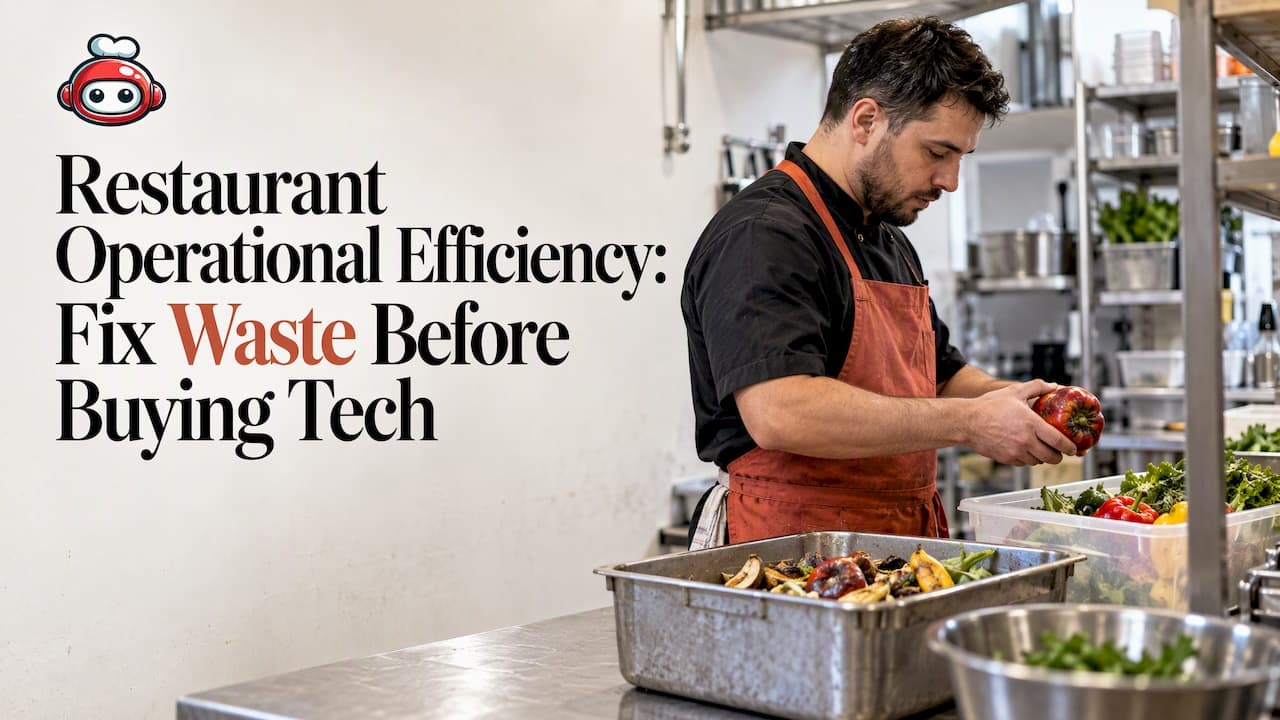
To improve operational efficiency in your restaurant, focus on key levers: staffing, inventory, kitchen layout, menu engineering, technology integrations, analytics and SOPs, starting with whichever gives the fastest win. Digital tools only pay off when staff actually use them well, so pair any new system with a short training push. An improvement plan follows below.
***
TL;DR:
>
- Build schedules from reservations, past covers, and local events, publish them early, and test cross training on one shift before expanding. - Use ABC stock categories, weekly par reviews, and daily fast mover counts reconciled with POS sales; log waste by shift using any tablet. - Prioritize POS to inventory syncing and one ordering dashboard, then launch on the quietest shift with tested logins, printers, and a fallback plan. - Pilot menu or technology changes on one daypart or shift, track ticket time, waste, order accuracy, and payback, and expand only when results support it.
***
Table of Contents
- Staffing and scheduling: predictive rostering and shift design
- Inventory management and cutting food waste
- Kitchen layout and workflow optimisation
- Menu engineering and simplification to reduce complexity
- Technology and integrations: what to connect first
- Analytics and KPIs that predict operational problems
- Standard operating procedures, training and staff buy-in
- Actionable quick wins and a 30-day improvement plan
- Customer flow and table turnover management
- Supplier management and procurement optimisation
- Energy usage and cost reduction strategies
- Employee motivation and communication tools
- Handling peak times and demand forecasting
- Impact of digital ordering and self-service kiosks
- Author perspective: combine small process fixes with targeted tech
- How RESTOBOT maps to the levers: consolidated ordering, dashboards and commission-free tips
- FAQ
- Sources
Staffing and scheduling: predictive rostering and shift design
Labour is usually the biggest controllable cost on the P&L, and most of the waste in it comes from guessing rather than planning. Reservation data, historic covers and local events (a concert, a public holiday, bad weather) give a far more reliable demand signal than a manager's gut feeling about how busy Friday will be.
Posting schedules well in advance cuts down on last-minute swaps and no-shows, because staff can plan their own lives around a roster instead of fighting it. Shift templates built around known peak windows, combined with cross-training so servers can cover a bar shift or a runner role, close gaps without needing extra headcount on the books.
- Build rosters from covers and reservation history, not habit.
- Publish schedules well in advance.
- Cross-train staff across roles to absorb sudden gaps.
- Track labour cost as a percentage of sales and covers per labour hour.
Run the new approach on a section or shift pattern before rolling it out everywhere.
Pro Tip: *Compare covers per labour hour week on week rather than day on day. It smooths out one unusual shift and shows the real trend.*
Inventory management and cutting food waste
Stock control is where small daily habits save the most money, because food waste is rarely one big mistake. It is dozens of small ones: over-ordering a slow mover, an oversized portion, a delivery that sat too long before storage.
ABC categorisation (ranking stock by value and turnover) lets you set par levels for the items that matter most and review them weekly instead of guessing on every order. Daily or per-shift counts on fast-moving items, reconciled against POS sales, flag shrinkage before it becomes a pattern. A simple waste log, where staff enter what is thrown away on a tablet each shift, does not need proprietary hardware to work, since standard tablet interfaces are enough to capture the data that matters.
- Apply ABC categorisation and set par levels reviewed weekly.
- Run daily stock checks on fast movers and reconcile against POS sales.
- Log waste by shift on any tablet, no special hardware required.
- Cross-use ingredients and standardise portions to cut spoilage.
Foodservice loss rates vary widely, with [served food lost](https://boku.ac.at/fileadmin/data/H03000/H81000/H81300/upload-files/Forschung/Lebensmittel/Lebensmittelabfaelle_Tourismus_Abgabe.pdf) ranging from 3% to 55% depending on the type of operation. That spread shows how much is within a kitchen's own control once the right habits are in place.
Kitchen layout and workflow optimisation
A kitchen that forces staff to walk further than necessary, or hands a ticket through three stations when two would do, loses time on every single order. Designing stations so the tools and ingredients each role needs are within arm's reach removes dozens of small delays across a shift.
Standardised mise en place and a fixed pass procedure mean a shift runs the same way whoever is working it, which matters more on a busy Saturday than any single piece of equipment. Consolidating printers and tablets at the pass, rather than scattering devices across stations, reduces the confusion that causes missed or duplicate tickets.
- Place tools and ingredients within reach at each station.
- Standardise mise en place and pass procedure across shifts.
- Consolidate printers and tablets to cut clutter and confusion.
- Run a short time-and-motion check during a peak service to spot bottlenecks.
Menu engineering and simplification to reduce complexity
Every dish on a menu carries a cost in prep time, stock variety and training, not just the ingredients on the plate. Sales data usually shows a handful of dishes doing most of the volume, with a long tail of low-margin or low-selling items that add complexity without adding much revenue.
Consolidating that tail, standardising recipes and choosing ingredients that cross over between dishes shrinks the stock list a kitchen has to manage. Offering portion choices, or running short-term specials to shape demand toward dishes you can prep efficiently, helps avoid the overproduction that drives waste. Before a full roll-out, piloting menu changes on a single daypart, lunch only, for example, shows what works with less risk.
- Use sales data to spot low-margin or low-selling dishes to cut.
- Standardise recipes and cross-use ingredients across the menu.
- Offer portion choices or specials to shape demand.
- Pilot changes on one daypart before a full roll-out.
Technology and integrations: what to connect first
Not every integration deserves the same priority, and chasing all of them at once usually means none get done properly. The two that save the most time, fastest, are syncing the POS to inventory and consolidating every ordering channel into one dashboard.
- Sync POS to inventory first, so stock usage updates automatically instead of drifting unseen between manual counts.
- Replace a scattered "tablet farm" of separate apps for website, delivery and walk-in orders with one consolidated dashboard.
- Build a cutover checklist for launch day, covering staff logins, printer tests and a fallback for the first busy service.
- Train managers to read the dashboard in real time and act on it immediately, not just review it the next morning.
A POS sync playbook keeps the menu on the till and the menu online from drifting apart, which is one of the quieter causes of order errors and refunds.
Pro Tip: *Launch a new integration on your quietest shift of the week, not your busiest. You want time to fix problems, not a queue building behind them.*
Analytics and KPIs that predict operational problems
A handful of numbers, tracked consistently, tell you more than a pile of reports nobody reads, especially when guided by digital marketing predictive analytics to forecast outcomes and boost ROI. Labour cost as a percentage of sales, covers per labour hour, average ticket time, waste measured in kilograms or cost, and order accuracy rate cover staffing, kitchen speed, waste and service quality between them.
- Check labour %, covers per hour and ticket time daily.
- Review waste and order accuracy weekly, alongside any changes you have piloted.
- Test changes on a small sample first, one shift or one section, before rolling out.
[Restaurant case studies show](https://dspace.vsb.cz/items/35f9aaad-305b-461d-b703-27be005e29b0) that digital kiosks and self-service can raise average spend and cut labour cost, provided the total cost and payback are worked out first. That caveat matters: a dashboard only earns its keep if someone is actually watching it and reacting. Our own metrics guide goes deeper into which figures to track daily versus weekly.
Standard operating procedures, training and staff buy-in
A process only sticks if staff actually follow it when a manager is not watching, which is why short, visual SOPs beat long written manuals every time. A one-page checklist pinned at the pass, showing the steps for closing a station or handling a walk-in order, works better than a binder nobody opens.
Short practice drills, run before a new process goes live, surface problems while they are still cheap to fix. Collecting staff feedback after each change, even a quick chat at the end of a shift, catches friction a manager might miss from the floor.
- Write one-page visual checklists for core shift tasks.
- Run short practice drills before any new process goes live.
- Collect staff feedback after each change and adjust quickly.
Pro Tip: *Tie a small, visible incentive, a shout-out, a bonus, extra break time, to waste reduction or order accuracy rather than to sales alone. It rewards the behaviour you actually want.*
Actionable quick wins and a 30-day improvement plan
Start with the change that needs the least effort for the most visible result, then build from there.
Post the roster in advance, count fast-moving items, and standardise a high-volume recipe. Pilot a POS-to-inventory sync on key ingredients, consolidate ordering tablets into one screen, and introduce a brief daily waste huddle.
- Choose the first test using an impact versus effort view: high-impact, low-effort changes go first, big investments wait until the basics are proven.
| Week | Focus | Expected outcome |
|---|---|---|
| First phase | Roster, stock count, a recipe standardised | Fewer scheduling gaps, visible waste pattern |
| Later phase | POS sync pilot, tablet consolidation, waste huddle | Less stock drift, fewer missed tickets |
Treat each step as a test, not a permanent commitment, until the numbers back it up.
Customer flow and table turnover management
Table turnover is a timing problem dressed up as a seating problem. Most delays come from gaps between stages, order taken but not fired, food ready but not delivered, table cleared but not reset, rather than from the meal itself taking too long.
Mapping your average sequence from seating to payment shows where the gaps actually sit. A host stand that tracks table status in real time, even on a simple whiteboard, avoids the common mistake of guessing which tables are nearly free. Pre-bussing (clearing finished plates as the table progresses rather than waiting for the whole party to leave) shortens the reset time between parties.
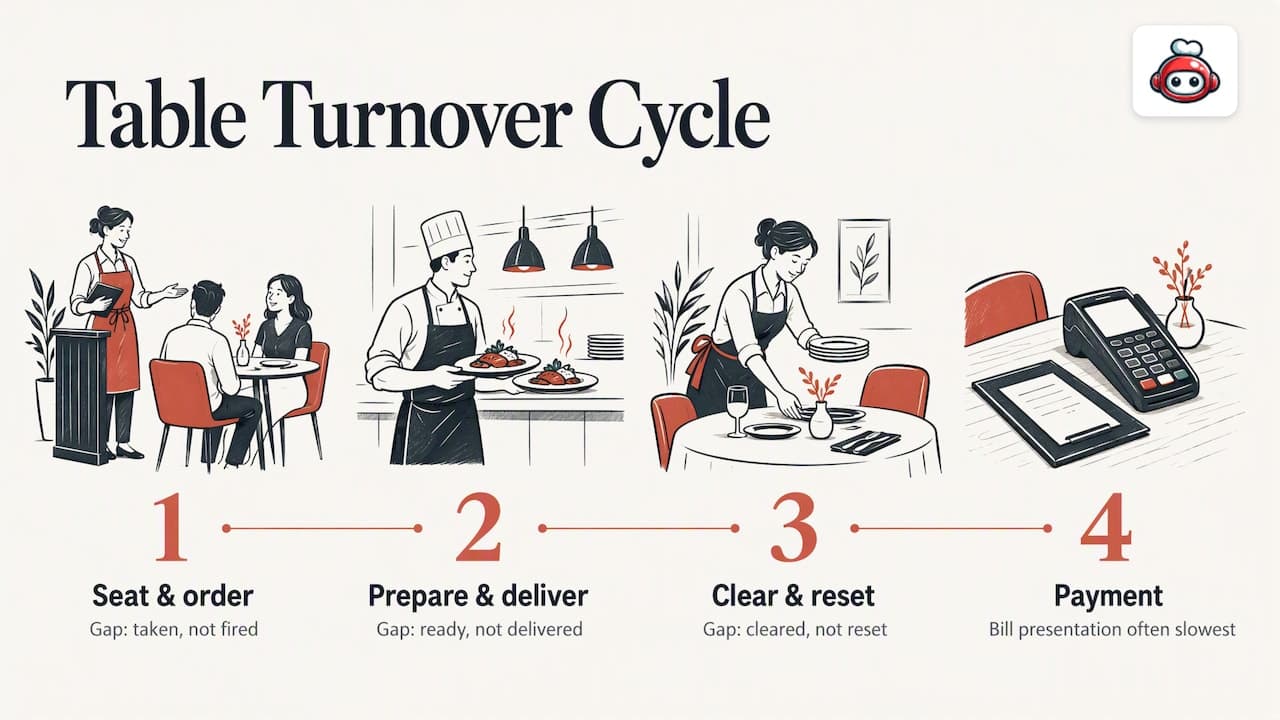
Bill presentation is often the slowest stage of all. Offering payment at the table, through a QR code or a handheld terminal, removes the wait for a server to notice the table is ready to pay. For walk-in-heavy venues, giving guests a realistic wait estimate up front, rather than a vague "it won't be long," reduces the walk-aways that cost a booking you never see.
None of this needs a renovation. It needs a clear view of where each table sits in its cycle and a habit of acting on that view during service, not reviewing it the next morning.
Supplier management and procurement optimisation
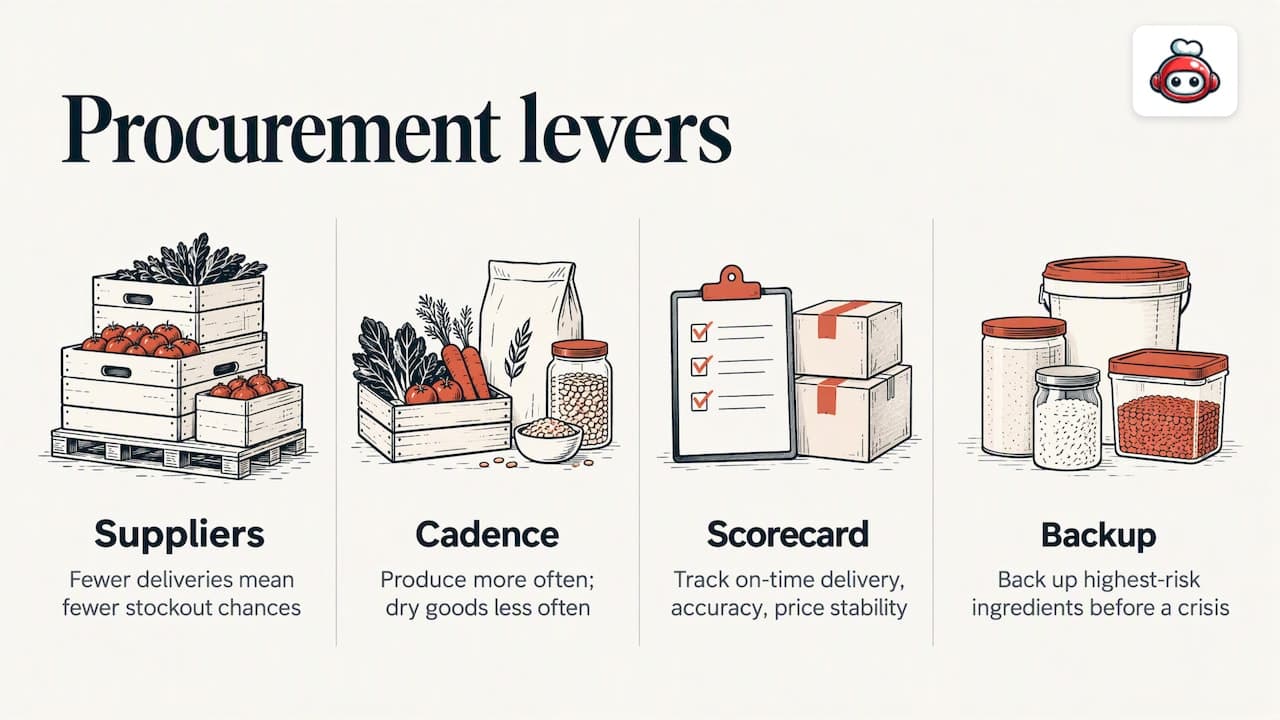
Procurement decisions show up on every plate, in freshness, in cost and in how often a kitchen has to improvise because a delivery was short. Supply logistics analysis points to supplier choice, delivery cadence and the procurement process itself as the levers that affect all three.
Consolidating orders with fewer, more reliable suppliers usually beats chasing the lowest price on every single item, since fewer deliveries mean fewer chances for a stockout mid-service. Matching delivery frequency to how fast an ingredient actually turns over, more often for produce, less often for dry goods, reduces both spoilage and the cash tied up in stock sitting on a shelf.
A short supplier scorecard, tracking on-time delivery, order accuracy and price stability, turns a vague sense of "they're usually fine" into something you can actually compare at renewal time. Building a backup supplier relationship for your highest-risk ingredients, before you need one in a crisis, protects the menu from a single point of failure.
Procurement is also where menu engineering and inventory meet: standardising recipes to use fewer distinct ingredients, covered earlier, directly shrinks the supplier list you need to manage in the first place.
Energy usage and cost reduction strategies
Energy is one of the few costs a restaurant can cut without touching the guest experience at all. Refrigeration, cooking equipment and lighting run whether the dining room is full or empty, so the biggest savings usually come from timing rather than equipment swaps.
Scheduling ovens and fryers to come on closer to service, rather than hours early "just in case," cuts idle running time. Checking that walk-in and reach-in fridge seals are tight stops cold air leaking out and compressors working harder than they need to. LED lighting, where it has not already replaced older fittings, pays for itself quickly given how many hours a dining room and kitchen run lights each day.
A simple weekly habit, checking that equipment not in use is actually switched off rather than left on standby, catches the kind of waste that never shows up as a single large bill but adds up steadily across a year. None of these changes require a capital project: they are habits to build into the same SOPs and checklists already covering food safety and closing procedures.
Employee motivation and communication tools
Efficiency gains do not survive on paper if the team running the floor and the kitchen is not on board with why a change is happening. A clear, short explanation of what a new process is for, "this cuts your wait for tickets," rather than just "do it this way now," gets far more genuine buy-in than an instruction alone.
A shared communication channel, whether that is a group chat, a shift handover log or a simple noticeboard, keeps staff aligned on what changed overnight without relying on word of mouth during a busy service. Recognising good performance in front of the team, not just privately, reinforces the behaviour faster than a policy memo ever will.
Small, visible incentives tied to the KPIs already covered, waste reduction, order accuracy, table turnover, work better than a vague bonus at the end of the quarter, because staff can see the link between what they did this week and what they earned. Tips sit alongside wages as part of that recognition: workers can collect tips directly from guests through their own profile, which gives them a personal stake in service quality that a flat wage alone does not.
Handling peak times and demand forecasting
Peak service failures are rarely about not having enough staff in the building. They are about not having the right number in the right place at the right moment, which is a forecasting problem more than a headcount problem.
Looking back at the same day and date last year, factoring in bookings already on the system and anything unusual happening locally, gives a far sharper forecast than simply scheduling "the usual Friday team." Building a small buffer into the schedule for genuinely unpredictable spikes, rather than staffing to the average, avoids the scramble of calling staff in at short notice.
During the peak itself, a manager's job shifts from planning to reacting: watching ticket times in real time and moving staff between stations before a bottleneck becomes visible to guests. That only works if the dashboard or whiteboard tracking it is actually being checked during service, not reviewed afterwards.
Impact of digital ordering and self-service kiosks
Digital ordering changes more than how an order gets placed. It changes who takes it, how fast it moves, and how much of a server's time is freed up for the table in front of them instead of standing at a terminal keying in someone else's order.
Case study evidence suggests kiosks and self-service can lift average spend and reduce labour cost, but only where the operator has worked out the total cost and payback first rather than installing hardware because competitors have it. A kiosk that sits unused because guests were never shown how to use it is a cost with no return.
Simulation work testing digital ordering, takeaway capacity and other operational changes found that at least one of the scenarios tested improved either waiting times or profitability, which suggests targeted, measured experiments reveal real operational benefit more reliably than broad assumptions about what technology "should" do. The lesson carries beyond kiosks: test one change, measure it properly, then decide whether to scale it.
Author perspective: combine small process fixes with targeted tech
Digital tools are amplifiers, not magic bullets. Evidence from franchise operators suggests efficiency gains depend on staff competence and simple routines at least as much as on the software itself. Start small, measure honestly, and let operational wins compound into better service and steadier margins.
*— ADMIN*
How RESTOBOT maps to the levers: consolidated ordering, dashboards and commission-free tips
Most of the levers above come down to one thing: less time lost to fragmented tools and more time spent on the floor. We built our platform around that idea, with a website and ordering channel that can be launched rapidly, so you can start consolidating.
- One dashboard for website, Telegram and delivery orders, instead of a tablet for each channel.
- Tools to help keep your till and online menu matching, cutting the order errors that come from drift.
- Real-time analytics so managers can react during service, not the next morning.
- Commission-free online tips for waiters, bartenders and other staff, paid straight to their own account.
Where a marketplace charges around 30% of the net order value in commission, almost 40% once VAT is added, we charge a flat monthly subscription with no per-order cut. You can check current pricing for our MENU and FULL plans before deciding which fits your operation.
FAQ
How to improve order accuracy in restaurants?
Order accuracy improves most by syncing your POS to your online menu so prices and items never drift apart, and by consolidating every ordering channel into one dashboard staff actually watch. Standardised recipes and a clear pass procedure also cut the mistakes that happen when tickets get handled inconsistently between shifts.
What is another term for operational efficiency?
Operational efficiency is often described as workflow optimisation or productivity, terms that all point to getting more output, covers served, orders fulfilled, from the same staff, time and stock. In a restaurant context, it usually means less waste, faster service and lower labour cost per cover.
What is the biggest problem in the restaurant industry?
Thin margins combined with volatile food and labour costs are consistently named as the toughest operational challenge, since even small waste or scheduling inefficiencies erode profit quickly. Food loss alone can range from 3% to 55% of served food depending on the type of operation, which shows how much is within a kitchen's control.
Why is efficiency important in business?
Efficiency matters because it determines how much of every pound of revenue actually turns into profit, rather than disappearing into waste, idle labour or avoidable errors. In restaurants specifically, efficient operations also tend to mean faster, more consistent service, which directly affects whether guests come back.