


Digital tips are taxable income, full stop. Under the One, Big, Beautiful Bill, qualified tips may earn a federal income tax deduction, but Social Security and Medicare taxes still apply to every dollar. Employers should confirm their POS offers a genuine no-tip option, start collecting monthly tip reports now, and make sure payroll knows how each tip is being logged and reported.
***
TL;DR:
>
- Digital tips remain taxable income, with Social Security and Medicare taxes applying to all tips regardless of the federal income tax deduction. - Employers must ensure tipping interfaces allow customers to select a zero or optional tip amount to maintain voluntary status and qualify for the deduction. - Accurate, schedule-based reconciliation of POS tip data against gross receipts is essential to stay audit-ready, especially during enforcement reviews. - A clear paper trail linking tips to the worker, occupation, and voluntary cash payments is critical for claiming the federal deduction and avoiding misclassification. - Tips received through platforms should be timestamped, worker-specific, and reported alongside cash and non-cash tips in monthly totals for proper IRS compliance.
***
Table of Contents
- What separates a digital tip from a service charge
- Payroll taxes still apply even with the OBBBA deduction
- Employer and payroll steps for digital tip reporting
- POS and QR tipping setups that protect qualified status
- How a restaurant platform can support compliant tipping
- Reporting cash and non-cash tips alongside digital ones
- State and local rules layered on top of federal tipping taxes
- How digital tips change take-home pay and withholding
- Why transparent tipping systems protect everyone
- A tipping tool built around voluntary, documented payments
- Sources
- FAQ
What separates a digital tip from a service charge
The IRS treats a tip as a payment the customer chooses to make in an amount the customer chooses, with no pressure to select a specific figure. Digital equivalents include card tips, mobile-app tips, gift-card gratuities, and other cash-denominated electronic payments, and the IRS confirms that qualified tips include cash, credit and debit card tips, and mobile payments denominated in cash, as long as the payment stays voluntary.
Service charges work differently. An 18% auto-gratuity added to a large party's check, or any charge the customer cannot remove or set to zero, counts as employer income and wages rather than a qualified tip. The line between the two often comes down to interface design, not intent.
- A QR code that lets a guest type any amount, including $0, preserves voluntary status.
- A checkout screen with preset percentages and no visible "custom" or "no tip" button starts to look like a required charge.
- A delivery app that forces a nonzero selection before the order can be placed pushes that payment toward service-charge treatment, regardless of what the receipt calls it.
That distinction determines whether a payment can ever qualify for the OBBBA deduction discussed next, and whether it belongs on the wage side or the tip side of payroll.
Payroll taxes still apply even with the OBBBA deduction
Every tip is taxable income the moment it lands, digital or cash. What changed under the One, Big, Beautiful Bill is a new federal income tax deduction for qualified tips, not a new exemption from payroll taxes. Social Security and Medicare withholding still apply to tips regardless of whether the worker later claims the deduction on their return.
The final regulations name a list of occupations eligible for the qualified-tip deduction, and they define what counts as a qualified tip: a voluntary payment, denominated in cash or a cash equivalent, reported through the standard channels, as confirmed in Treasury and IRS final regulations on tip occupations. Reporting still runs through the usual forms, W-2 for employees, 1099 for certain contractors, or Form 4137 when tips were not reported to an employer.
The most common misunderstanding is treating the deduction as a payroll tax break. It is not. It reduces federal income tax liability on qualifying amounts, but the employer still withholds and remits the employee share of Social Security and Medicare, and still pays the employer share. Self-employed tipped workers qualify under different math: their deduction is capped at net income from the tipped activity after subtracting related business costs, according to the CRS analysis of OBBBA tax provisions, which also notes the deduction carries annual caps and phases out at higher income levels.
Documentation matters more than ever. A worker claiming the deduction needs a clear paper trail tying reported tips to the qualifying occupation and to voluntary, cash-denominated payments, since the deduction excludes any amount that started life as a mandatory service charge.
Employer and payroll steps for digital tip reporting
Employers carry most of the compliance burden, and the workflow is more mechanical than most managers expect.
- Collect a written or electronic tip statement from every employee who received $20 or more in tips during the month, due by the 10th of the following month, per IRS Publication 531.
- Add reported tips to the employee's wages for withholding purposes, then report the total on Form W-2 using the boxes and codes specified in current IRS guidance.
- File Form 4137 for any employee-reported shortfall between what was reported and what payroll can substantiate, and use Form 8027 if the location is a large food or beverage establishment required to allocate tips.
- Reconcile POS tip exports against gross receipts monthly, not just at year-end, so allocation issues surface before they become a filing problem.
Employers must withhold and remit the employer share of Social Security and Medicare on all reported tips, and the IRS can issue a notice assessing liability when reported tips look inconsistent with charge receipts or industry norms. That risk is exactly why digital records matter: the IRS has signaled it increasingly cross-checks POS and digital platform data during enforcement reviews, so a restaurant with clean, timestamped exports has a much easier audit than one relying on handwritten tip logs.
Retention matters too. Keep exported POS tip reports, signed employee statements, and reconciliation summaries for at least the period the IRS can examine, and store them somewhere payroll can pull on short notice.
Pro Tip: *Run your tip-to-gross-receipts reconciliation every payroll cycle instead of quarterly, so a coding error in the POS gets caught before it compounds across dozens of shifts.*
POS and QR tipping setups that protect qualified status
The interface a guest sees when leaving a digital tip is now a compliance document, not just a design choice. Regulatory commentary is specific on this point: a POS flow that logs the customer's explicit selection, including a zero, is the strongest evidence a tip was voluntary, while a forced or defaulted prompt invites the IRS to treat part of that amount as a service charge instead.
- Offer a real "no tip" or $0 option on every checkout and QR flow, not just a smallest preset percentage.
- Use neutral wording like "add tip (optional)" instead of language that implies an expected amount.
- Log the customer's actual selection, the timestamp, and the worker or table identifier for every transaction.
- Keep tip-pooling policies written down and apply them consistently, since inconsistent redistribution is a common audit flag.
Detailed setup guidance for the QR side of this, including how to structure QR-code tipping so the selection data survives into payroll, and how to think through tip pooling versus direct tips when a shift splits gratuities among several staff, covers the operational side in more depth.
| POS practice | Why it matters for tax status |
|---|---|
| Explicit zero-tip button | Preserves voluntary status required for a qualified tip |
| Timestamped, worker-tagged records | Supports reconciliation against W-2 and 1099 totals |
| Written tip-pool policy | Documents redistribution for payroll and audit review |
| Exportable monthly reports | Speeds up Form 8027 allocation and Form 4137 corrections |
Regardless of the software involved, the core habit that keeps a business audit-ready is boring but effective: export tip data on a schedule, reconcile it against gross receipts, and confirm the totals match what shows up on W-2 or 1099 forms before those forms go out.
How a restaurant platform can support compliant tipping
A tipping feature illustrates what a compliance-friendly setup looks like in practice: individual workers can create a personal profile and receive tips through a QR code, with each transaction timestamped and tied to that worker's own record rather than a shared house pool.
- Guests choose their own tip amount, including declining to tip, which keeps the payment voluntary in the way current IRS guidance requires.
- Funds go straight to the worker's account with no commission taken by the platform, so the recorded tip amount matches what the worker actually receives.
- The feature works whether or not the worker's employer has any contract with the platform at all, so an individual server can start building documented tip records independently.
- Exportable records give payroll teams something concrete to reconcile against W-2 or 1099 filings instead of relying on memory or paper slips.
None of this replaces advice from a tax professional or payroll provider. It simply means the underlying data, who tipped, how much, and when, exists in a form that holds up when someone asks for it.
Reporting cash and non-cash tips alongside digital ones
Digital tips do not exist in isolation. Most tipped workers also collect cash tips, and some receive non-cash tips like event tickets or merchandise, and all of it has to be combined into a single monthly total for reporting purposes.
Under Publication 531, any employee who receives $20 or more in tips during a calendar month, added up across cash, card, digital, and non-cash tips, must report that total to their employer by the 10th of the following month. Non-cash tips get reported by value even though no payroll tax is withheld on them directly, since they still count toward the employee's total taxable tip income.
The practical habit that keeps this manageable is a single daily log per worker rather than separate mental tallies for "cash" and "app" money. A shift that ends with $40 in cash, $65 in card tips through the POS, and a $15 gift card from a regular customer reports $120 for the day, all under the same monthly threshold and the same reporting deadline. Mixing tracking systems is where most underreporting starts, not deliberate concealment.
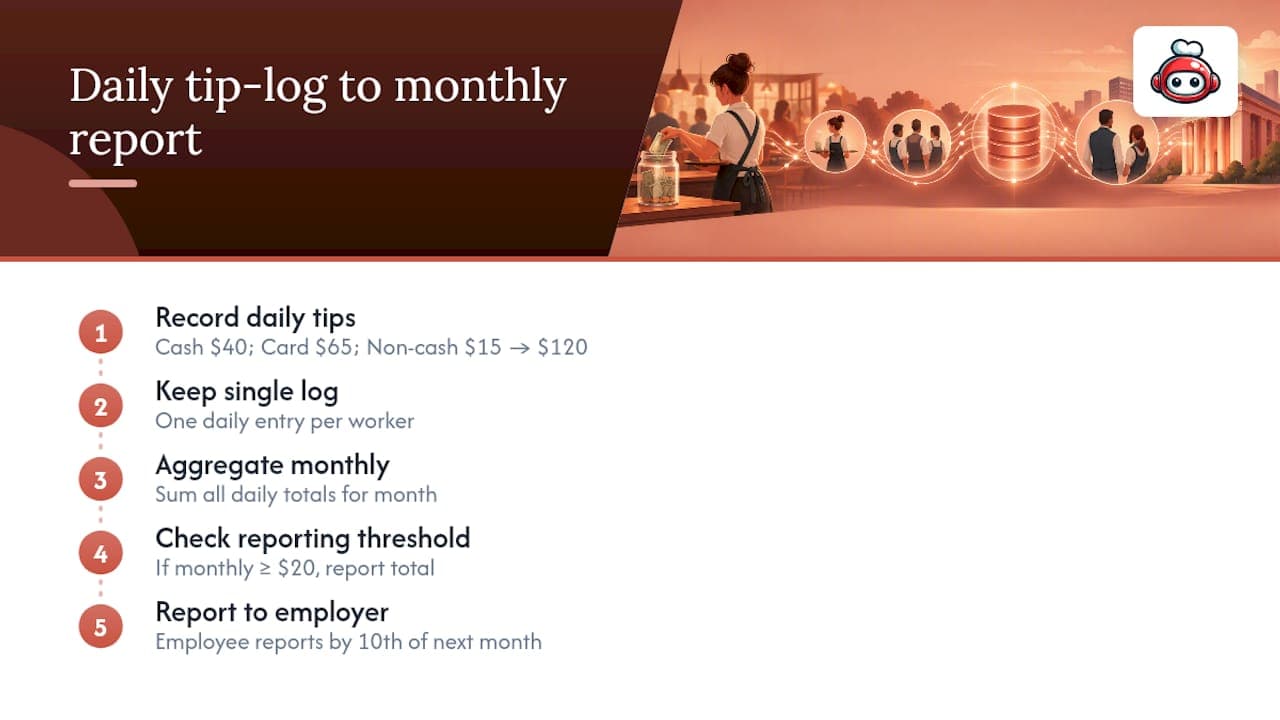
Workers who receive tips directly through an employer-independent tool, the kind of standalone worker profile described above, still owe the same monthly report to any employer they work for, since the reporting obligation follows the worker's total tip income, not the platform that delivered it.
State and local rules layered on top of federal tipping taxes
Federal treatment sets the floor, but state and local tax rules add their own layer, and they vary enough that no single figure applies everywhere. Some states follow the federal qualified-tip deduction concept for state income tax purposes, some do not offer any comparable deduction, and local jurisdictions can impose their own wage and hour rules around tip pooling and service charges that have nothing to do with federal tax treatment at all.
Because these rules differ by state and sometimes by city, the practical approach is to treat federal compliance as the baseline and then check the specific state's department of revenue guidance for how it treats tip income, tip credits against minimum wage, and any state-level deduction tied to the OBBBA framework. A worker or employer operating across state lines should not assume the same tip qualifies the same way in every location.
Local minimum-wage tip credit rules can also affect what counts as a compliant tipping setup independent of tax treatment. A jurisdiction that restricts how much of the minimum wage can be met through tips affects payroll math even before the tax question comes up, so payroll teams juggling multi-location operations need a state-by-state reference rather than a single company-wide policy.
How digital tips change take-home pay and withholding
Digital tips get added to wages for withholding purposes the same way cash tips do, which means an employee's take-home pay reflects Social Security, Medicare, and income tax withholding on the full reported amount, not just the base hourly wage. A worker who reports a strong month in digital tips will see a bigger paycheck, but also a bigger withholding line, since payroll has to fund the employer and employee share of payroll taxes on tips just as it does on regular wages.
The OBBBA deduction changes the year-end tax return, not the paycheck. Because it is a deduction claimed when filing, most workers will not see it reflected in every pay period's withholding, so the mid-year cash flow looks the same as it did before the deduction existed. The difference shows up when the return is filed and qualifying tips reduce taxable income for federal purposes.

Workers who suddenly rely heavily on digital tips should expect withholding to track that income closely and in real time, unlike cash tips that sometimes go underreported. That tighter link is a trade-off: less flexibility to under-report, but a cleaner, more defensible income record for anything from loan applications to unemployment claims, since digital tip totals are already documented rather than reconstructed after the fact.
Why transparent tipping systems protect everyone
Digital tip records make compliance easier the moment a system is configured to capture a real customer choice instead of a default. Operators who treat tips as genuinely voluntary, and who can produce a clean export when payroll or an auditor asks for one, protect their staff's income and reduce their own exposure at the same time. The fix is not complicated: configure the interface correctly, train staff on what counts as a reportable tip, and run reconciliations on a schedule instead of scrambling at tax time.
*— ADMIN*
A tipping tool built around voluntary, documented payments
An online tips feature gives individual hospitality workers a QR-based profile where guests choose their own tip amount, with no commission taken from the payment and no requirement that the worker's employer even use the platform. That setup lines up with the voluntary-payment standard IRS guidance describes, and every tip generates a record a worker or a payroll team can pull later.
Restaurants that want tipping built into a fuller operational stack, alongside ordering, reservations, and loyalty, can compare the LOYALTY, MENU, and FULL plans, while any hospitality worker can look at the online tips page directly to see how the QR profile and reporting work before deciding whether it fits their setup.
This article is general information, not a substitute for advice from a qualified financial advisor. Consult a qualified financial professional about your own circumstances before acting on anything here.
Sources
FAQ
Do you have to pay taxes on digital tips?
Yes, digital tips are taxable income regardless of the payment method, and Social Security and Medicare taxes apply even when a tip qualifies for the OBBBA federal income tax deduction. Report them to your employer if they total $20 or more in a month, following the process in IRS Publication 531.
What is digital tipping?
Digital tipping means a customer leaves a gratuity through an electronic channel, a card terminal, a QR code, or a mobile app, instead of handing over cash. It qualifies for the same tax treatment as cash tips as long as the payment stays voluntary and the customer can choose any amount, including zero.
Are tips still taxable in 2026?
Yes, all tips remain taxable income, and the OBBBA deduction only affects federal income tax on qualifying amounts, not payroll tax withholding. The final IRS regulations list the occupations eligible for the deduction and the conditions that apply.
Is a 10% tip disrespectful?
Tipping etiquette varies by country, region, and service type, and this article does not cover gratuity norms since it deals with tax treatment rather than tipping customs. From a tax standpoint, any amount the customer freely chooses, including a smaller one, is treated the same way as long as it was voluntary.