


Tip pooling is a mandatory arrangement where an employer requires staff to combine and redistribute tips by a set formula. Direct tips, sometimes called tip sharing, stay under the control of the employee who earned them and get shared only if that employee chooses to share them. That single difference triggers two separate legal frameworks: mandatory pools fall under the Fair Labor Standards Act and affect whether you can claim a tip credit, while voluntary direct tips generally stay the employee's property with fewer strings attached.
- Mandatory pools: governed by FLSA rules, can include or exclude back-of-house depending on your tip-credit decision.
- Direct tips: voluntary, employee-owned, minimal employer involvement required.
Pro Tip: *Before you write a single policy line, decide whether you're taking a tip credit at all. That one decision determines almost every other rule you have to follow.*
Key Takeaways
Choosing between tip pooling and direct tips comes down to one decision: whether you take a tip credit, because that single choice determines legal eligibility, payroll structure, and how much control you keep over distribution.
| Point | Details |
|---|---|
| Define your model first | Tip pooling is employer-mandated redistribution; direct tips stay employee-controlled and voluntary. |
| Tip credit drives eligibility | Taking a tip credit limits pools to front-of-house; paying full wage allows back-of-house inclusion. |
| Managers can contribute, never collect | Federal rules bar managers from receiving any pool funds, even occasionally. |
| Document everything | Written formulas, job title lists, and payout timing protect against wage claims and audits. |
| Voluntary direct tipping simplifies compliance | Tools like RESTOBOT's no-commission QR tipping profiles keep gratuities genuinely optional and employee-owned. |
Table of Contents
- Tip Pooling vs Direct Tips: Weighing the Practical Tradeoffs
- What Federal Law Requires for Mandatory Tip Pools
- Is a Mandatory Service Charge the Same as a Tip?
- Who Can Legally Receive Pooled Tips?
- How Do You Set Up a Compliant Tip Pooling Policy?
- Payroll, Tax Reporting, and Common Pitfalls
- Where Direct, No-Commission Tipping Fits the Compliance Picture
- What I'd Tell an Owner Deciding Between the Two
- Try RESTOBOT's Direct Tipping Profiles
- Sources
- FAQ
Tip Pooling vs Direct Tips: Weighing the Practical Tradeoffs
Pooling gives you predictable, evened-out payouts across a shift. A slow Tuesday server and a packed Saturday bartender end up closer in take-home pay, which cuts down on the kind of resentment that festers in a tipped-out kitchen. Direct tips do the opposite: the server who works the best section on the best night keeps what they earn, full stop.
Fairness cuts both ways. If you drop the tip credit and pay full minimum wage, you can fold dishwashers and cooks into the pool, spreading tip income to people who never see a table. Direct tips concentrate money in front-of-house roles that interact with guests, which can widen the pay gap between service and kitchen staff.
- Control: pooling lets management smooth out variance; direct tips leave income variance intact.
- Compliance load: pools require formulas, participant lists, and payroll timing discipline; direct tips require you to prove tips are truly voluntary and reported properly.
- Morale: transparency about the formula matters more than which model you pick.
Neither model is inherently better. A high-turnover casual spot with a big kitchen staff often leans toward pooling with a nontraditional structure. A fine-dining room with senior servers who guard their sections tends to resist pooling outright.
What Federal Law Requires for Mandatory Tip Pools
Under 29 C.F.R. § 531.54, a mandatory tip pool is legal, but the rules around it are specific and unforgiving if you get them wrong. Here's what the federal rulebook actually demands:
- The employer defines the pool. You set eligibility, the formula, and the schedule, but you cannot use it as a slush fund.
- Managers and supervisors cannot receive pool money, even if they occasionally bus tables or run food. DOL Fact Sheet #15 draws this line clearly.
- Managers can be required to contribute their own directly received tips into the pool, but nothing flows back to them from it.
- Distribution must happen by the regular payday for the workweek in which the tips were earned. Holding tips to "true up" the pool later opens you to wage claims.
- Documentation matters. Keep the formula, the eligible job titles, and the actual distribution records. Auditors and plaintiffs' attorneys look here first.
There's no federal ceiling on how much of a tip an employee can be required to pool. You could set a contribution rate at 100% of tips into the pool if your formula redistributes it fairly. But an improperly run pool, one that lets a manager skim, misses paydays, or pools tips from employees who don't customarily receive them, can cost you the tip credit entirely and expose you to back-wage liability across your whole tipped staff, not just one worker.
Is a Mandatory Service Charge the Same as a Tip?
No, and the IRS applies a four-factor test to tell the difference. A payment only counts as a tip if all four hold true:
- The payment is made free from compulsion.
- The customer determines the amount.
- The payment is not dictated by the employer or policy.
- The customer, not the house, generally decides who receives it.
Fail any one of those and the IRS treats it as a service charge, which the FORCS guide on service charges confirms gets classified as regular wages, not tip income.
A mandatory gratuity on parties of a certain size is a service charge, not a tip, because the customer never controlled the amount. That reclassification changes withholding, overtime math, and whether the money can support a tip credit at all.
To preserve tip status on your POS, leave the tip line blank and editable rather than defaulting to a locked percentage. If you run an automatic service charge for large parties, be upfront that it's a service fee, not a gratuity, and route it through payroll as wages.
Who Can Legally Receive Pooled Tips?
This comes down entirely to whether you take a tip credit against minimum wage. Get this wrong and you either owe back wages or leave money on the table.

If you're claiming a tip credit, meaning you pay a reduced cash wage and count tips toward the federal minimum, your pool is traditional and legally restricted. DOL Fact Sheet #15 limits participation to employees who "customarily and regularly receive tips," which in practice means servers, bartenders, bussers, and hosts in most jurisdictions. Cooks and dishwashers cannot legally share in that pool.
If you pay everyone the full minimum wage with no tip credit, you can run a nontraditional pool and legally add back-of-house staff. Plenty of operators discover they're already paying full wage out of habit but still running a front-of-house-only pool, missing a chance to spread income more evenly to the kitchen without any new payroll cost.
- Taking a tip credit? → Traditional pool. Front-of-house only.
- Paying full minimum wage? → Nontraditional pool. Back-of-house eligible.
Pro Tip: *Run the payroll math both ways before you decide. Switching off the tip credit to include the kitchen sounds generous, but it raises your base labor cost. Know the number before you announce the policy.*
How Do You Set Up a Compliant Tip Pooling Policy?
Build the policy in order, not all at once:
- Decide your tip-credit stance first. Everything else depends on it.
- List eligible job titles by name, not vague department labels.
- Choose a distribution method: hours worked, a points system, or a flat percentage split.
- Write the formula down with real numbers, not "fair shares."
- Communicate it in writing and collect signed acknowledgments from every participant.
A hours-based pool might look like this: total pooled tips divided by total hours worked by eligible staff that shift, multiplied by each person's hours. A points-based pool assigns weight by role, say 1.5 points per bartender hour and 1.0 per server hour, then divides the pool by total points.
| Distribution method | How it works |
|---|---|
| Hours-based | Pool total ÷ total eligible hours = rate per hour, paid per person worked |
| Points-based | Roles weighted by point value; pool ÷ total points = value per point |
| Percentage-based | Fixed share assigned per role (e.g., percentages assigned by role) |
Credit-card tips can have processing fees deducted, but only the actual fee charged, never an estimate, and never enough to drop anyone below minimum wage. Distribute pooled tips no later than the regular payday for that workweek. Your handbook should spell out eligible titles, the formula, the payout schedule, and how disputes get resolved.
Payroll, Tax Reporting, and Common Pitfalls
Tips, pooled or direct, get reported through payroll, and employers owe the matching FICA and Medicare share on reported tip income. Service charges are different: they're wages from day one, they factor into the regular rate for overtime calculations, and they don't qualify for the Section 45B FICA tip credit the way genuine tips do.
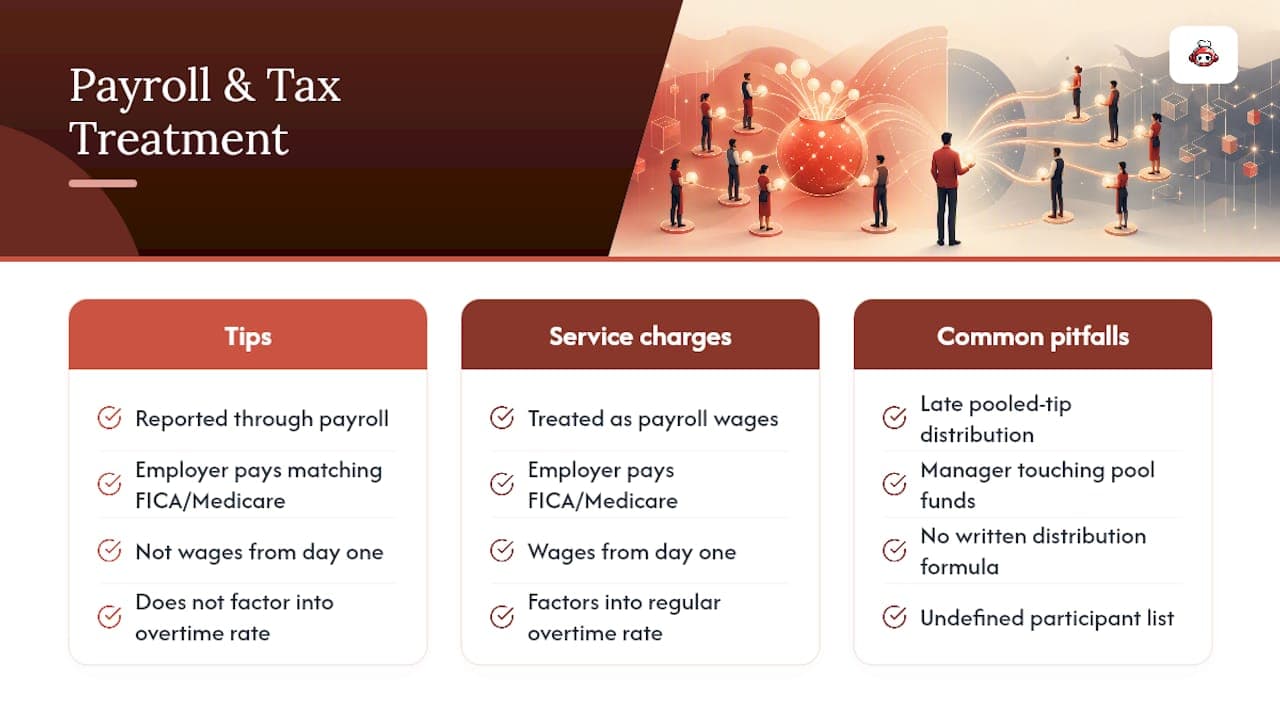
The pitfalls that generate wage claims are almost always the same three: distributing pooled tips late, letting a manager touch pool funds even informally, and skipping documentation of the formula. A written policy with defined participant lists is the single best defense against an audit or a disgruntled former employee's complaint.
Where Direct, No-Commission Tipping Fits the Compliance Picture
A voluntary QR-based tip flow, like the standalone tipping profiles built into RESTOBOT, sidesteps most pooling regulation entirely because nothing about it is mandatory. Guests scan a code, pick their own amount, rate the worker, and the money lands directly in that staff member's account with zero commission taken by the platform.
- Keep the tip prompt genuinely optional. Never convert a QR flow into a disguised mandatory charge.
- Document that the arrangement is voluntary and employee-initiated, not employer-directed.
- Report and treat the income appropriately in payroll regardless of how it's collected.
What I'd Tell an Owner Deciding Between the Two
Run the payroll math before you pick a side. A written policy beats a good instinct every time. If your concept depends on rewarding individual hustle, direct tips fit better. If you need to stabilize kitchen pay, a nontraditional pool usually wins.
Try RESTOBOT's Direct Tipping Profiles
Unlike a pooled system that requires formulas, payroll timing, and constant documentation, RESTOBOT's tipping feature lets each worker, waiter, bartender, or barista, run their own QR-based tip profile with zero commission taken by the platform, keeping the transaction voluntary and the money theirs from the moment a guest taps to pay. It works whether or not their restaurant has any contract with RESTOBOT at all, and it pairs naturally with digital loyalty cards if you want to build repeat business alongside individual tipping. Visit the RESTOBOT landing page to set up a profile or explore how the full platform handles ordering, reservations, and reviews for your restaurant.
Sources
FAQ
Is tip pooling better or worse than direct tips?
Neither is universally better. Pooling evens out income and can include back-of-house staff if you forgo the tip credit; direct tips reward individual performance but concentrate income in front-of-house roles.
Are pooled tips considered qualified tips for tax purposes?
Yes, tips distributed through a valid mandatory pool remain tip income under IRS rules, as long as the underlying payments meet the four-factor test for voluntariness rather than being reclassified as service charges.
What states allow tip pooling?
Tip pooling is legal under federal law nationwide, but several states impose stricter limits on eligible participants or contribution amounts, so check your state labor department's rules before finalizing a policy.
Is tip pooling the same thing as tipping out?
Not exactly. Tipping out is usually a voluntary or informal practice where servers share a portion of tips with support staff like bussers, while tip pooling is a formal, employer-mandated system with defined formulas and legal recordkeeping requirements.
Can RESTOBOT's tipping feature replace a pooling policy?
It can work alongside one. RESTOBOT's direct-tip profiles handle voluntary, individual gratuities with no commission taken, while a separate written pooling policy still governs any mandatory redistribution your restaurant requires.