

Yes, restaurants can eliminate per-order marketplace commissions by moving orders to a first-party website or app, or by subscribing to a fixed-fee platform, and handling delivery through a courier integration or an in-house team. The tradeoff is that you take on control of ordering, payments, and delivery logistics yourself. The fastest path in is to pilot first-party ordering with regular customers or sign up for a zero-commission platform built for restaurants.
***
TL;DR:
>
- Switching to zero-commission ordering can increase profit margins by removing percentage-based fees and keeping full menu prices for direct sales. - A complete system for commission-free orders requires POS integration, secure payments, and delivery routing, with order data supporting customer loyalty efforts. - Launching direct ordering involves choosing a platform, setting up a menu, linking payments, selecting delivery options, and promoting to regular customers first. - Flat subscription plans with customer-paid delivery tend to be the lowest-cost, but success depends on careful management of delivery time and customer loyalty.
***
Table of Contents
- What commission-free delivery actually means
- How commission-free ordering works end to end
- What commission-free delivery actually saves you
- How to launch commission-free ordering, step by step
- Choosing between in-house, courier, and hybrid delivery
- How RESTOBOT handles commission-free ordering and delivery
- Why zero commission only works if you protect the order itself
- Get started with zero commission ordering
- FAQ
- Sources
What commission-free delivery actually means
Marketplace apps take a customer order and route it to you for a cut of the sale, often with delivery and "service" fees layered on top. First-party ordering flips that: the order comes straight to your own website, app, or chat bot, and you keep the full menu price.
Most zero-commission systems charge restaurants one of three ways: a flat monthly subscription, a fixed per-order fee that doesn't scale with order size, or no platform fee at all, with the customer paying delivery costs directly. None of these take a percentage cut of your food revenue.
- You keep a larger share of each sale since there's no percentage commission.
- You own the customer relationship instead of a marketplace owning it.
- You can build loyalty programs and repeat-order incentives directly, something marketplaces rarely let you do well.
How commission-free ordering works end to end
A working system has four moving parts that need to talk to each other.
- Order capture: customers place orders through your website, a branded app, or a messaging bot like Telegram, instead of a third-party marketplace listing.
- POS integration: orders should flow into your point-of-sale system automatically so kitchen staff see one ticket stream, not two separate workflows.
- Payments and tips: payments run through a processor like Stripe, which charges its own standard transaction fee regardless of your delivery model; tips can route separately and directly to staff.
- Fulfillment and routing: once an order is confirmed, it either goes to an in-house driver or gets dispatched to a courier integration, with automatic customer notifications at each stage.
Every order placed this way also captures the customer's contact details and order history, data a marketplace order never gives you. That data is what makes loyalty programs and repeat-order campaigns possible later. Our guide to commission-free online ordering walks through this flow in more detail for owners setting it up for the first time.
What commission-free delivery actually saves you
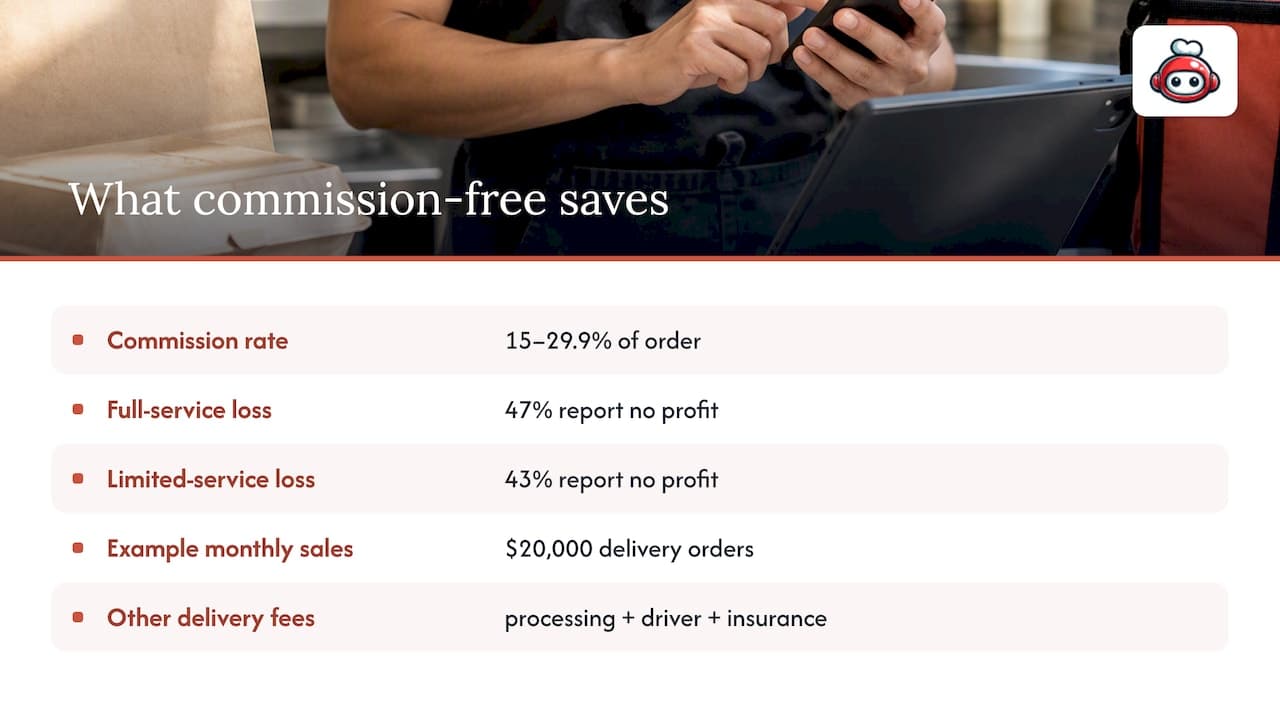
Marketplace commissions commonly run between 15% and 29.9% of the order total, according to National Restaurant Association survey data submitted to the FTC, and about 47% of full-service operators and 43% of limited-service operators say they don't turn a profit on third-party delivery orders at all.
A substantial share of full-service restaurant operators report no profit on third-party delivery orders, per the same National Restaurant Association comments, which underscores why the commission rate alone understates the real cost.
Part of that gap comes from fees stacked on top of the commission. The FTC's complaint against Grubhub describes how "service" and "small order" fees were used to mask the true delivery cost, in some cases more than doubling what a diner saw advertised. Say a restaurant does $20,000 in monthly delivery orders. A fixed monthly subscription replaces that variable cost with a flat fee, but you still owe payment processing charges, driver pay or courier fees, and any delivery insurance, so the comparison has to include those, not just the headline commission rate.
How to launch commission-free ordering, step by step
Moving off marketplace commissions is a sequence, not a single switch.
- Pick your platform. Choose a zero-commission ordering system or build a first-party site, checking for POS compatibility, payment options, and delivery integrations before committing.
- Set up your menu. Load pricing for direct orders, making sure it matches what's in your POS so kitchen tickets stay accurate.
- Connect payments. Link a processor and confirm its fee structure, since this cost doesn't disappear even with zero platform commission.
- Choose your delivery method. Decide between in-house drivers, a courier API integration, or a hybrid of both based on your order volume and service area.
- Turn on tips and loyalty. Enable direct tip collection for staff and set up a loyalty mechanism to reward customers for ordering through your own channel.
- Promote the switch. Use receipts, in-store signage, and loyalty perks to tell regulars that ordering direct is available and worth it.
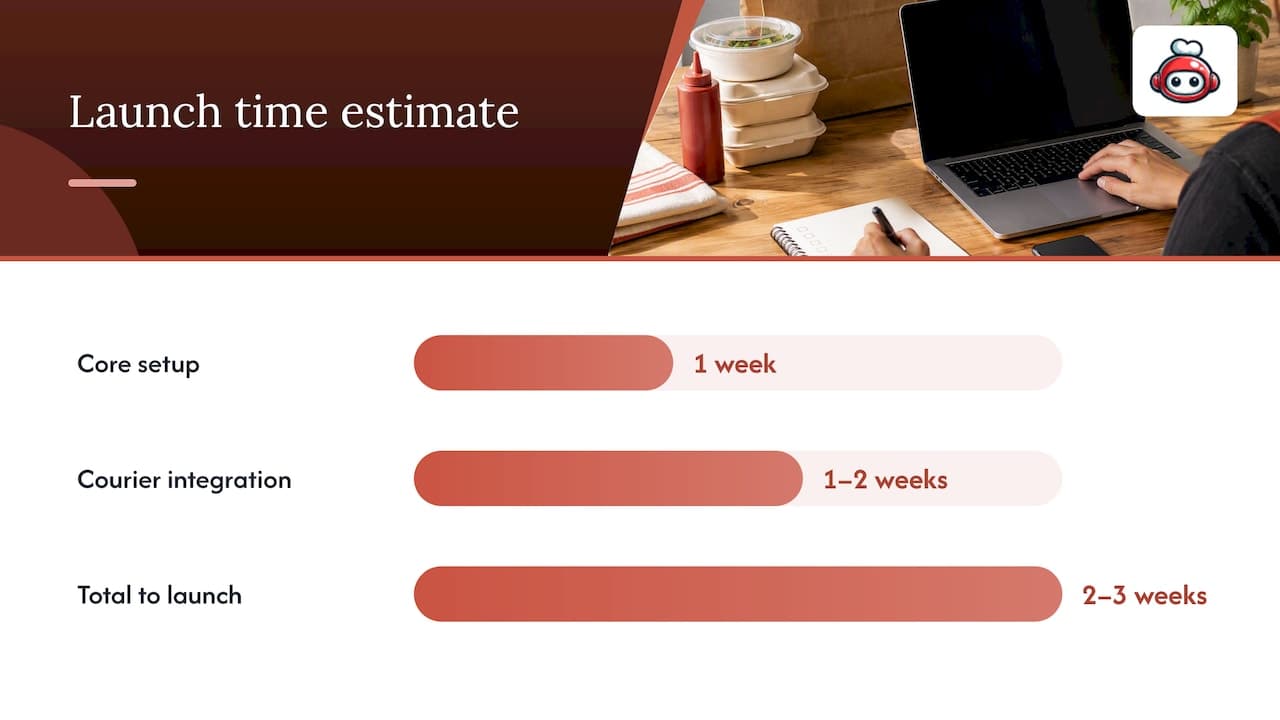
Most restaurants can get the core setup running within a week if the menu and payment accounts are ready in advance; integrating couriers or training staff on a new workflow usually adds another week or two.
Pro Tip: *Start your first-party rollout with your most frequent customers; they're the easiest group to convert and the fastest way to prove the model works before you promote it more broadly.*
Choosing between in-house, courier, and hybrid delivery
Delivery logistics are where most of the operational tradeoffs live.
- In-house drivers give you full control over timing and food handling, but add payroll, scheduling, and insurance overhead you have to manage directly.
- Courier integrations (services like Wolt Drive) remove staffing headaches since the delivery fee is typically paid by the customer, not deducted from your sale.
- Hybrid models use in-house drivers for peak local hours and courier dispatch for overflow or longer distances, which helps capacity without over-hiring.
- Batching and cold food are real risks with third-party couriers serving multiple restaurants at once; the National Restaurant Association's FTC comments point to first-party delivery and negotiated service-level agreements with couriers as ways to protect product quality.
Clear delivery-time windows and courier agreements that specify single-order handling are worth writing into any contract. Our breakdown of delivery management software options covers how these integrations typically get configured.
How RESTOBOT handles commission-free ordering and delivery
We built our platform around the idea that restaurants should keep what they earn. Our system includes:
- An instantly created website and embedded ordering menu, live as soon as an application is approved.
- Omnichannel ordering through a website and a Telegram bot.
- Direct tip routing to individual staff accounts (only standard Stripe processing fees apply).
- Delivery coordination through third-party couriers, where the delivery fee is paid by the customer, not deducted from the restaurant.
- A management dashboard with real-time order control and analytics.
Deployment is typically rapid once an application is confirmed. Owners still manage their own menu pricing, staffing, and customer promotions; we handle the technical setup, hosting, and order routing. More detail on the ordering side is in our commission-free ordering guide.
Why zero commission only works if you protect the order itself
Cutting commissions doesn't automatically improve your margin. If direct orders arrive late or cold because a courier batched them with three other restaurants, you lose the repeat customer you worked to win back from the marketplace.
Start by moving your regulars to direct ordering with a loyalty incentive, since they convert fastest and reward loyalty naturally. Put delivery-time and handling expectations into any courier agreement. Then track two numbers: net margin per direct order and the share of repeat customers ordering direct instead of through a marketplace. If both climb, the switch is working.
*— ADMIN*
Get started with zero commission ordering
We offer three subscription plans built around this exact problem: LOYALTY at €49 per month, MENU at €99 per month, and FULL at €199 per month, all listed on our pricing page. None of them take a cut of your orders.
- A demo typically covers website setup, menu configuration, and delivery integration options for your specific courier needs.
- Most restaurants go live the same day their application is approved.
- Staff can also set up individual tip collection through our tips page, independent of whether their restaurant uses RESTOBOT at all.
Check the pricing page to see which plan fits your order volume, or set up a staff tipping profile on the tips page today.
FAQ
What is the highest paying delivery platform for restaurants?
There's no single "highest paying" platform in absolute terms, since payout depends on your commission rate and order volume rather than a fixed figure. Restaurants generally keep more revenue with first-party ordering or a fixed-fee subscription model than with marketplace apps charging 15% to 29.9% commission.
Which food delivery app doesn't charge delivery fees?
Most major marketplace apps charge some form of delivery or service fee to the customer, and many layer commission charges onto the restaurant as well. Platforms built around first-party ordering, including RESTOBOT, charge the restaurant a flat subscription with no per-order commission instead, with delivery fees handled separately through courier partners like Wolt Drive.
What food delivery option has the least fees overall?
Options that replace marketplace commissions with a flat subscription and customer-paid delivery tend to carry the lowest total cost for restaurants. The FTC's action against Grubhub also found that some marketplace "service" and "small order" fees obscured the real cost diners and restaurants were paying.
Who currently offers free delivery for restaurant orders?
Delivery cost depends on the specific agreement between a restaurant and its courier provider. In setups like RESTOBOT's integration with Wolt Drive, the delivery fee is paid by the customer at checkout rather than deducted from the restaurant's revenue, so the restaurant itself isn't charged for delivery.