

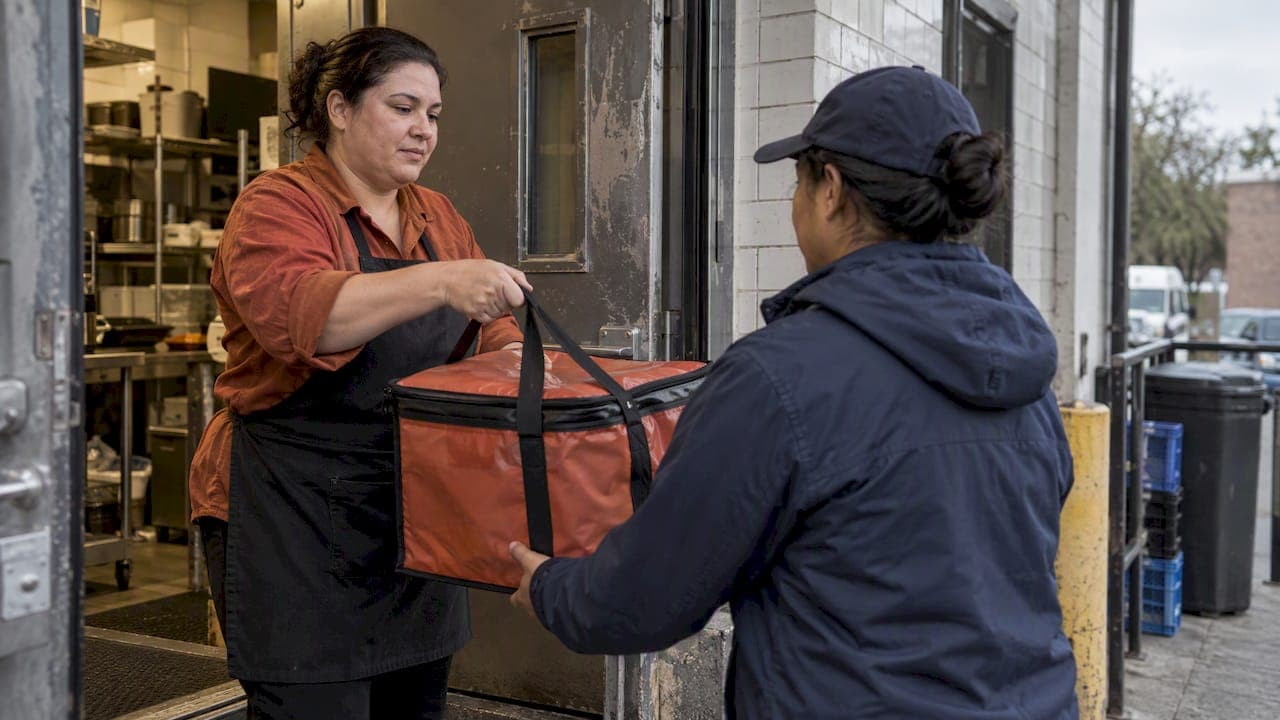
For most restaurants, a hybrid delivery approach, where you keep drivers for your core area and send overflow to a courier partner, delivers the best mix of margin and reach. A fully outsourced model suits low-volume or remote operations better. Either path beats an all-in-house fleet on cost control, coverage, and customer experience, and the right choice depends on your order volume, zone density, and how much control you need over the handoff.
***
TL;DR:
>
- Outsourcing delivery reduces fixed costs and enables rapid expansion but sacrifices direct control over food handling, refunds, and customer communication. - Hybrid models balance control and reach by combining in-house drivers in dense zones with third-party couriers for overflow, especially when supported by delivery management software. - Before committing, calculate the delivery cost per order, average basket size, zone density, and current driver utilization, then pilot in low-density zones for at least four weeks. - Packaging with tamper-evident seals and insulated bags, along with accurate tracking and fixed delivery windows, mitigates risks associated with third-party handling. - Switching to variable courier fees moves delivery costs with volume and influences pricing decisions, often requiring absorb, pass-through, or delivery-only menu adjustments.
***
Table of Contents
- What outsourced delivery and Delivery-as-a-Service actually mean
- Pros and cons of outsourcing delivery
- Delivery models compared: in-house, marketplace, courier, white-label, hybrid
- How to decide: a checklist and questions to ask providers
- Operational checklist: packaging, food safety, and tracking
- Cost and pricing considerations: what shifts in your P&L
- How an integrated platform helps you run outsourced delivery
- Piloting outsourced delivery: what 60 to 90 days should show you
- Get your delivery operation running with RESTOBOT
- FAQ
- Sources
What outsourced delivery and Delivery-as-a-Service actually mean
Outsourced delivery means a third party handles the physical trip from kitchen to door instead of your own payroll drivers. Delivery-as-a-Service (DaaS) is the broader category: you keep your own ordering channel, website, app, or phone line, while a logistics partner plugs in behind it to fulfill the trip. That differs from marketplace ordering (Uber Eats, Deliveroo-style apps), where the platform owns the customer relationship, the data, and often the pricing.
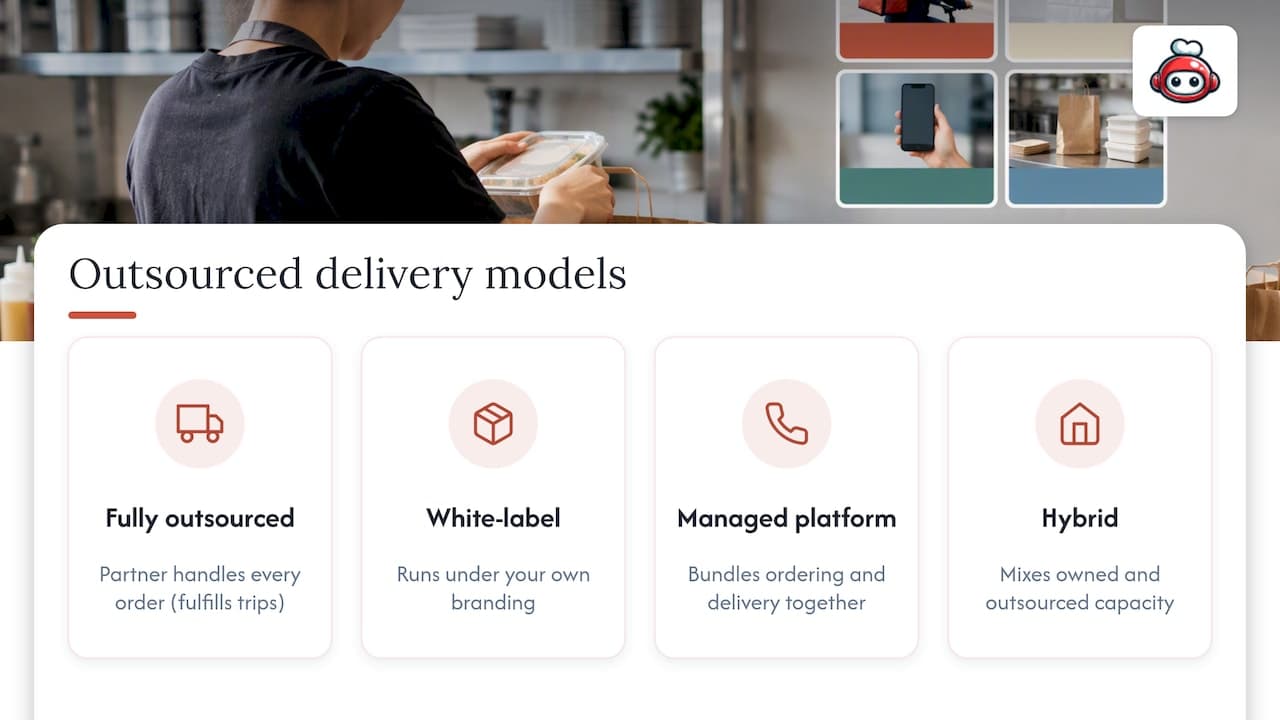
Within outsourced delivery, four common models show up: fully outsourced couriers handling every order, white-label logistics running under your own branding, managed platforms bundling ordering and delivery together, and hybrid setups mixing owned and outsourced capacity. Single-location restaurants with tight delivery radii often pick a courier partner outright. Multi-location or high-volume operators tend toward hybrid, since it protects margin on dense routes while still covering the long tail.
Pros and cons of outsourcing delivery
Handing delivery to a third party removes fixed labor costs: no driver payroll, insurance, or vehicle maintenance sitting on your books whether or not orders come in. Capacity scales with demand, and expanding into new ZIP codes takes a contract change rather than a hiring push.
The trade-offs are real. You lose direct control over how couriers handle food and how refunds get resolved when something goes wrong, and fees can erode margin on lower-ticket orders. Customer communication also gets harder to manage when a third party is the last touchpoint before the door.
- Lower fixed cost: no driver payroll or vehicle overhead to carry during slow periods.
- Faster expansion: new delivery zones open without hiring or fleet purchases.
- Less control: handling, timing, and refund decisions sit partly outside your kitchen.
- Margin pressure: per-order fees can outweigh savings on smaller baskets.
Packaging and customer messaging need extra attention once a stranger, not your own staff, is the person knocking on the door; following tips to elevate restaurant service and boost satisfaction can help maintain quality in takeaway and delivery.
Pro Tip: *Audit your refund and complaint process before signing with any courier partner. Hidden friction there costs more repeat business than the delivery fee itself.*
Delivery models compared: in-house, marketplace, courier, white-label, hybrid
Each model carries a different cost shape and a different answer to the question of who owns your customer data.
- In-house: fixed payroll and vehicle costs, full control, full data ownership, best for dense, high-volume areas.
- Marketplace: commission per order (often near 30% of the order value before fees), customer relationship and data sit with the platform.
- Courier partner: variable per-trip fee, you keep your ordering channel and customer data, delivery cost typically passed to the diner.
- White-label logistics: similar to a courier partner but delivered under your own branding end to end.
- Hybrid: fixed cost for a core fleet plus variable courier fees for overflow, balancing control with reach.
Many operators land on hybrid because it avoids the two failure modes of the all-in approaches: the idle payroll of an oversized in-house fleet on slow nights, and the fee erosion of routing every single order through a marketplace. A hybrid setup with delivery management software unifying both flows gives you one dashboard for routing, ETAs, and refunds instead of two disconnected systems.
How to decide: a checklist and questions to ask providers
Before you sign anything, calculate four numbers: delivery cost per order, average basket size, order density per zone, and current driver utilization if you already run a fleet. These tell you whether outsourcing overflow saves money or just shifts it.
Then bring a short list of questions to any provider:
- What SLA do you guarantee for pickup and delivery time, and what happens when you miss it?
- Are your drivers insured for food transport, and who is liable for a spoiled or damaged order?
- How long does onboarding take, and what systems do you integrate with (POS, ordering platform, kitchen display)?
- Who owns the order and customer data generated through the delivery?
- How do you handle peak-hour surges and refund disputes?
As a decision rule, pilot outsourcing in your lowest-density delivery zone first. If cost per order there beats your in-house average and on-time rate holds above your current benchmark, expand the courier relationship before touching your core zones.
Pro Tip: *Run the pilot for at least four weeks. A single bad weekend will not tell you whether a provider's SLA holds up under real volume.*
Operational checklist: packaging, food safety, and tracking
Packaging is your main defense once a courier who is not your employee is handling the order. Tamper-evident seals, insulated bags for hot items, and separate compartments for items that need to stay cold or crisp all reduce the chance of a bad unboxing experience.
There is no uniform legal standard for how food-safety responsibility is divided between a restaurant and a third-party courier during delivery, according to an Ohio State survey of restaurant practices. That gap means practices vary widely, so temperature-control packaging and a documented handoff at pickup become your practical safeguard rather than an afterthought.
- Seal every bag with a tamper-evident sticker so customers can see it was not opened in transit.
- Use insulated packaging rated for the specific temperature range of the dish.
- Log the handoff time at pickup so you have a record if a complaint arises later.
- Set delivery windows based on real courier data, not optimistic estimates, and notify customers when a trip runs long.
Clear tracking and honest windows matter more than speed alone. Diners are sensitive to inaccurate or late orders, and that sensitivity shapes whether they order from you again, according to reporting on diner delivery expectations.
Cost and pricing considerations: what shifts in your P&L
Outsourcing moves delivery from a fixed cost (driver payroll, vehicle insurance, maintenance) to a variable one (per-trip courier fees). That shift helps during slow seasons, since you are not paying idle drivers, but it means your delivery cost line moves with volume instead of staying flat.
You generally have three ways to handle the fee: absorb it into your margin, pass it directly to the customer as a delivery charge, or build a small premium into delivery-only menu pricing. Say a dish costs $12 on-premise and your courier fee averages $4 per trip. Passing that fee straight through keeps your food margin intact but raises the customer's final price, which can affect order frequency.
- Fixed costs shrink: no driver payroll sitting on the books during slow weeks.
- Variable costs rise: per-trip fees scale directly with order volume.
- Pricing choices multiply: absorb, pass through, or blend into delivery-only pricing.
Run the comparison for at least one full month of your own order volume before locking in a pricing approach.
How an integrated platform helps you run outsourced delivery
Running outsourced delivery well depends on a few things working together: an ordering system that talks to your POS, a delivery-management layer that tracks third-party couriers in real time, and analytics that show you cost per order without manual spreadsheet work. Fragmented tools make this harder than it needs to be.
We built RESTOBOT around that gap. We charge no commission on orders, so delivery fees paid by the customer go to the courier while the food revenue stays with the restaurant. Our platform connects to third-party couriers, deploys a restaurant's ordering site rapidly, and includes a standalone Tips feature so individual staff can collect commission-free tips by QR code regardless of which plan the restaurant is on.
- Connect your ordering channel to a courier integration instead of managing it manually.
- Sync with your POS so orders and inventory stay accurate across channels.
- Check analytics weekly to catch cost-per-order drift before it compounds.
Piloting outsourced delivery: what 60 to 90 days should show you
A good pilot stays narrow: one delivery zone, a trimmed menu that travels well, and a 60 to 90 day window. Track delivery cost per order, on-time rate, refund rate, and whether delivery is bringing in incremental revenue or just cannibalizing dine-in traffic.
Scale once on-time rate holds steady above your internal benchmark for several consecutive weeks. Watch for early red flags: rising refund rates, repeated late pickups, or a courier that cannot explain its own SLA numbers. Those signals show up faster than most operators expect, often within the first three weeks.
*— ADMIN*
Get your delivery operation running with RESTOBOT
We give you the pieces outsourced delivery actually needs in one place: zero-commission ordering, a courier integration for delivery, and a Tips feature your staff can use whether or not your restaurant runs on our platform at all. Setup is rapid once your application is confirmed, and you keep full control of your food revenue and customer data.
Check our pricing plans, LOYALTY, MENU, and FULL, to see which tier fits your delivery volume, or look at how Online Tips works for your team.
FAQ
What is the 30/30/30 rule for restaurants?
This figure is not tied to a verified industry standard we can confirm, and definitions vary depending on who is using it. Rather than repeat an unverified rule, we recommend tracking your own cost-per-order, labor, and food-cost percentages directly against your P&L.
What delivery service do restaurants use?
Restaurants typically choose among marketplace apps, dedicated courier partners like Wolt Drive, white-label logistics services, or a hybrid mix of owned drivers and third-party couriers. The right choice depends on order density, delivery radius, and how much control you need over the customer handoff.
Who are the big three foodservice distributors?
This question concerns food and supply distribution, which is a separate function from delivery logistics, and we do not have a sourced list to confirm specific companies here. If you are evaluating distributors, that research sits outside the scope of a delivery-outsourcing decision.
What are ghost kitchens?
Ghost kitchens are delivery-only kitchen spaces with no dine-in area, built to fulfill online orders exclusively. They let operators test new concepts or expand delivery reach without the overhead of a full storefront.
Is outsourced delivery cheaper than running an in-house fleet?
It often is for lower-volume or spread-out orders, since you avoid fixed payroll and vehicle costs. For dense, high-volume zones, an in-house fleet can be cheaper per order once utilization is high enough, which is why many operators settle on a hybrid approach.