

A restaurant website runs $1,500 to $4,000 for a basic menu-and-contact build, $4,000 to $8,000 once you add reservations, and $8,000 to $25,000 or more for online ordering, custom design, or multi-location setups. Most single-location restaurants should plan a starting budget around $3,000 to $5,000 for the build, plus $50 to $150 a month to keep it running.
Take a single-location bistro adding online ordering and reservations: a $6,500 build plus $100 a month in hosting, ordering fees, and maintenance lands around $7,700 for year one. Stretch that to a 3-year total cost of ownership and you're looking at roughly $10,300, before any redesign.
Three things push a project into a higher tier fast:
- Integrations. Each POS or reservation connection typically adds developer hours on top of the base build.
- Photography and content. Professional photos and written menu copy are frequently underbudgeted, then added later at a premium.
- Accessibility and multilingual needs. WCAG compliance work and a second language both add scope most owners don't anticipate.
A survey of quotes from 60 agencies for the same brief found a median price of $4,800, with integrations, photography, and accessibility explaining most of the spread between low and high bids.
Key Takeaways
Building a realistic restaurant website budget means pricing the full three-year total, not just the sticker price on the initial build.
| Point | Details |
|---|---|
| Know your tier | Basic sites run $1,500 to $4,000; ordering and multi-location builds run $8,000 to $25,000+. |
| Think in 3-year TCO | Monthly subscriptions can total more than a one-time build once you multiply across 36 months. |
| Prioritize photography and ordering | These two line items drive conversion more than custom design flourishes. |
| Budget for integrations separately | POS and reservation connections often become the largest cost after design. |
| Consider an integrated platform | RESTOBOT bundles website, ordering, and reservations under one subscription with 0% order commission. |
Table of Contents
- What Determines Restaurant Website Cost, Line by Line?
- How Much Should a Website Cost for Different Restaurant Types?
- One-Time Costs vs. Ongoing Fees: What Actually Adds Up?
- How Long Does It Take to Launch a Restaurant Website?
- DIY, Builder, Restaurant Platform, or Agency: Which Fits You?
- Where Can You Cut Costs Without Hurting Conversions?
- How RESTOBOT Fits These Budgets
- What 2026 Pricing Data Actually Tells Restaurant Owners
- Ready to Skip the Line-Item Math?
- Sources
- FAQ
What Determines Restaurant Website Cost, Line by Line?
Think of a restaurant website budget the way you'd think of a menu: a base plate, then add-ons that change the final bill. Domain, hosting, and a content management system are your fixed costs. Everything else scales with how much the site needs to do.
Domain names run $10 to $25 a year, and small-site hosting typically falls between $5 and $50 a month depending on whether you're on shared or managed infrastructure. Neither line item looks like much on its own, but cheap hosting is the most common reason a restaurant site loads slowly on mobile during a Friday dinner rush, which is exactly when it matters most.
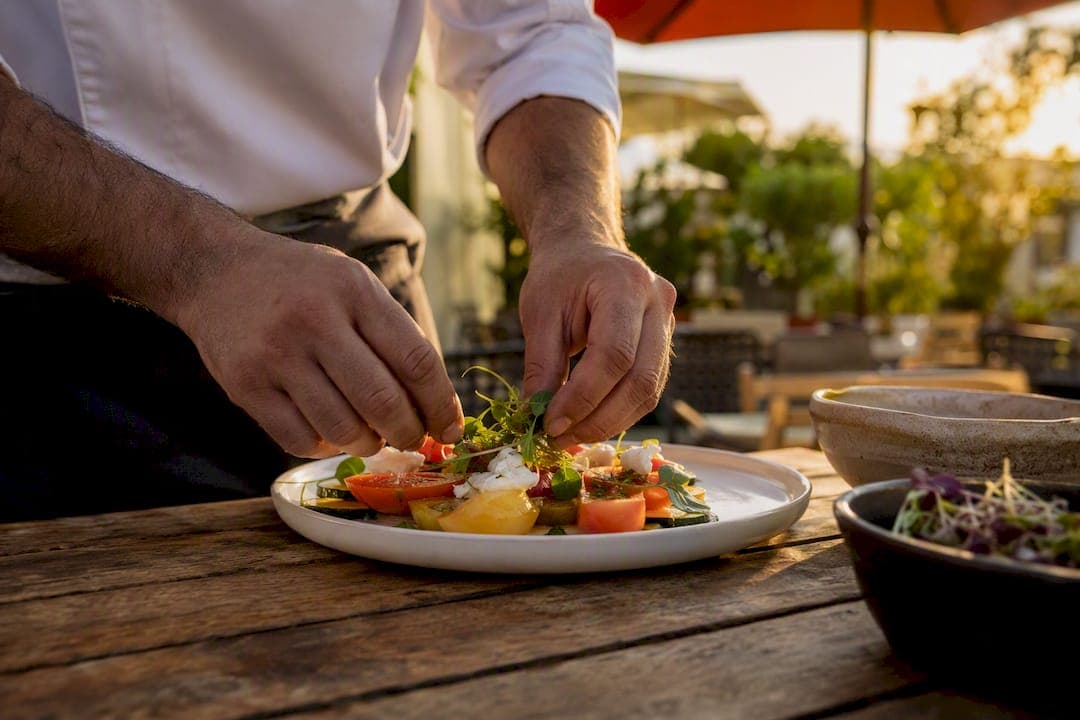
Design is where budgets diverge. A template-based build from a website builder or freelancer costs far less than a custom design built around your brand, but it also looks more like every other restaurant site in your market. Photography sits next to design in importance: professional food photography commonly costs $300 to $3,000 per session and is consistently cited as one of the highest-return investments a restaurant can make on its site, as detailed in this guide to restaurant food photography, because bad photos kill orders faster than bad code.
Copywriting and menu setup often get treated as a free afterthought, then eat hours nobody budgeted. Someone has to write dish descriptions, format the menu for the CMS, and keep it updated when prices or availability change.
Online ordering integration ranges from a simple embedded widget to a fully custom checkout flow tied to your kitchen display system. Reservations follow a similar pattern: a basic booking widget is cheap, while a system that syncs with Google Maps, your POS, and a waitlist gets expensive. POS and payment integration is frequently the single largest cost after design on projects with multiple connected systems, since each integration typically takes 4 to 10 developer hours to wire up correctly.
SEO setup and local listings matter more than most owners expect. Getting your Google Business Profile right and building basic local citations is part of what separates a site that shows up in "restaurants near me" searches from one that doesn't; Moz's research on local ranking factors consistently ranks these signals near the top of what determines local visibility.
Here's how those pieces typically price out:
Pro Tip: *If you can only fund three line items well this year, make them photography, online ordering integration, and fast hosting. Those three touch conversion directly; a fancier logo animation does not.*
How Much Should a Website Cost for Different Restaurant Types?
Your restaurant type should drive your budget tier more than your personal taste in design. A food truck doesn't need reservations. A fine-dining room without online ordering is leaving money on the table if guests want to book ahead but can't.
Basic (menu and contact): $1,500 to $4,000 one-time, plus $30 to $80 a month. This fits food trucks, coffee shops, and single-location spots that take walk-ins and phone orders only. First-year total lands around $2,000 to $4,900; three-year TCO around $2,600 to $6,900.
Mid-range (custom template, reservations, basic ordering): $4,000 to $8,000 one-time, plus $80 to $250 a month. This is the sweet spot for a single-location bistro, a casual sit-down spot, or a wine bar that wants online bookings and simple order-ahead. First-year total: roughly $4,960 to $11,000. Three-year TCO: roughly $6,900 to $17,000.
Advanced (online ordering, POS integration, multi-location): $8,000 to $25,000+ one-time, plus $400 to $1,200 a month. Multi-location groups, fine-dining rooms with complex reservation logic, and restaurants running their own delivery all land here. First-year total can run $12,800 to $39,400; three-year TCO climbs toward $17,600 to $68,000 depending on how many locations you're running.
Agency rates vary meaningfully by region, too. A shop quoting $3,500 for a mid-range build in a lower cost-of-living market might quote $7,000 for the identical scope in a major metro, simply because local developer rates differ. Get quotes from at least two providers if your city skews expensive.
One-Time Costs vs. Ongoing Fees: What Actually Adds Up?
The build fee is the number everyone fixates on, but ongoing costs are what actually decide whether a website was a good deal three years later.
| Cost Type | Category | Typical Range |
|---|---|---|
| Design and build | One-time | $1,500 to $25,000+ |
| Photography | One-time | $300 to $3,000 |
| Hosting | Ongoing (monthly) | $5 to $50 |
| Platform/CMS subscription | Ongoing (monthly) | $0 to $250 |
| Maintenance/support | Ongoing (monthly) | $30 to $300 |
| Online ordering commission (third-party) | Ongoing (per order) | 15% to 30% advertised |
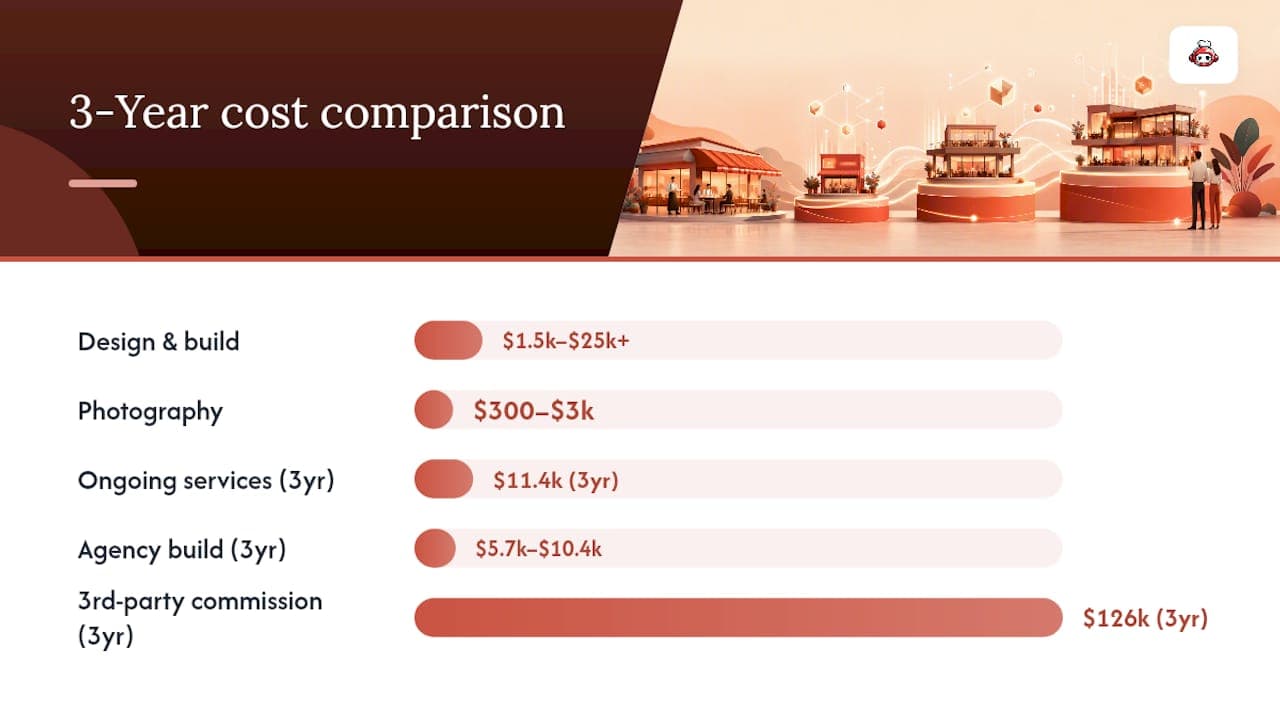
Here's the math that trips people up: a $50-a-month builder subscription looks cheap next to a $6,000 custom build, until you multiply by 36 months and land at $1,800, which starts closing the gap fast. PageDrop's three-year comparisons show builder subscriptions totaling $870 to $1,100 over three years against $5,700 to $10,400 for agency builds of similar scope, so the "cheaper" option isn't always cheaper once you extend the timeline.
Per-order commissions matter even more. Third-party ordering apps advertise 15% to 30% commission, but once service and promotional fees stack on top, the effective cut often reaches 30% to 40% of the order. On $10,000 in monthly third-party orders, that's $3,000 to $4,000 disappearing every month. Rule of thumb: if you're doing meaningful order volume, a one-time investment in owned online ordering usually pays for itself within a year.
How Long Does It Take to Launch a Restaurant Website?
A DIY template build can go live in days to two weeks if your menu and photos are ready. A mid-range freelancer or small-agency build typically takes 4 to 8 weeks. Complex, multi-location, or heavily integrated builds run 8 to 16 weeks or longer.
Expect these milestones regardless of tier: discovery and brief, content and photography collection, design review, integration builds for POS or ordering, testing, launch, then a post-launch tweak period.
The most common delay isn't the developer. It's the restaurant. Late menu content, slow photo delivery, and endless design revision rounds stretch timelines more than any technical hurdle does.
DIY, Builder, Restaurant Platform, or Agency: Which Fits You?
Match the route to your actual needs, not your budget alone.
- Estimate your order and traffic volume. Low volume favors simpler, cheaper routes; high volume justifies integrated ordering and POS connections.
- Decide how much you want to own. Agencies sometimes retain design files or CMS access; confirm ownership terms before signing.
- Assess in-house content capability. If nobody on staff can write copy or manage photo updates, budget for that as a service.
- Check integration needs. Reservations, POS, and delivery all add scope, and a platform built for restaurants handles these natively where a generic builder does not.
- Factor in growth. A single-location build today with plans for a second location next year should start on a platform that scales without a rebuild.
Ask any vendor: How long from signed contract to launch? Who owns the content and code afterward? What's the support response time? Can you show three restaurant builds you've shipped? Is WCAG accessibility included or extra?
Red flags: vague scope documents, no milestone dates, open-ended hourly billing with no cap, and contracts silent on who owns the domain and CMS after launch.
Pro Tip: *A quote that can't tell you the exact deliverables for each dollar is a quote you should ask to see broken down again before signing.*
Where Can You Cut Costs Without Hurting Conversions?
Cut in the wrong place and you'll pay for it in lost orders. Invest in photography and clear menu copy before spending on custom animations or micro-interactions nobody notices. Choose a solid template over a fully custom design if budget is tight, but don't skimp on hosting quality; a slow site loses orders regardless of how it looks.
Cheap wins worth grabbing: a mobile-first template, compressed images, a single obvious call-to-action for ordering or booking, and embedded third-party ordering widgets before building anything custom.
Pro Tip: *Count your own hours. Owners running DIY sites routinely underestimate the staff time spent on updates, and that labor cost belongs in your three-year total.*
How RESTOBOT Fits These Budgets
RESTOBOT builds your restaurant website automatically once your application is approved, no multi-week design phase, no separate invoice for the site itself. That collapses a chunk of the cost breakdown above into a single subscription.
- Instant restaurant website creation with menu, photos, and branding built in from day one
- Online ordering with a 0% commission model, so you keep the margin that third-party apps would otherwise take
- Built-in reservations and POS integration instead of paying separately for each connection
- CRM and analytics to track orders and customers without a third tool
Pro Tip: *If your current quote separates "website," "ordering system," and "POS integration" into three line items, compare that total against one subscription that bundles all three.*
What 2026 Pricing Data Actually Tells Restaurant Owners
The conventional advice tells owners to compare monthly plans side by side. That's the wrong unit of comparison. A $29-a-month plan and a $6,000 custom build aren't competitors until you put them on the same timeline, and three years is long enough to reveal which one actually costs less.
What's overrated: chasing the cheapest possible builder subscription without checking whether it can handle reservations or ordering as you grow, then paying twice to migrate later. What's underrated: photography. It shows up in nearly every cost breakdown as the highest-return single line item, yet it's routinely the first thing cut when a budget gets tight.
If you take one thing from this playbook, take this: price your website decision in three-year totals, not monthly fees, and put photography and ordering integration ahead of design polish. Everything else is negotiable.
Ready to Skip the Line-Item Math?
Every scenario above assumes you're stitching together a builder, a separate ordering tool, and a POS integration from three different vendors. RESTOBOT collapses that into one subscription: your site, menu, ordering, and reservations launch together, automatically, once your application is approved. No separate design invoice, no per-order commission eating into your margin.
For restaurants tired of budgeting five line items just to take an order online, the RESTOBOT restaurant website builder gets you live with ordering and reservations built in from the start. Check out the full platform and see what a launch looks like without the multi-vendor invoice pile.
Sources
- Restaurant Website Cost 2026: What $1.5K vs $25K Actually Buys
- How much does a restaurant website cost in 2026? Real quotes from 60 agencies | Nuxa
- Restaurant Website Cost 2026: Real 3-Year Pricing | PageDrop
- Restaurant Website Cost in 2026: Complete Pricing Breakdown
- The ROI of professional food photography for your restaurant | Snappr
FAQ
Is $1,500 a Good Price for a Restaurant Website?
Yes, for a basic menu-and-contact site with no reservations or online ordering. That figure sits at the low end of the $1,500 to $4,000 typical range for that scope, but expect to pay more once you add booking or ordering features.
What Is a Fair Price for a Restaurant Website?
A fair price depends on scope: $1,500 to $4,000 for menu-only, $4,000 to $8,000 with reservations, and $8,000 to $25,000+ with online ordering or multiple locations. The median across 60 real agency quotes for a mid-scope build landed at $4,800.
What Is the 30/30/30 Rule for Restaurants?
This isn't a standardized industry framework with one agreed definition, so treat any specific version you see online with caution rather than as an authoritative rule.
What Is the 60/40 Restaurant Rule?
Like the 30/30/30 rule, this isn't a formally defined industry standard, and definitions circulating online vary. It's best understood as informal shorthand rather than a fixed benchmark to budget against.
Does RESTOBOT Charge Commission on Online Orders?
No.