

The best restaurant management software for an independent UK restaurant or café that wants more direct orders, bookings and repeat guests is an all-in-one platform with a flat subscription and no commission on orders. RESTOBOT is built that way: website, menu, ordering, reservations, loyalty and reviews in one dashboard, with 0% commission and a site that can go live in a day. Till-first systems such as Square and Lightspeed are strong at the counter, but they start from the payment terminal rather than from the guest relationship.
Table of Contents
- What restaurant management software actually does
- The cost most owners underestimate: marketplace commission
- The main options compared
- How to choose: a short checklist
- Reporting and visibility
- Getting found: ordering is only half of it
- Perspective: why we built it as one system
- Start with the plan that fits your venue
- For hospitality workers: take your tips directly
- FAQ
- Sources
What restaurant management software actually does
The phrase is used loosely. A restaurant operating system, an all-in-one restaurant platform and a POS (point of sale, the till and payment system) overlap, but each starts from a different place.
Most operators already have a till. TouchBistro's 2026 report on Canadian independents found that 95% of operators use a POS system, and that online ordering, kitchen order routing and invoicing were among the most commonly automated tasks. The same survey reports that 48% saw time savings and 47% faster service. It is Canadian data, but the pattern is familiar to UK operators: the till is solved, and the growing work is everything around it.
That gives you two broad categories:
- Till-first systems. They handle payments, tables, kitchen tickets, stock and staff reports, then add online ordering as a module.
- Guest-first platforms. They start from your website, menu, orders, bookings and loyalty, and connect to the till you already use.
A small venue often needs the second kind more urgently, because that is where commission leaks out and where repeat visits are won.
The cost most owners underestimate: marketplace commission
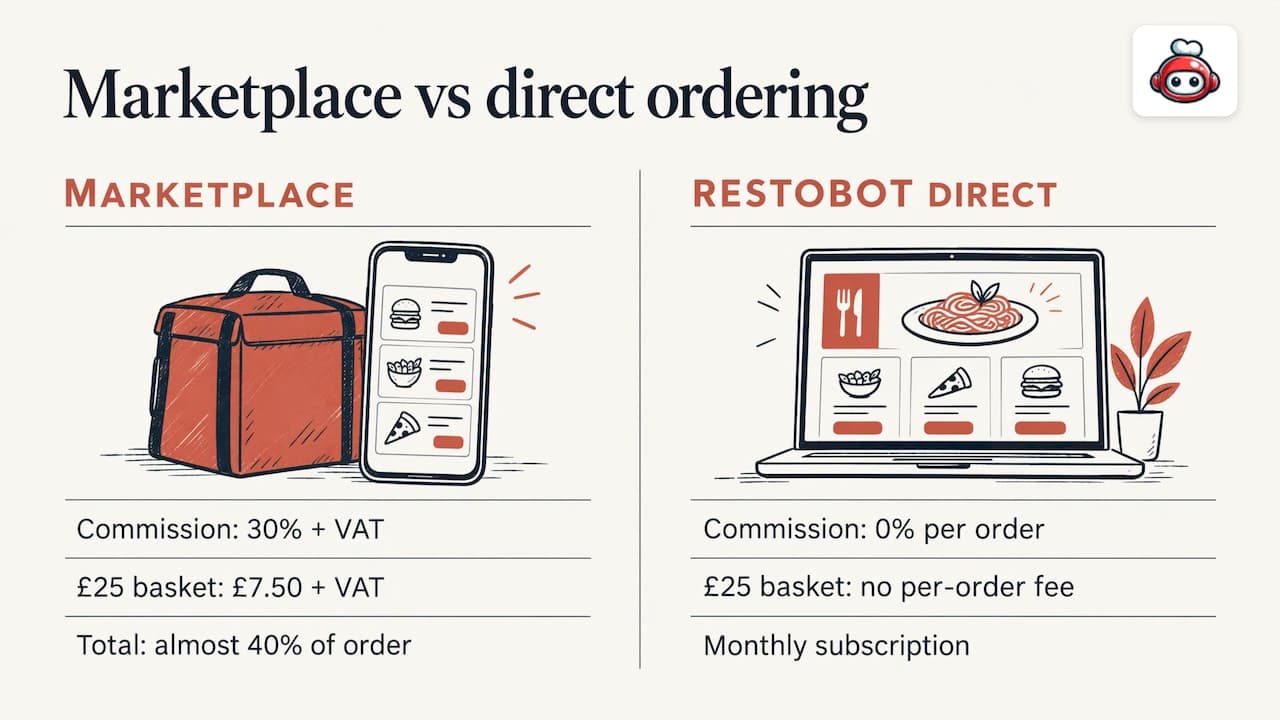
If delivery or collection orders arrive through a marketplace, that channel is likely your most expensive software bill, even though it never appears as a subscription. Uber Eats, Glovo, Bolt Food, Wolt, Just Eat and similar marketplaces charge 30% of the net order value plus VAT, which comes to almost 40% in total.
A worked example. On a £25.00 net basket, a 30% commission is £7.50, and VAT on top of that brings the total to almost 40% of the order. Whatever the food and labour cost of that basket, a large share of the margin is gone before the order is cooked. The same basket ordered on your own website with RESTOBOT carries 0% commission: you pay the monthly subscription and nothing per order.
Two of our guides go deeper on this: commission-free online ordering and how to promote direct ordering.
The main options compared
| RESTOBOT | Square for Restaurants | Lightspeed Restaurant | Toast | |
|---|---|---|---|---|
| Starting point | Website, ordering, reservations, loyalty | Payments and POS | POS and analytics | US restaurant POS |
| Published subscription | €39, €69 or €119 per month (from); annual €29, €59, €99 | Free; Plus from £29 per month in the UK | From £69 to £219 per month in the UK | From $69 per month in the US |
| Commission on direct orders | 0% | Not charged on orders, but card fees apply | Partner-based online ordering | None on direct orders |
| Available in the UK | Yes, serves venues worldwide | Yes | Yes | US only |
Sources for the figures: Square UK fees, Lightspeed UK pricing and the Toast and Lightspeed comparison. RESTOBOT prices are those published on our pricing page.
RESTOBOT: the all-in-one pick for guest-facing operations
RESTOBOT is the one we recommend for a restaurant, café or eatery that wants its own channel for orders, bookings and loyalty. What it includes:
- A customisable website builder with the menu and reservations embedded, and an intuitive design that gets you live fast. Site creation is instant and launch takes one day.
- Omnichannel ordering through the website and a Telegram bot.
- Reservations from the web, Google Maps and Telegram.
- Digital loyalty cards that sit in Apple Wallet and Google Wallet.
- Automated prompts that boost reviews and ratings on Google and TripAdvisor.
- Online payments with several methods, including cryptocurrency.
- Delivery coordination through third-party couriers such as Wolt Drive.
- A management dashboard with real-time order and reservation control, analytics, CRM tools and a manager mobile app.
- POS integrations, and QR pay-at-table with tips.
The plans are tiered. LOYALTY starts from €39 per month, MENU from €69 per month and FULL from €119 per month. Annual billing is listed at €29, €59 and €99 per year for the same three plans. The only charge is the subscription: no commission on orders, so the margin on each direct sale stays with you.
Square for Restaurants
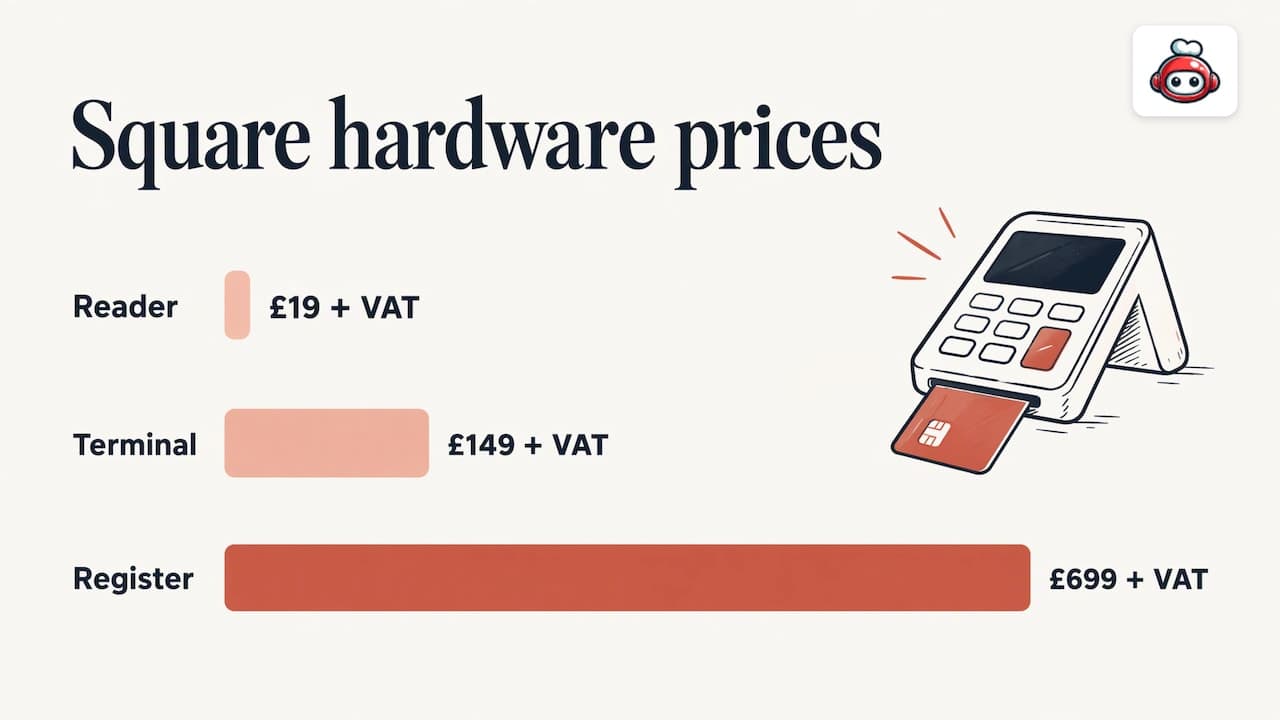
Square suits owners who want one supplier for card payments and the till. In the UK, published rates are 1.75% in person for UK cards and 1.4% plus 25p online, with no monthly fee on the Free plan and Plus from £29 per month. Hardware is bought separately: the Reader is £19 plus VAT, the Terminal £149 plus VAT and the Register £699 plus VAT.
Features step up by tier. In the US, Free covers menu management, pickup and delivery and an online site, Plus adds inventory tracking, loyalty and email marketing, and Premium adds reservation integrations. Check the UK feature split against the UK plan page before you commit, since packaging differs by country.
Lightspeed Restaurant
Lightspeed is known for reporting. A 2026 review credits it with server performance, menu intelligence and labour reports that suit data-driven multi-site groups. UK pricing runs from £69 per month for the basic plan up to £219 per month for multi-location management. The same review says Lightspeed's inventory tracking can deduct exact ingredient amounts per order, for example for cocktails.
Its online ordering often relies on partners, so factor that connection into your cost. Lightspeed relies on partners such as Deliverect for part of that ordering ecosystem.
Toast
Toast is the largest restaurant-specific POS in the US, with built-in direct ordering that carries no commission on direct orders. For a UK reader the limit is geography: the same comparison notes it is US-only and needs its own hardware. It is a useful reference for what "integrated" can mean, not an option for a UK venue.
How to choose: a short checklist
The Restaurant Association's guidance on back-office stacks suggests ranking problems by time, labour cost, food cost, accuracy and visibility, then documenting your current systems and how data moves between them. In practice, for a UK independent:
- Name the leak. Is it commission, empty tables on weekdays, low repeat visits or slow review growth? Pick software that fixes the biggest one first.
- Count the full cost. Add the subscription, card processing, hardware, extra terminals and add-ons over twelve months. Processing fees apply to every order, so model your channel mix. MerchantHQ notes that online and in-person rates cross over at around £71 per transaction in its Square example.
- Check how it joins your till. The Restaurant Association stresses integration with what you already run. RESTOBOT offers POS integrations; our guide to restaurant POS integrations explains how direct orders reach the kitchen.
- Look at the guest journey. Can a guest find you on Google Maps, book, order, pay and collect a loyalty stamp without downloading an app? Wallet-based cards remove the app barrier. See website versus app ordering.
- Plan for delivery. If you deliver, decide how couriers are dispatched. Our guides to delivery management software and third-party delivery integration show how a courier network such as Wolt Drive fits alongside your own ordering.
- Plan for more than one site. If you will add venues, read how multi-location ordering is set up.
Reporting and visibility
Whichever system you choose, you want to know where orders come from and what each channel earns. RESTOBOT's dashboard shows orders and reservations in real time, with dynamic analytics. If you also want to measure how website visitors become orders, analytics and tracking setup helps connect your website traffic data to those results.
AI is also entering back-office work. Restaurant365's 2026 mid-year report, covering 420+ US operators, found that 62% had implemented or planned AI in at least one back-office function, with adopters reporting lower food and labour costs. The sensible move is a platform with clean data in one place, because that is what any later automation will run on.
Getting found: ordering is only half of it
A direct ordering page earns nothing if guests do not reach it. Pair your platform with local search work: your Google Business Profile, menu pages and reviews. A tool built for restaurant SEO services can help your site appear for local searches, and RESTOBOT's review boosting and Google Maps reservations support the same goal from the platform side.
Perspective: why we built it as one system
We see restaurant software the way an owner pays for it. A till is a tool you use for service, but a marketplace is a tax on every order, and it is the biggest one most small venues pay.
That is why we put the website, the menu, ordering, bookings, loyalty cards and review prompts in one place and charge a flat subscription. A guest who orders on your own page is your guest: you hold the relationship, the order data and the whole margin. Our commission is 0%, against 30% of the net order value plus VAT, almost 40% in total, on the marketplaces.
The same thinking applies to your team. Waiters, bartenders and baristas can build a rating tied to them personally, and receive tips directly through a QR code, with no platform commission. It is available on all plans, and a worker can register alone even if the venue is not on RESTOBOT.
Choose software that makes the direct relationship with your guest stronger. Everything else is a feature.
the author
Start with the plan that fits your venue
If you want a site, an embedded menu and direct orders live quickly, the MENU plan starts from €69 per month. If you want ordering, reservations, loyalty and reviews together, FULL starts from €119 per month. LOYALTY, from €39 per month, is for venues that only want digital loyalty cards. Compare them on our pricing page.
For hospitality workers: take your tips directly
If you are a waiter, bartender or barista, RESTOBOT Tips gives you a personal profile and a QR code. Guests rate you, leave a comment and choose an amount. The money goes to your own account with no commission from the platform, and you set the payout schedule in the payment provider. Your profile and rating are public and stay with you, whether or not your employer uses RESTOBOT. Taxes on tips are the worker's own responsibility.
FAQ
What is the best restaurant management software for a small UK restaurant?
For a small restaurant that wants direct orders, bookings and loyalty, an all-in-one platform with a flat fee is the best fit, and RESTOBOT is designed for that job. It starts from €39 per month and charges no commission on orders. Add a till-based system only if you need heavy stock or staff reporting on the floor.
What is a restaurant operating system?
It is a single platform that joins the parts of running a venue: ordering, menu, bookings, payments, loyalty, reporting and staff tools. The aim is one set of guest and order data rather than several disconnected apps. RESTOBOT takes this approach for the guest-facing side of the business.
Do I need a POS as well as an online ordering platform?
Most venues already have a till, and 95% of operators in TouchBistro's Canadian survey use a POS system. RESTOBOT offers POS integrations, so direct orders can reach your existing workflow rather than replace it.
How fast can I go live?
Site creation with RESTOBOT is instant and launch takes one day. Menu and reservation functions are embedded in the site you build.
Sources
- Restaurants Post Strong Margins in Uneven Recovery: TouchBistro's 2026 Canadian State of Restaurants Report
- Square for Restaurants Review 2026: Features and Pricing (NerdWallet)
- Square fees UK 2026: every published rate explained (MerchantHQ)
- Lightspeed Restaurant POS Review 2026 (RestaurantLaunchpad)
- Best Point of Sale Systems for UK Restaurants in 2026 (Wise)
- Toast POS vs Lightspeed Restaurant (2026) (Velocity AI Insights)
- How to Build Your Restaurant Back Office Software Stack (Restaurant Association)
- Restaurant365 flags emerging AI-driven profitability gap (TipRanks)