

The best restaurant website builder depends on what the site must do. Wix suits most restaurants wanting a general-purpose builder, and Squarespace suits design-led venues. If your priority is taking orders and bookings without paying a cut, an all-in-one restaurant platform such as RESTOBOT is built for that job. Below we compare the main options, say who each one fits, and give you a checklist to choose with.
Table of Contents
What a restaurant website actually has to do
A restaurant site is not a brochure. A hungry guest on a phone wants four things within a few seconds: the menu, opening hours, a way to book, and a way to order. If any of those is buried in a PDF or a slow page, they go back to Google Maps or a delivery app.
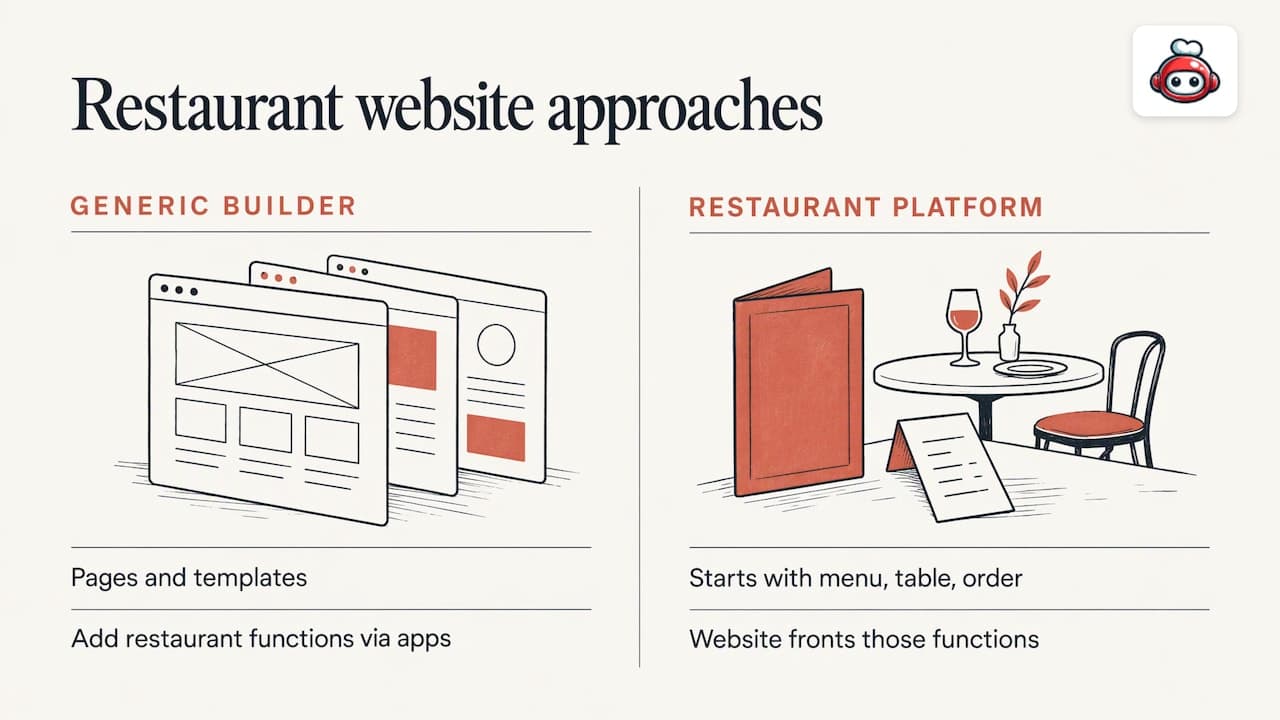
That is why generic builders and restaurant-specific platforms behave so differently. A generic builder gives you pages and templates, and you add the restaurant functions yourself, often through apps. A restaurant platform starts from the menu, the table and the order, and the website is the front door to them.
If you are still deciding how much to spend, our breakdown of restaurant website costs shows realistic budgets. For the pages and layout that convert, see our website best practices for owners.
The best restaurant website builders compared
Two professional review sites, ExpertMarket and FitSmallBusiness, have tested the field. They disagree on the winner, which tells you something: the right choice depends on the kind of venue. Here is how the main options line up.
| Builder | Best for | Restaurant-specific strength |
|---|---|---|
| Wix | Most restaurants | Wix Restaurants for menus, reservations and ordering |
| Squarespace | Concept and upscale venues | Sleek, high-end design |
| GoDaddy | Fast, easy setup | Integrated marketing tools |
| Hostinger | Pop-ups and small food vendors | Simplicity |
| Shopify | Fully online ghost kitchens | Online selling |
| Weebly | Overall pick in FitSmallBusiness's ranking | Easy to use |
| GloriaFood | Dedicated restaurant sites | Built for restaurants |
| Duda | Local SEO | Local search features |
| RESTOBOT | Restaurants wanting orders, bookings and loyalty with no commission | All-in-one platform, live within a day |
The first eight rows come from the two reviews above. The detail behind each follows.
Wix
ExpertMarket names Wix the best overall for restaurants and food delivery, citing its AI features, its own Wix Restaurants system, in-house ordering and a free-forever plan. FitSmallBusiness likewise picks it for the most robust restaurant features.
If you go this route, remember that a beautiful site still needs to be found. Automating the search side is possible with tools such as Wix SEO automation, which covers keyword planning, publishing and technical audits for Wix sites. For the basics that matter most to local restaurants, start with our guide to fixing your Google Business Profile and menu pages.
Squarespace
ExpertMarket recommends Squarespace when a restaurant wants a highly unique website with premium design flourishes, and FitSmallBusiness chooses it for sleek design. It suits a tasting-menu room or a destination venue where the brand look is part of the product.
GoDaddy and Hostinger
ExpertMarket rates GoDaddy best for quick and easy setup and Hostinger best for pop-ups and smaller food vendors. FitSmallBusiness calls Hostinger the easiest and credits GoDaddy with good integrated marketing tools. They are a sensible choice if you need a simple presence online and little else.
Shopify, Weebly, GloriaFood, Duda and Bluehost
Shopify is ExpertMarket's choice for fully online ghost kitchens. FitSmallBusiness ranks Weebly first overall, GloriaFood as the best dedicated restaurant site builder, Duda for local SEO and Bluehost for restaurants building on WordPress. If you run a delivery-only brand, our piece on ghost kitchen ordering explains why testing direct orders first protects your margin.
RESTOBOT
RESTOBOT is a platform for restaurants and foodservice businesses rather than a general builder. You get a customisable website with the menu and reservations embedded, ordering through your website and a Telegram bot, delivery coordination with third-party couriers such as Wolt Drive, digital loyalty cards for Apple Wallet and Google Wallet, automated review boosting for Google and TripAdvisor, and a dashboard and manager app for real-time control. Our approach is built for intuitiveness and quick launch: instant site creation and a one-day go-live.
Why commission matters more than the template
Most owners compare templates first and fees last. It should be the other way round. Uber Eats, Glovo, Bolt Food, Wolt, Just Eat, Pyszne and similar marketplaces charge 30% of the net order value plus VAT, almost 40% in total. On a £20 net order, that is £6 plus VAT gone before you have paid for ingredients or staff.
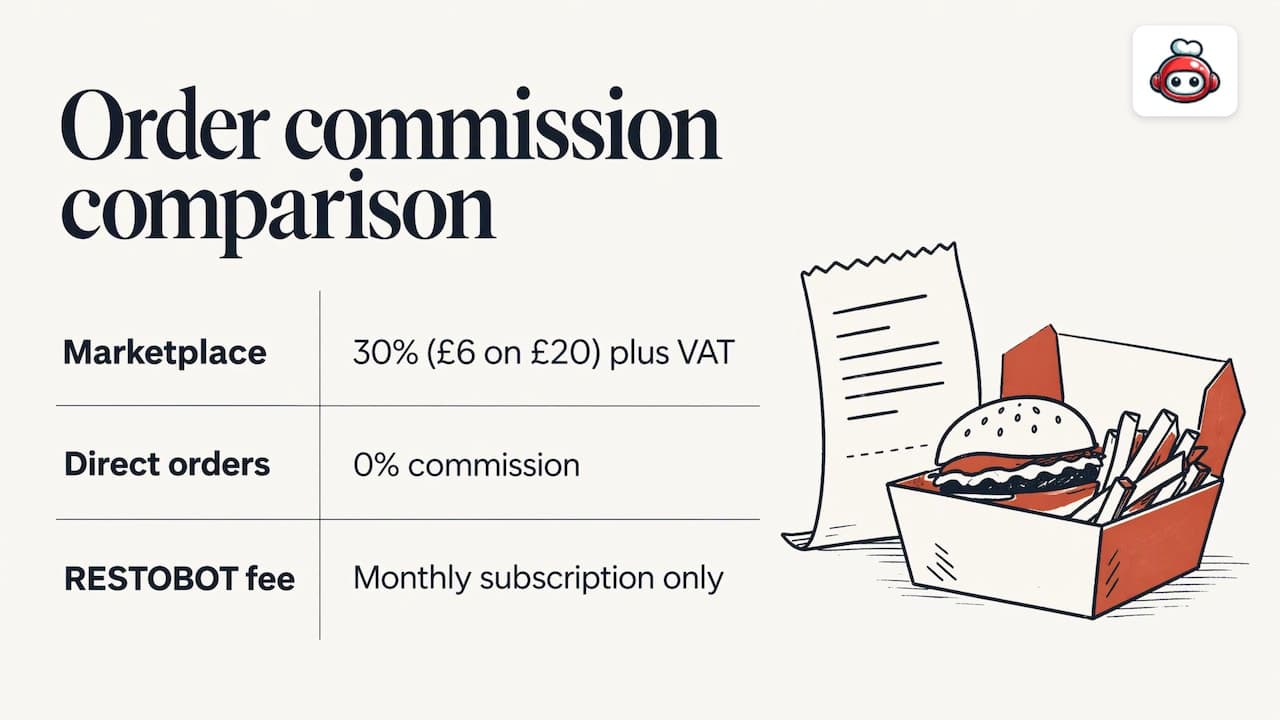
A website that takes orders directly changes that sum. RESTOBOT charges only a monthly subscription, and its commission on orders is 0%. The marketplace is still useful for being discovered, but a good website lets you steer repeat customers to your own channel. Our guide to restaurant POS integrations compares the 30% plus VAT model with 0% direct orders in more detail.
How to choose: a checklist
Work through these in order. They map to the questions owners ask most.
- Can you launch it yourself? Every builder here is aimed at non-developers. Judge by how many steps stand between sign-up and a live menu. Ours is designed to go live within a day.
- Menu tools. Look for a menu you edit in a dashboard, not a PDF upload. You should be able to change a price or hide a sold-out dish from your phone. Our guide to online menu optimisation shows what to put on it.
- Reservations. Check whether bookings are built in or need a separate app. Our practical guide to online reservations covers the set-up.
- Ordering and delivery. Ask how orders reach the kitchen, how couriers are booked, and what fee applies per order. See our overview of delivery management software.
- Payments. Look at which methods guests can use at the checkout.
- Loyalty and reviews. A wallet loyalty card and automated review requests bring guests back and lift your Google rating.
- Total monthly cost. Add the plan, any apps you need to bolt on and any per-order fee. A cheap plan with paid add-ons can cost more than an all-in-one plan.
Which one should you pick?
- A destination restaurant where the look is everything: Squarespace.
- A general restaurant that wants a flexible, popular builder: Wix.
- A pop-up, food truck or very small vendor: Hostinger or GoDaddy.
- A delivery-only brand selling nationally: Shopify is the review pick; if you want direct orders without commission, RESTOBOT is built for this.
- A café, bar or restaurant that wants site, orders, bookings, loyalty and reviews in one subscription: RESTOBOT.
Perspective
We built RESTOBOT because a restaurant website that cannot take an order or a booking is a menu on the wall. Owners tell us the same thing: they do not want another tool to stitch together, they want guests to order directly and keep the money.
That is why we put the website, the menu, ordering, reservations, loyalty cards and review requests on one platform, and why we charge a subscription rather than a share of your sales. When a marketplace takes 30% of the net plus VAT, the website is not a nice extra, it is where your margin is decided.
We also think a site should be live in a day, not a quarter. Instant site creation and a one-day launch are how we design it, so your first direct order does not wait on a design project.
the author
RESTOBOT plans and pricing
RESTOBOT has three plans. Prices are published on our pricing page:
| Plan | Monthly | Annual |
|---|---|---|
| LOYALTY | from €39 per month | €29 per year |
| MENU | from €69 per month | €59 per year |
| FULL | from €119 per month | €99 per year |
There is no commission on orders on any plan. If you want the site, ordering and bookings together, look at the MENU and FULL plans on the pricing page or start from the RESTOBOT homepage.
A bonus for your team: online tips
All plans include online tips for your staff. Each waiter, bartender or barista gets a personal profile and a QR code, and guests can rate them, comment and choose an amount. The money goes straight to the worker's own account with no commission from the platform, and the worker sets the payout schedule in the payment provider. A worker can also register alone, even if the venue is not on RESTOBOT. As for taxes on tips, they are the worker's own responsibility.
FAQ
What is the best website builder for a restaurant?
For a general-purpose builder, reviewers most often name Wix, as ExpertMarket does. If you want ordering, bookings, loyalty and reviews in one subscription with no commission on orders, RESTOBOT is designed for that.
Can I build a restaurant website myself?
Yes. Modern builders use templates and dashboards, so no coding is needed. With RESTOBOT, instant site creation and a one-day launch are the aim, and you edit your menu from the dashboard.
Do restaurant website builders charge commission on orders?
It varies by product, so check the per-order fee before you commit. Delivery marketplaces charge 30% of the net order value plus VAT, almost 40% in total. RESTOBOT's commission is 0% and you pay only the monthly subscription.
How much does a restaurant website builder cost?
RESTOBOT plans start at €39 per month for LOYALTY, €69 for MENU and €119 for FULL, with annual prices of €29, €59 and €99 per year. For a wider look at budgets, see our restaurant website cost guide.
Can I launch a restaurant website quickly?
Yes. Our launch plan for a restaurant website walks through the steps. RESTOBOT is designed for instant site creation and a one-day launch.