


The right Yext alternative depends on how many locations you run. Multi-location brands that need listings syndicated at scale should look at Uberall, Birdeye, BrightLocal, Moz Local or Synup. A restaurant that mainly wants to be found, booked and ordered from can often get more from a restaurant-specific platform such as Marqii, or from an all-in-one tool like ours, RESTOBOT, which puts your own website, menu, reservations, reviews and loyalty under one login.
This guide compares the options with the prices their publishers or reviewers have put in writing, then covers what to do before you cancel.
Table of Contents
What Yext does, and why restaurants look elsewhere
Yext describes itself as an enterprise marketing platform. Its investor page says thousands of brands use it to manage visibility at scale, in sectors including retail, healthcare, hospitality and food. In practice that means one dashboard that pushes your name, address, opening hours and menu links out to directories, maps and search destinations.
Three things push restaurant owners to look elsewhere:
- Fit. One professional review calls Yext a platform for multi-location brands, franchises and regulated industries, not single-location owners.
- Price opacity. A restaurant-industry blog reports that Yext removed public pricing in 2026 and now routes enquiries through demo and contact flows. You cannot compare a quote you have not received.
- Restaurant-specific needs. Menus change weekly, delivery apps carry their own copies of them, and guests book tables and order from several places at once. A generic listings tool treats all of that as a single data field.
The main Yext alternatives side by side
Prices below are as published or reported in 2026 and are mostly in US dollars, because the vendors price that way. Check each vendor's own page for the current figure before you decide.
| Option | Best for | Reported pricing | Notes |
|---|---|---|---|
| Marqii | Restaurants of any size | $90 per location per month (Base), $145 (Pro), annual contracts, July 2026 | POS-native menu sync, delivery app links |
| Moz Local | Small chains in the US, UK and Canada | $199 per location per year (Lite), $399 (Elite) | Pushes data to 90+ directories, three countries only |
| BrightLocal | Local SEO plus citations | Platform from $31 per month; Manage $40 per month annually for one location | Review monitoring on the Grow tier at $65 per month |
| Synup | Agencies and multi-location | Listings Pro add-on, $35 per location per month | Agency workflows |
| Uberall | Larger franchises | Custom pricing, 25-location minimum | Sales-led |
| Birdeye | Reviews plus listings | Custom quote | Strong reputation tooling |
| RESTOBOT | Restaurants that want an owned website, ordering, reservations and reviews | From €69 per month (MENU), from €119 per month (FULL) | 0% commission, launch in a day |
The table shows the main divide. Most tools in it manage where your information appears. A few go further and manage how guests actually reach you.
Listings-first alternatives for multi-location brands
Uberall and Birdeye
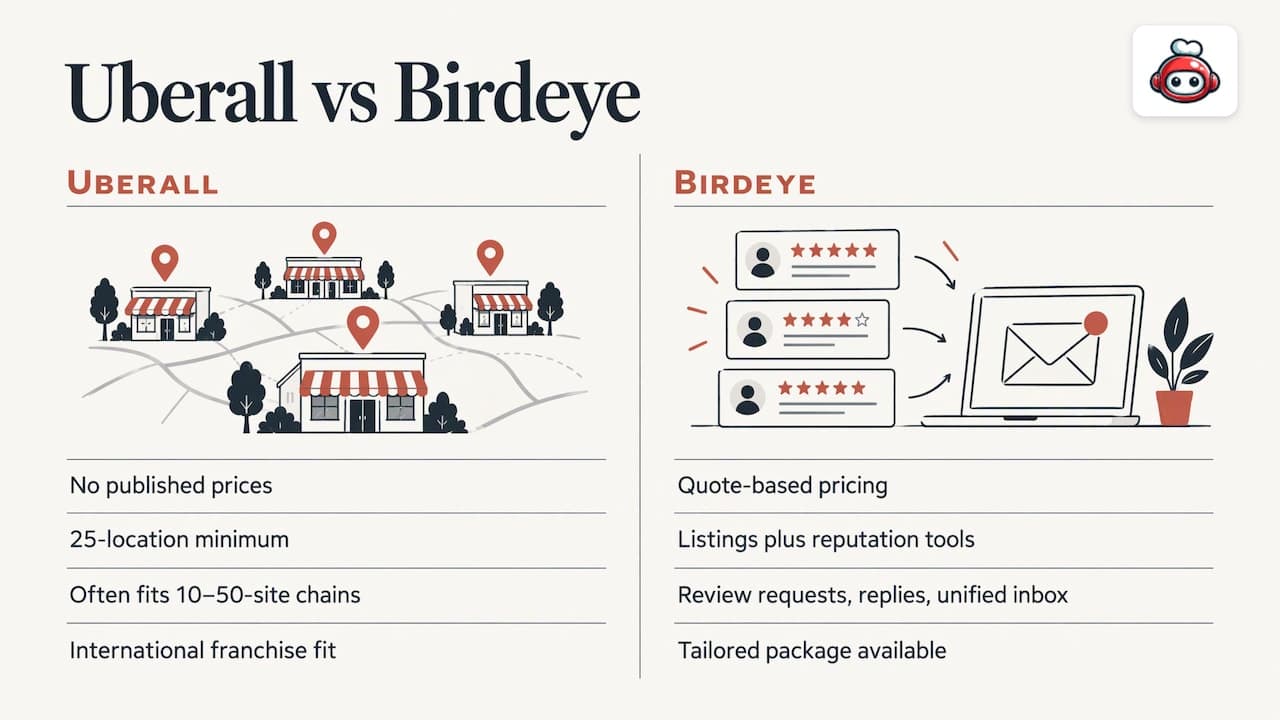
Uberall is the usual name for larger restaurant groups. One review of its pricing says it has no published prices and a 25-location minimum, so it suits operators with a real footprint. A restaurant-finance blog suggests that for chains of 10 to 50 sites Uberall is often a better fit for international franchises, and that Yext only makes sense where brand search volume is very high (Restaurant Bottom Line). That is one blogger's view, but it matches how these tools are sold.
Birdeye joins listings with reputation tools: review requests, replies and a unified inbox. Its pricing is quote-based, which is not automatically a drawback for a group that wants a tailored package. It does mean a small operator cannot compare it with a simple review tool until a written proposal arrives (Small Business AI Review).
BrightLocal and Moz Local
BrightLocal combines rank tracking, citation building and review monitoring. Its Citation Builder covers 20 countries, and review monitoring and replies arrive on the Grow tier at $65 per month, while Track costs $41 per month (SocialPilot's comparison).
Moz Local is the one to consider if you are UK based. It covers the United States, United Kingdom and Canada only, pushes data to 90+ directories, and charges per location per year, so the cost is easy to forecast for a small group of sites (SocialPilot's comparison).
Synup
Synup is aimed at agencies and multi-location businesses that want listings, local SEO and review management in one workflow. The Listings Pro add-on is $35 per location per month.
Restaurant-specific alternatives
Marqii
Marqii is built for restaurants. Its main difference is POS-native menu synchronisation: change a price or dish in a system such as Toast or Square and the update flows to listings and delivery apps. For restaurants whose pain is out-of-date menus across Google and delivery apps, that is the feature that matters. As of July 2026 it was reported at $90 per location per month for Base and $145 for Pro on annual contracts.
If stale menus are your problem, read our guide to stopping menu drift with POS menu sync first. It shows where the copies of your menu live and who should own each one.
RESTOBOT
We approach the problem from the other end. Instead of pushing your details to as many third-party destinations as possible, we help you build the channels you own, so that every search lands somewhere you control. With RESTOBOT you get:
- A customisable website with the menu and reservations built in.
- Online ordering through the website and a Telegram bot.
- Reservations from the website, Google Maps and Telegram.
- Automated review boosting for Google and TripAdvisor.
- Digital loyalty cards for Apple Wallet and Google Wallet.
- Delivery coordination through third-party couriers such as Wolt Drive.
- A management dashboard, a manager mobile app and POS integrations.
We offer instant site creation and a one-day launch. Pricing is a subscription only: MENU from €69 per month or €59 per year, FULL from €119 per month or €99 per year, and LOYALTY from €39 per month or €29 per year. Prices are as published on our pricing page. There is no commission on orders.
That last point is worth putting in numbers. Uber Eats, Glovo, Bolt Food, Wolt, Just Eat, Pyszne and similar marketplaces charge 30% of the net order value plus VAT, almost 40% in total. Every order that moves to your own website or Telegram bot keeps that margin with you. Our guide to restaurant POS integrations and the cost of marketplace orders works through the arithmetic.
How to choose: five questions
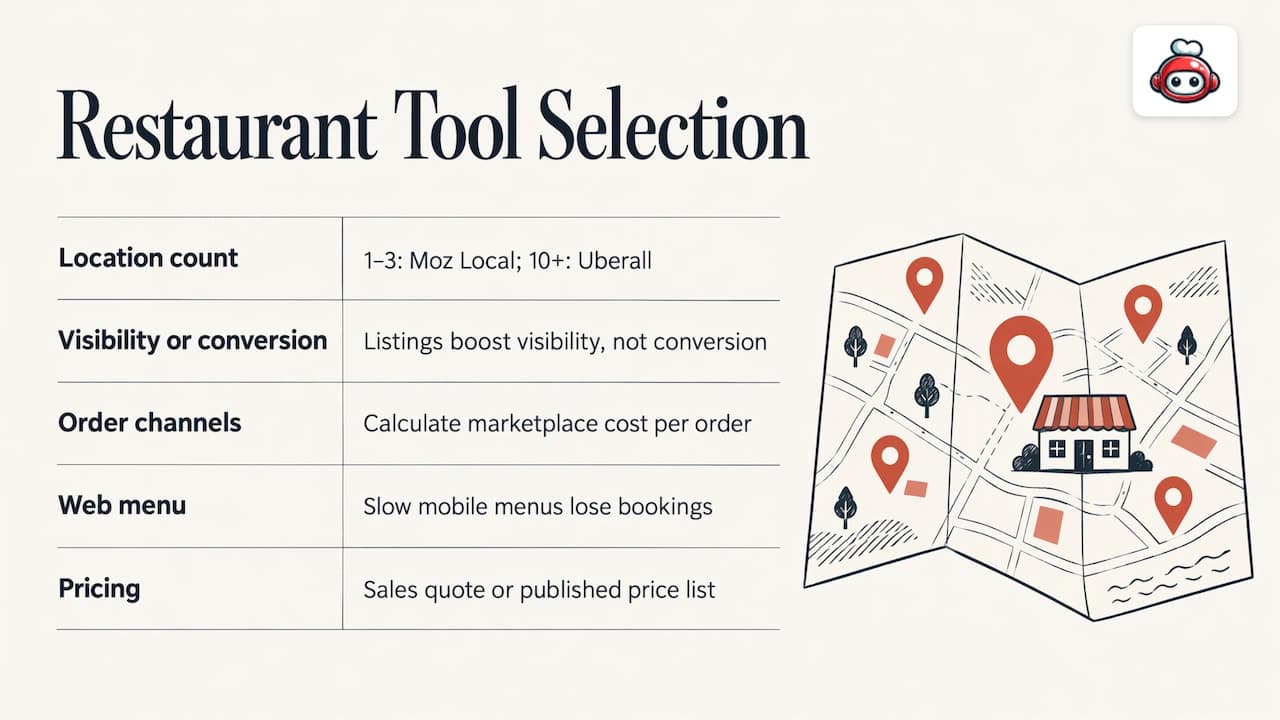
1. How many locations do you run? One to three sites: look at Moz Local, Marqii or RESTOBOT. Ten or more: Uberall, Birdeye or Synup are designed for you. Twenty-five or more is where Uberall's minimum stops being an obstacle.
2. Is your problem visibility or conversion? If guests already find you and then book or order elsewhere, a listings tool does not fix that. A website with ordering and reservations built in does. Our comparison of website versus app ordering explains why a browser-based channel is usually the faster start for a restaurant.
3. Where do you take orders? If most come through marketplaces, work out the true cost per order first. The guide to third-party delivery integration shows how to keep couriers without handing over the customer relationship.
4. What does your menu look like on the web? A menu that loads slowly or reads badly on a phone loses bookings, whichever listing tool you use. See online menu optimisation for owners and the quick guide to online menu QR code setup.
5. Do you need a quote or a price list? Yext, Uberall and Birdeye sell through sales conversations. Moz Local, BrightLocal, Marqii and our own plans publish figures, which makes budgeting simpler.
Before you cancel Yext
Leaving is a migration, not just a cancellation. One citation-building guide describes Yext as a rented listings model: when the subscription ends, nobody keeps defending your data, and publishers can drift back to older or less accurate sources. The same guide reports a case where a 60-listing account lost or corrupted a large share of its listings within two weeks of cancelling. Treat that as a warning to plan, not as a certainty for every account.
A safe order of work:
- Export everything. Business names, addresses, phone numbers, opening hours, categories, menu links and any duplicate listings Yext was suppressing.
- Claim the core profiles yourself. Google Business Profile and Apple Business are free to own directly, and they are the listings most diners see.
- Choose the replacement workflow before the contract ends. Decide who updates what, and how often. Our walkthrough on multi-location local SEO is a good companion for documenting each location and planning the changeover.
- Check your content engine. If you are rebuilding local pages, the local SEO academy covers structured data and content planning for search and AI answers.
- Audit a month later. Search your name, address and phone number, and fix whatever has drifted.
If your site is also thin, rebuild that in parallel. Our restaurant tech stack guide shows how to launch a commission-free setup in a day, and the operational efficiency guide helps you fix waste before you buy more software.
Our perspective
Most Yext alternatives compete on the same promise: more directories, more syncing, more dashboards. For a restaurant, that is rarely the bottleneck. The bottleneck is what happens after a guest finds you.
We think a restaurant should own its front door. That means a website with the menu on it, a booking button that works from Google Maps, an ordering link that does not hand a third of each basket to a marketplace, and a loyalty card in the guest's phone wallet. When those channels are yours, the listings elsewhere only need to point to them.
That is why RESTOBOT is built as one platform with one subscription and 0% commission on orders. Our formula is designed so that a small team can launch in a day and run everything from one dashboard or the manager app, without stitching five tools together.
Chains with hundreds of sites will still want a dedicated listings platform, and that is fair. For everyone else, we would start with the channels you control.
the author
Where RESTOBOT fits
If you want your website, menu, ordering, reservations, review boosting and loyalty in one place, the MENU and FULL plans are the ones to look at. MENU starts at €69 per month, and FULL, which carries the full feature set, starts at €119 per month. Annual billing brings them to €59 and €99 per year.
Your front-of-house team can join too. Waiters, bartenders and baristas can set up a personal profile and receive online tips by QR code, paid straight to their own account with no commission from us, even if their venue is not on RESTOBOT. Guests can rate the worker and leave a comment. Taxes on tips are the worker's own responsibility.
FAQ
What kind of company is Yext?
Yext is an enterprise marketing platform that manages business information and visibility across directories, maps and search destinations. According to its investor page, its customers include brands in financial services, healthcare, retail, hospitality and food.
Who are Yext's main competitors?
The names that come up most are Uberall, Birdeye, BrightLocal, Moz Local, Synup, Semrush Local and Whitespark, according to one 2026 roundup. For restaurants, Marqii is the specialist option, and we offer an all-in-one platform that focuses on your own website, ordering, reservations and reviews.
Is there a cheaper alternative to Yext for a single restaurant?
Yes, because Yext no longer publishes prices and is aimed at larger brands. Moz Local lists $199 per location per year on its Lite plan. Our MENU plan is from €69 per month or €59 per year and covers a website with an embedded menu and reservations.
Do I lose my listings if I stop using Yext?
You can, if you have not claimed them yourself first. Reports describe Yext as a rented model, where data may drift once the subscription ends. Claim your Google and Apple profiles directly and export your location data before cancelling.
Do delivery marketplaces replace a listings tool?
No. Marketplaces are an order channel, and they charge 30% of the net order value plus VAT, almost 40% in total. Your own website and Telegram bot take orders at 0% commission with us, so you keep the margin and the customer relationship.
Sources
- Company Information, Yext, Inc.
- Yext Review 2026, Restauranttools.ai
- Marqii Pricing and Review 2026, Restauranttools.ai
- Marqii vs Uberall vs Yext for Restaurant Local Listings, Restaurant Bottom Line
- 8 Best Yext Alternatives for 2026, SocialPilot
- 10 Best Yext Alternatives for Local Listings Management, Local SEO Checklist
- Uberall alternatives, WiserNotify
- Birdeye Review 2026, Small Business AI Review
- How to Choose a Citation Building Platform
- Multi-location local SEO
- Local SEO academy