

Ghost kitchen ordering means every order arrives through a digital channel and is routed to a kitchen with no dining room, then prepared and handed to a courier. The operational catch is that orders from several apps must land in one queue and be timed precisely, or service fails. Start by piloting one direct ordering channel that feeds a single dashboard.
***
TL;DR:
>
- Marketplace orders cost 30% of net order value plus VAT, nearly 40% total, and leave customer relationships with the platform; direct sales retain both. - An existing kitchen can test a virtual brand using spare capacity for 5–20 extra daily orders, but delivery tickets must not slow dining service. - Couriers arriving off schedule can leave food cold or delay handoffs, so time cooking to pickup and check each bag against its ticket. - During a small pilot, test one or two dishes that travel well and track timing and accuracy before adding brands or widening the delivery radius.
***
Table of Contents
- What is a ghost kitchen and where does it sit in the delivery ecosystem?
- How does ghost kitchen ordering work from order to courier?
- Which ghost kitchen model needs which ordering approach?
- What technology and integrations keep orders from failing?
- How do menu, packaging and pickup routines change the customer experience?
- What does ghost kitchen ordering cost, and where does the margin go?
- What is the step-by-step checklist to launch and test a delivery-only brand?
- When is a ghost kitchen the right call?
- How do we help you run direct, commission-free delivery-only ordering?
- FAQ
- Sources
What is a ghost kitchen and where does it sit in the delivery ecosystem?
A ghost kitchen is a commercial kitchen optimised for off-premise dining. Orders come in through apps or direct channels, get routed to the kitchen, are prepared and packaged, and then go to a delivery driver. Three terms get mixed up, so here is how we separate them:
- Ghost kitchen: the physical production site. It has no storefront and no seating, only cooking, packing and a dispatch point.
- Virtual brand: a delivery-only menu and identity, often several of them, produced from one kitchen. The customer sees a restaurant name; the operator sees a shared stove.
- Cloud kitchen: most often used as a synonym for a shared ghost kitchen facility where several brands rent stations under one roof.
The channel matters as much as the kitchen. Orders through marketplaces such as Uber Eats, Glovo, Bolt Food, Wolt, Just Eat and Pyszne cost 30% of the net order value plus VAT, almost 40% in total, and the marketplace owns the customer relationship. Direct orders through your own website or bot keep the margin and the customer data with you.
Who is it for? Existing restaurants can add a virtual brand to use idle kitchen hours, and new operators can test a concept without a dining room. Industry experts quoted by NACS Magazine advise using the model to fill specific delivery gaps rather than treating it as a fix for every restaurant.
How does ghost kitchen ordering work from order to courier?
Orders can arrive from a marketplace app, a direct web order or a messaging bot such as Telegram. Marketplace tickets come with their own tablet, timing rules and customer messaging. Direct orders land in your own system, where you control the menu, the prices and the payment. The danger is a counter covered in separate tablets, each beeping on its own schedule.
The fix is consolidation: route every channel into one POS or order dashboard so the kitchen sees a single queue. Our guide to a restaurant order dashboard shows what that looks like in practice. The lifecycle then runs like this:
- Order arrives in the single queue with channel, items, notes and promised pickup time.
- Kitchen accepts and sets a preparation time that the courier can see.
- Cooking starts in an order that matches the pickup times, not the arrival order.
- Packing happens at a dedicated station where the ticket is checked against the bag.
- Handoff to the courier at a marked dispatch point, with the bag sealed and labelled.
- Close-out records the handoff time so you can measure lateness later.
The usual failure points are mislabelled bags, orders finished before the courier arrives (food sits and cools) and orders finished after. Matching the courier's arrival in the cooking start, and checking the label against the ticket at the pass, fixes most of them.
Pro Tip: *Print the pickup time in large type on the bag label. Couriers read it before anything else, and it settles disputes about who was late.*
Customers also want updates once the order is on its way. Omnichannel messaging practices, like those in this customer service roadmap, help keep notifications and support replies consistent across phone, web and chat.
Which ghost kitchen model needs which ordering approach?
The right model depends on how much you want to control and how much you want to rent. Each one shifts what you should prioritise on the ordering side. The National Restaurant Association describes several formats; here is how we map them to ordering.
- Standalone ghost kitchen: you hold the lease and the brand. Direct ordering and delivery routing come first, because no dining room traffic will cover weak digital sales.
- Shared or cloud kitchen: several brands share a facility. You need a centralised queue and strong brand differentiation on the apps, so customers do not confuse your listing with the neighbour's.
- Virtual brand from an existing kitchen: the cheapest way to test. Existing kitchens often have spare capacity for an extra 5–20 orders a day, so the main job is balancing dine-in tickets against delivery tickets without slowing either.
- Commissary or fulfilment partnership: a hub prepares food and local points finish or hand it off. This relies on central dispatch software so each hub knows what to make and when a courier is due.
Whichever you choose, start with the narrowest version that can take real orders. You can widen the radius and add brands once the queue works.
What technology and integrations keep orders from failing?
Think of the stack as five jobs that need to talk to each other. If any one is manual, errors creep in at peak.
- Ordering platform: it should support direct website orders and a bot channel such as Telegram, so you are not forced to rely on marketplaces for every sale.
- Delivery management: courier integrations give live tracking and efficient routing. Our overview of delivery management software covers what to look for.
- Order consolidation: a POS or kitchen display that merges every channel into one flow, so staff cook from a single list.
- Payments for direct orders: a subscription or fixed-fee model rather than a per-order commission, so growth does not eat margin.
- Analytics: a dashboard for preparation times, refunds and review monitoring, so you see problems before ratings do.
Technology platforms also let operators digitise orders and manage them without marketplace commission, and they make use of kitchens that often run well below their productive capacity. Delivery-only restaurants rely on consolidated order flows and technology in place of a storefront, which is exactly why the integration choices above matter more than the decor ever would.
How do menu, packaging and pickup routines change the customer experience?
Customers judge a ghost kitchen on the bag that arrives, not the kitchen they never see. Operations are where ratings are won or lost. A strictly organised dispatch zone that brings together packaging, invoices and clear handoff protocols prevents the errors that damage ratings.
- Design a delivery-first menu. Choose dishes that travel well in a bag, are simple to assemble and come with a clear reheating note where needed.
- Pick packaging for heat and spills. Vented lids for fried food, sealed tubs for sauces and separate compartments for cold items. Brand it so the customer recognises the order at the door.
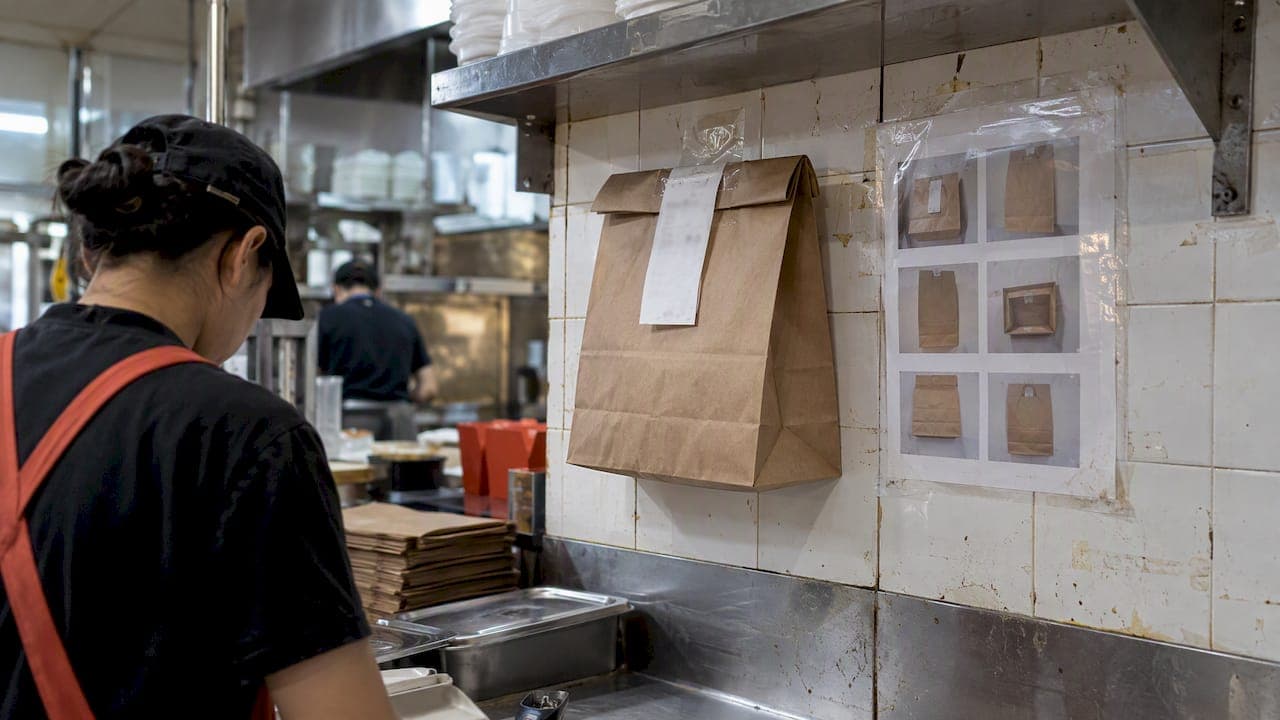
- Label every bag. Include order number, customer name, items, allergen notes where required and the pickup time.
- Build a dispatch station. One shelf, one door, one person responsible per shift, and a rule that a courier never walks into the kitchen.
- Measure and iterate. Track delivery time, order accuracy and repeat purchase rate weekly, and change one thing at a time.
Staffing the dispatch station well matters as much as the layout. A scheduling tool such as the one described in this restaurant scheduling guide can help you cover the lunch and dinner peaks without overpaying for quiet hours.
Pro Tip: *Tape a sample correctly packed bag, with its label, above the dispatch station. New staff match it against the real thing during their first shifts.*
What does ghost kitchen ordering cost, and where does the margin go?
A customised ghost kitchen pod needs a substantial upfront investment, but the National Restaurant Association notes it is notably lower than building out a food truck or a brick-and-mortar restaurant. Running costs still add up, and the order channel decides how much of each sale you keep.
- Start-up: equipment, a smaller fit-out and no front-of-house spend, which is where the saving against a restaurant comes from.
- Rent and staff: a kitchen lease or station fee, cooks, and someone on the dispatch pass.
- Packaging and delivery fees: a per-order cost that traditional restaurants largely do not carry.
- Platform costs: either a commission on every marketplace order or a flat subscription on direct orders.
- Volume: fixed costs need enough daily orders to cover them, so test demand before signing a long lease.
Marketplaces such as Uber Eats, Glovo, Bolt Food, Wolt, Just Eat and Pyszne charge 30% of the net order value plus VAT, almost 40% in total. On a direct channel with a flat subscription, we charge 0% commission and a fixed monthly fee instead. For a deeper look at the trade-off, read our piece on hybrid direct versus marketplace ordering and on commission-free online ordering.
What is the step-by-step checklist to launch and test a delivery-only brand?
Treat the initial pilot as an experiment with a small, measurable scope. This sequence keeps risk low.
- Choose your model and test radius. Start with the virtual brand or shared kitchen route, and a delivery area you can cover in a short ride. Our notes on delivery zones help you set it.
- Pick one or two dishes designed for delivery, and cost them with packaging included.
- Set up ordering channels. Launch a direct channel (website or bot), add one marketplace app if you want reach, and route everything into one dashboard.
- Prepare a pilot day. Packaging stocked, labels printed, dispatch roles assigned and a courier briefed on where to collect.
- Run it and record. Capture order volume, average delivery time, order accuracy and repeat rate, plus any customer comments.
- Review and adjust. Remove the dish that travels worst, tighten the label, move the handoff point if couriers queue.
- Promote the direct channel. Short video content can bring orders to your own link, as in this approach to turning Instagram Reels into bookings.
Only expand to new brands or a wider radius once your accuracy and timing targets are consistently met.
When is a ghost kitchen the right call?
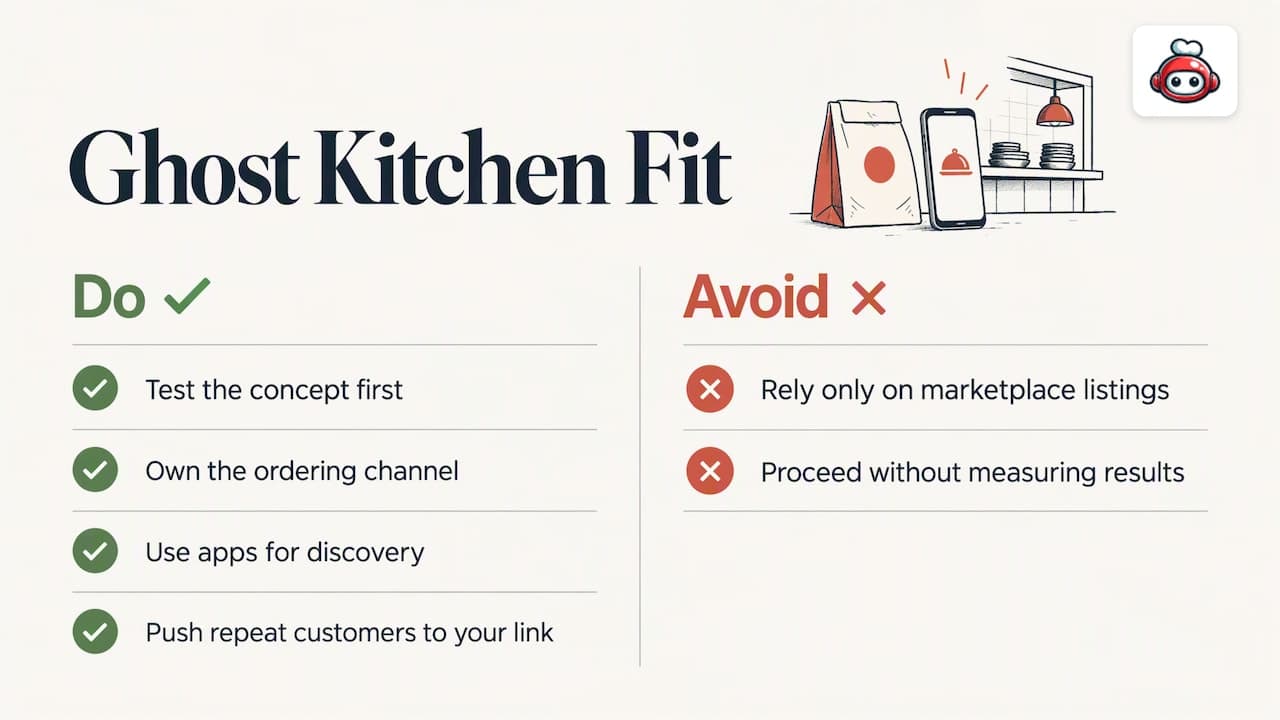
The profile that benefits most is an operator with spare kitchen hours or a proven dish, little appetite for a dining-room lease and the discipline to measure. Everyone else should wait.
Our view: test first, and own the ordering channel wherever you can. Marketplaces are useful for discovery, but visibility on them is a bidding contest where every competing listing is one swipe away, so a brand that lives only there rents its customers. Use the apps to be found, then push repeat customers to your own link.
*— ADMIN*
How do we help you run direct, commission-free delivery-only ordering?
We built RESTOBOT for exactly this setup. Your site is created instantly once your application is confirmed, and launch takes one day including integrations. Customers can order through the website or a Telegram bot, delivery is coordinated with third-party couriers, and everything lands in a real-time order dashboard. We charge 0% commission on orders, with a monthly subscription only. Workers can also collect tips on a personal profile, even if their venue is not on RESTOBOT. See the plans and prices on our pricing page, or message us to discuss your setup.
FAQ
How do I know if it's a ghost kitchen?
Look for a brand that only appears on delivery apps or a website, with no dining room, no street-facing storefront and often a shared address. Maps and listings usually show a pickup point rather than a restaurant. A ghost kitchen is simply a commercial kitchen optimised for off-premise orders.
What is the best app to order food in the UK?
It depends on your area, because coverage and restaurant choice differ between apps. Many ghost kitchens also take orders on their own websites, which can be cheaper for the restaurant and sometimes for you. Compare the same dish across the apps and the restaurant's own site before ordering.
How do you start a ghost kitchen?
Pick a model, choose one or two delivery-friendly dishes and set up a direct ordering channel that feeds a single order queue. Then run a small pilot and measure delivery time and order accuracy. Our step-by-step checklist above gives the full sequence.
Is a ghost kitchen cheaper to open than a restaurant?
Generally yes. Building a customised pod still needs a substantial investment, but it is notably lower than a traditional restaurant or food truck build-out. You still pay for rent, staff, packaging and delivery.
Sources
The evidence is consistent across the sources we rely on: ghost kitchens cost less to build than a restaurant, and technology does the heavy lifting in operations. A practical workflow rule follows from this: dedicate a dispatch zone and consolidate order queues so handoffs cannot be missed.
Successful ghost kitchen workflows depend on a strictly organised dispatch zone that integrates packaging, invoice management and clear handoff protocols to prevent errors that harm ratings.
That is the finding from Kitchen Management Authority, and it matches what we see in operator setups: the kitchen is rarely the problem, the handoff is.
On margin, direct ordering with a subscription model keeps the full order value, because there is no per-order cut. Our platform is one example of that approach: a website and a Telegram bot feeding one real-time order dashboard, with 0% commission on orders and on tips for workers.