


If you run a restaurant or café and are weighing up Podium alternatives, start with the job you need done. Podium is a texting and review-request platform built for local businesses in general. A restaurant also needs a website, a menu, orders, bookings, loyalty and reviews, and paying separately for each tool adds up. RESTOBOT puts those into one subscription, with no commission on orders, and it also gives individual waiters and bartenders a free way to collect tips.
This guide compares the realistic options for a restaurant, explains how to choose, and shows where each one fits. It also covers hospitality workers who landed here looking for a way to be tipped directly.
Table of Contents
- Why restaurants look beyond Podium
- The main types of Podium alternative
- How the options compare for a restaurant
- What a restaurant should check before switching
- Reviews: replacing the Podium use case
- Orders without marketplace commission
- Loyalty and repeat visits
- What RESTOBOT costs
- For waiters, bartenders and baristas: tips straight to you
- Getting started
- FAQ
- Sources
Why restaurants look beyond Podium
Podium sits in the category of customer-interaction software: a shared inbox for texts and web chat, review requests, and payment links. That suits a roofer, a dental clinic or a car dealer, where the relationship starts with a call or an enquiry.
A restaurant works differently. Guests find you on Google Maps, look at the menu, book a table or order for delivery, and then (you hope) leave a review. The messaging inbox is one small part of that path. Restaurant owners who search for Podium competitors usually have one of three reasons:
- They only need reviews. Google ratings drive footfall, and the main task is asking every guest at the right moment.
- They need more than messaging. They want orders, bookings and loyalty in the same system as their reviews.
- They want to stop paying commission. Marketplace fees eat margin on every delivery order, and a messaging tool does nothing about that.
Each reason points to a different kind of alternative, covered below.
The main types of Podium alternative
Review and reputation platforms
Birdeye, NiceJob, Emitrr and similar tools focus on collecting reviews and monitoring them across sites. They suit businesses whose main marketing asset is their rating. For a restaurant they cover one stage of the guest journey: after the meal. The website, menu, ordering and loyalty remain separate subscriptions.
Business messaging platforms
Weave and Text Request lean toward texting, call handling and appointment reminders. They were designed for appointment-based practices. A restaurant with a walk-in and delivery trade gets little from appointment reminders.
Restaurant all-in-one platforms
This is where RESTOBOT sits. Instead of a messaging inbox it offers the things a restaurant's customers actually do: browse an embedded menu, order through the website or a Telegram bot, book a table, collect loyalty points in Apple or Google Wallet, and get asked for a review.
How the options compare for a restaurant
| Need | Podium | Review-only tools | RESTOBOT |
|---|---|---|---|
| Review requests | Yes, through texting | Yes, the main feature | Automated review boosting for Google and TripAdvisor |
| Restaurant website with menu | No | No | Customisable builder with embedded menu |
| Online ordering | No | No | Website and Telegram bot |
| Delivery coordination | No | No | Third-party couriers such as Wolt Drive |
| Reservations | No | No | Web, Google Maps and Telegram |
| Digital loyalty cards | No | Rarely | Apple and Google Wallet |
| Commission on orders | Not applicable | Not applicable | None |
| Tips for staff | No | No | Yes, on all plans and as a standalone profile |
The table compares scope, not quality: Podium and the review tools do what they were built for. The point is that a restaurant has more jobs to cover than they do.
What a restaurant should check before switching
Choose on the work your restaurant needs done, in this order.
- List the guest journey. Write down how guests currently discover you, order, book and come back. Mark each step that has no tool.
- Count what you pay now. Add up the website, ordering, booking, loyalty and review subscriptions, plus commissions. A single plan often replaces several lines.
- Look at the review process, not only the software. Google's own guidance says reviews must reflect a genuine experience, and that offering incentives in exchange for reviews is not allowed, as set out on its Google Business Profile help page. Whatever you choose should ask every guest the same way.
- Think about speed. A tool that takes weeks to configure costs you the busy season. RESTOBOT sites are created instantly and launch within one day.
- Decide where the money sits. With commission-based channels, a share of every order goes to the platform. With a subscription, it does not.
For a broader view of reputation work beyond software, this step-by-step reputation guide covers the routine of monitoring and responding. For restaurant-specific scripts, see our guide on how to respond to Google reviews.
Reviews: replacing the Podium use case
Many owners use Podium mainly to ask for reviews. RESTOBOT includes automated review boosting for Google and TripAdvisor as part of the platform, so the request sits next to the order, booking and loyalty data rather than in a separate inbox.
If you want to set this up yourself, three of our guides walk through it:
- Creating a Google review link for SMS, receipts and QR codes.
- Automating review requests in an afternoon.
- Getting 100 Google reviews a month automatically.
A printed code on the table or receipt is the simplest start, and our Google review QR code guide shows how to roll it out in a single shift.
Orders without marketplace commission
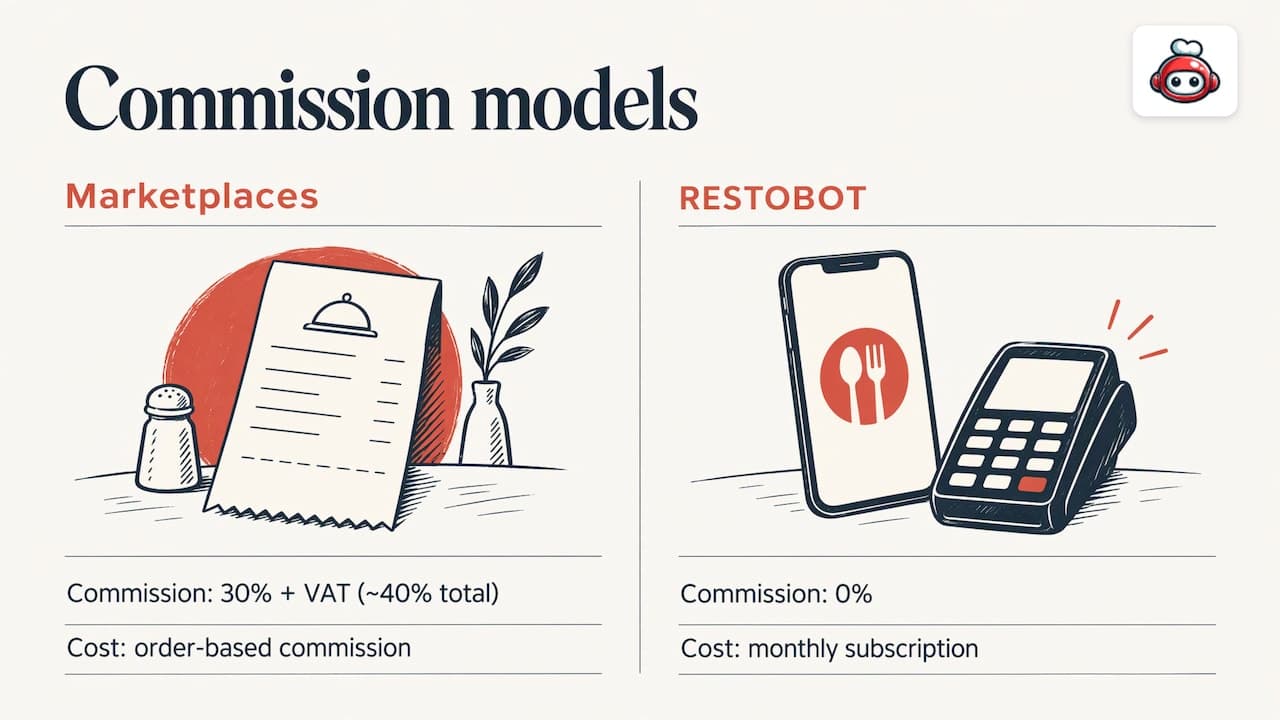
This is the gap no Podium alternative in the review category fills. Uber Eats, Glovo, Bolt Food, Wolt, Just Eat, Pyszne and similar marketplaces charge 30% of the net order value plus VAT, almost 40% in total. On a busy delivery night that is the biggest line on your cost sheet.
RESTOBOT's commission is 0%. You pay a monthly subscription and keep the order value. Guests order on your own website or through a Telegram bot, pay online by several methods (cryptocurrency included), and delivery can be handed to third-party couriers such as Wolt Drive. Our guide to delivery management software explains how that fits together, and the comparison of a Telegram bot and a mobile app helps you choose a channel.
Loyalty and repeat visits
Podium-style tools bring guests back by text. RESTOBOT uses digital loyalty cards that live in the guest's Apple Wallet or Google Wallet, with CRM and engagement tools behind them. The LOYALTY plan is the entry point if loyalty is your main goal.
What RESTOBOT costs
Plans as published on the client site in October 2026:
| Plan | Monthly | Annual |
|---|---|---|
| LOYALTY | from €39 a month | €29 per year |
| MENU | from €69 a month | €59 per year |
| FULL | from €119 a month | €99 per year |
There is no commission on orders. Tips for staff are available on every plan. Prices and plan contents are on the pricing page.
For waiters, bartenders and baristas: tips straight to you
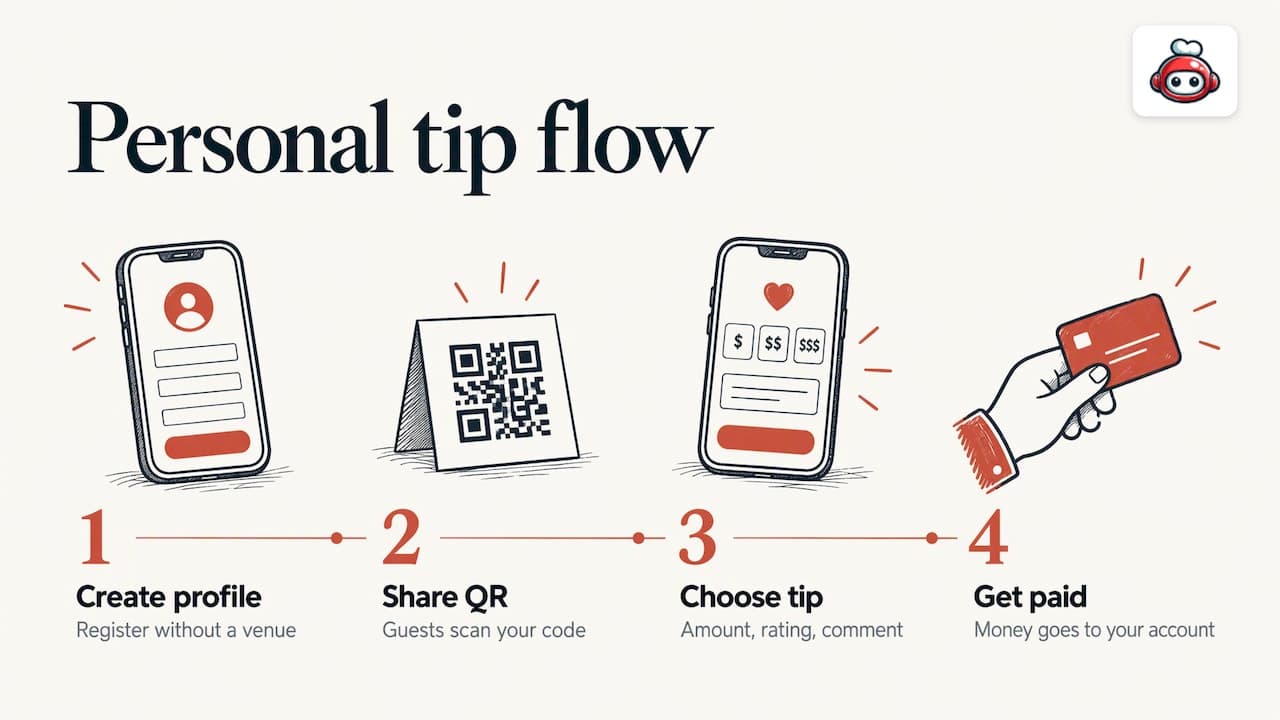
Some readers arrive here as hospitality workers, not owners. If you want guests to tip you personally, RESTOBOT's online tips feature lets you create your own profile and share a QR code. Guests scan it, choose an amount, and can rate you and leave a comment. The money goes directly to your own account, and RESTOBOT takes no commission on it.
You can register on your own, even if your venue is not on RESTOBOT. Your profile shows a public rating and comments tied to you rather than to the venue, so your service reputation travels with you when you change jobs. You set your payout schedule in the payment provider. Taxes on tips are your own responsibility.
Our view
We built RESTOBOT because restaurants kept stitching together separate tools for the website, the menu, orders, bookings, loyalty and reviews, and then paying commission on top. A messaging inbox is useful, but it is not where a restaurant's revenue is made.
Our position is simple: the venue should own its orders and its customer relationships. That is why we charge a monthly subscription and no commission, why a site can be live within a day, and why we added tips that go directly to the individual worker.
If your main problem is reviews, you can solve it inside the same platform that takes your orders and bookings. That keeps your guest data in one place and your costs in one line.
the author
Getting started
If your restaurant needs a site, ordering, bookings, loyalty and reviews under one roof, start with the MENU or FULL plan on the RESTOBOT pricing page. If you only want loyalty cards, LOYALTY is the lighter entry. For a first look at what to fix before you add technology, read our guide to restaurant operational efficiency.
FAQ
Who are Podium's main competitors?
In reviews and messaging, the names that come up most are Birdeye, Weave, NiceJob, Emitrr and Vendasta. For a restaurant, the closest fit is an all-in-one restaurant platform such as RESTOBOT, which covers reviews alongside orders, bookings and loyalty.
What is the best Podium alternative for a restaurant?
The one that matches your guest journey. If you need a website, online ordering, reservations, loyalty and review requests in one subscription with no commission on orders, RESTOBOT is built for that. Review-only tools cover only the last step.
Can I replace Podium's review requests with RESTOBOT?
Yes. RESTOBOT includes automated review boosting for Google and TripAdvisor, and our guides show how to set up review links and QR codes. Ask every guest in the same way, as Google's guidance on genuine reviews requires.
Do waiters need their restaurant to use RESTOBOT to get tips?
No. A worker can register alone and share a personal QR code, even if the venue is not on RESTOBOT. The money goes straight to the worker's own account with no platform commission.