


If you want to stop paying a marketplace for guests who could book you directly, the best OpenTable alternative is a system that takes bookings on your own website, Google Maps and Telegram, for a flat monthly fee. RESTOBOT does this: reservations sit alongside your menu, ordering, loyalty cards and review tools, with 0% commission on orders and a launch in one day. Below we compare it with the other platforms owners shortlist, so you can pick on fees, guest data and fit.
Table of Contents
Why owners look beyond OpenTable
OpenTable has the largest diner network and is strongest for diner discovery. That is a genuine strength for a new venue in a tourist area. It also explains the cost structure: OpenTable typically charges a monthly subscription plus per-cover fees for bookings that come through its network, whereas most alternatives use a flat-fee subscription with no per-cover charges.
The friction owners describe falls into three groups:
- Cost that grows with success. A per-cover fee rises exactly when you are busiest.
- Who owns the guest. Marketplace models such as OpenTable and Yelp use centralised diner databases, which can blur whose customer the diner is.
- Scope. A booking tool does not sell your food, fill a quiet Tuesday or bring a guest back. You end up stitching together separate systems.
If you recognise yourself in the second or third point, you are not looking for a cheaper OpenTable. You are looking for a different kind of tool.
The main OpenTable competitors at a glance
The field splits into two kinds of platform: marketplace-led discovery, and operations-led management tools. The names that come up most are Resy, SevenRooms, Yelp Guest Manager, Toast Tables and Eat App, plus Tock. The picture has also shifted: American Express owns Resy and acquired Tock, which has intensified competition between reservation platforms.
| Platform | Best known for | Published pricing (US dollars) | Fits best |
|---|---|---|---|
| OpenTable | Largest diner network, discovery | Subscription plus per-cover fees on network bookings | Venues that need new diners |
| Resy | American Express-owned booking and guest tools | Platform $289/month, Platform 360 $459/month | Higher-end venues |
| Tock | Prepaid bookings, dynamic pricing | Essential $289/month, Premium $459/month, plus 3% or 2% on prepayments | Ticketed or prepaid dining |
| Eat App | Table management and guest data | Free up to 100 covers, then $69–99, $159–199 and $299–389/month | Independents wanting a tiered tool |
| RESTOBOT | Reservations plus website, ordering, loyalty and reviews | MENU from €69/month, FULL from €119/month | Owners who want one system with no commission |
The Resy, Tock and Eat App figures come from a 2026 comparison of reservation software. Tock's 3% and 2% apply to prepayments and sit on top of standard payment processing fees. Prices are in dollars, so confirm UK pounds and VAT with each provider before you commit.
Tock's model is built around prepaid bookings and dynamic pricing, which suits a tasting-menu room far better than a neighbourhood café. SevenRooms is generally seen as the tool for operators who want control over guest relationships and data.
Fees: what you actually pay for
A headline monthly price tells you little. Four costs decide the real bill:
- Per-cover or per-booking fees. These apply to OpenTable's network covers. Multiply the fee by your monthly covers, not your quietest week.
- Payment fees on deposits. Tock's percentage on prepayments is a clear example.
- Tier jumps. Eat App's published range runs from a free tier to the Pro tier at up to $389 a month, so the feature you need may sit one tier above the one you priced.
- Separate tools around the booking. Website, online ordering, loyalty and review requests often arrive as extra subscriptions.
Do the sum over a year. Take your average covers, the fee per cover, the subscription, and the add-ons you would otherwise buy elsewhere. Then compare that to a flat plan that already includes them.
How RESTOBOT charges
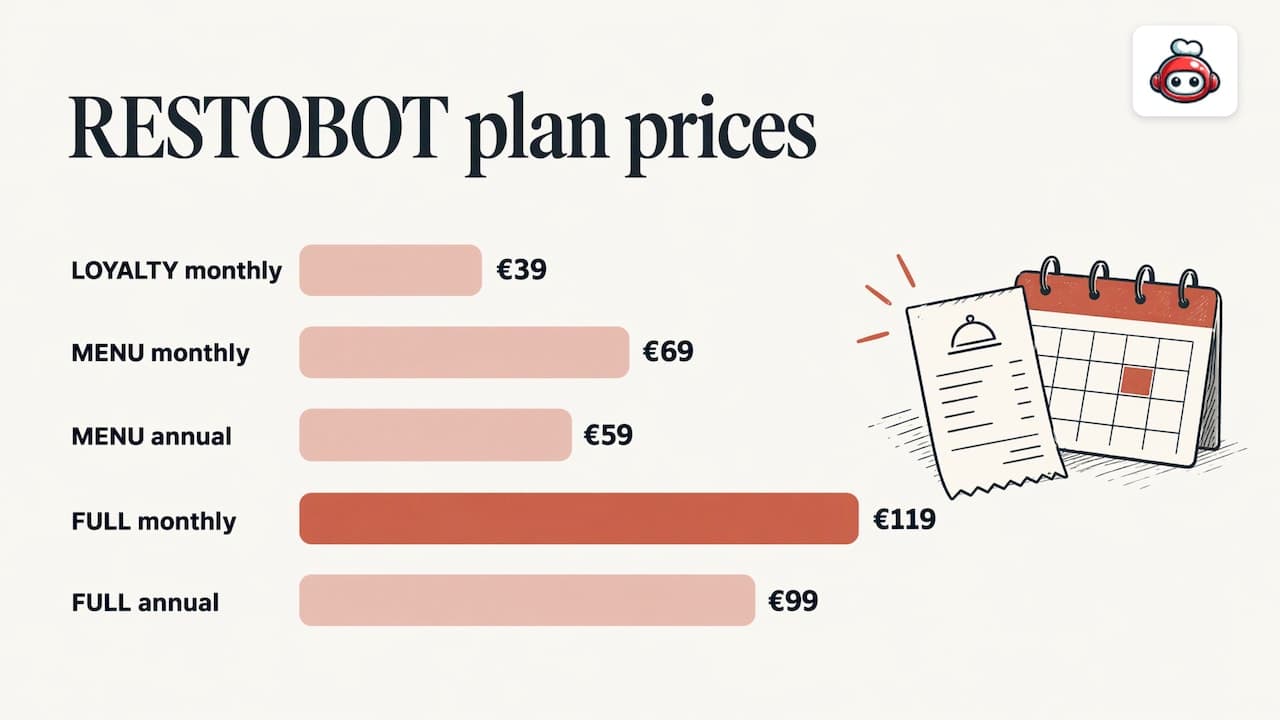
RESTOBOT charges only a monthly subscription, with no commission on orders. The published plans are LOYALTY from €39 per month, MENU from €69 per month and FULL from €119 per month. Annual prices are €29 for LOYALTY, €59 for MENU and €99 for FULL. See the RESTOBOT pricing page for what each plan includes.
The no-commission point matters well beyond reservations. Uber Eats, Glovo, Bolt Food, Wolt, Just Eat, Pyszne and similar marketplaces charge 30% of the net order value plus VAT, almost 40% in total. Orders that arrive through your own website or Telegram bot carry 0% from RESTOBOT. Our guide to POS integrations and 30% plus VAT versus 0% direct orders shows how that plays out in a kitchen.
Who owns the guest data
This is the dividing line that matters most over several years. When a guest books through a marketplace, the relationship runs through the marketplace's app, its emails and its diner profile. When a guest books on your own site, the contact, the preference and the repeat visit are yours to build on.
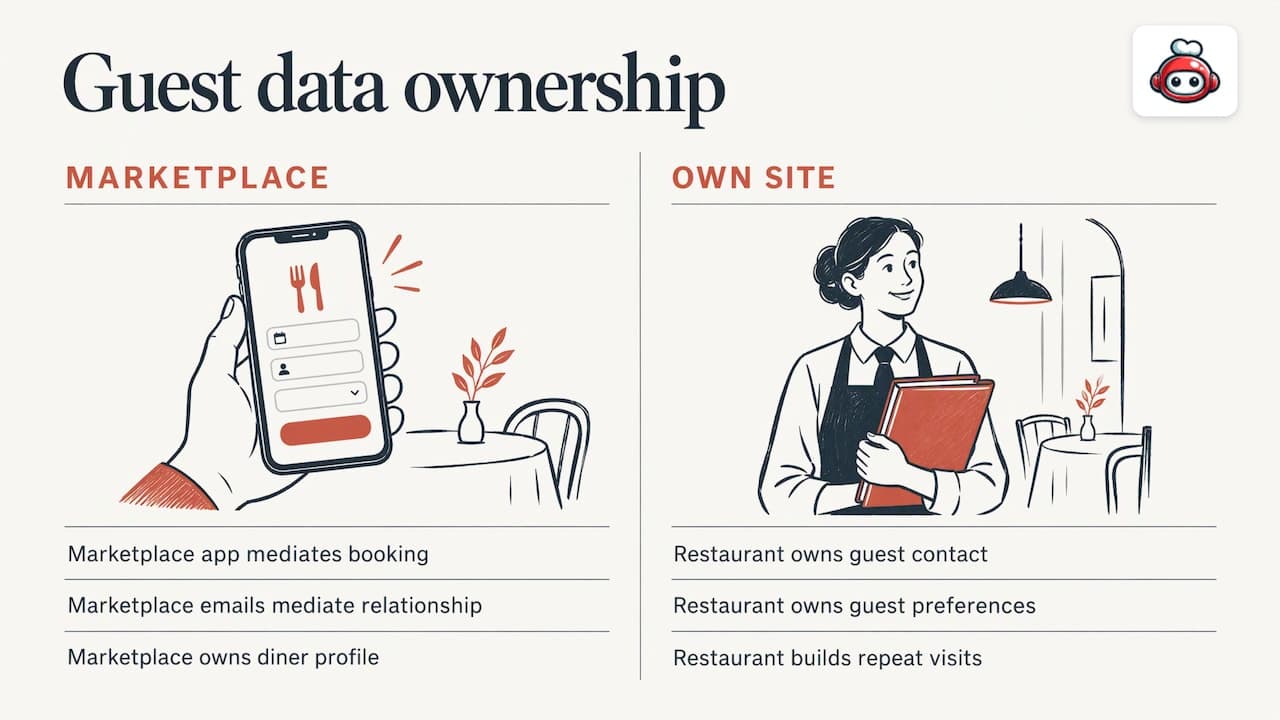
A reservation tool that sits inside the rest of your digital presence makes this practical. With RESTOBOT, reservations come in through your website, Google Maps and Telegram. Guests can then collect a digital loyalty card in Apple or Google Wallet, and the platform helps boost reviews on Google and TripAdvisor. The booking becomes the first step of a relationship you run, not a transaction you rent.
If you are setting up the Google route, our walkthrough on Reserve with Google for restaurants covers it in a day.
What else you may need around bookings
A reservation tool is rarely the only thing a restaurant needs. Ask what the platform covers beyond the table:
- Pre-orders and deposits. Useful for events and large parties. Our guide to online pre-orders covers lead times and set-up.
- Online ordering and delivery. Direct ordering through a website or Telegram bot, with delivery coordinated through third-party couriers such as Wolt Drive.
- Loyalty. Digital cards that live in the guest's phone wallet.
- Guest communication. Some tools focus on messaging. Ecco, for example, offers voice and WhatsApp guest communication from €179 a month. If messaging is your priority, see how WhatsApp compares with Telegram for restaurants.
- Several venues. If you run more than one site, read about multi-location reservations.
One system that handles all of these removes the reconciliation work between tools. That is the practical case for an all-in-one platform over a booking-only product.
How to choose a platform for your venue
Owners should weigh diner discovery against operational control, their existing POS integration, and their budget. A working checklist:
- Name your main goal. New diners from a marketplace, or more bookings and orders from people who already know you?
- Count your covers. Work out what per-cover pricing would cost in your busiest month.
- List what you pay for around bookings. Website, ordering, loyalty and review requests.
- Check your POS. The platform needs to work with the till you already use.
- Decide how much CRM you need. A full guest database, or a simple host-stand view.
- Think about launch time. A tool you can run this week beats a better one you set up in a quarter.
For a table-by-table view of the first steps, our practical guide to adding online reservations shows what to set up and in what order.
Which option fits which restaurant
- A new venue needing footfall: a marketplace brings discovery. Pair it with a direct channel so repeat guests come to you.
- A tasting-menu or ticketed restaurant: Tock's prepaid model is designed for this.
- A group wanting deep guest profiling: SevenRooms is the usual shortlist entry.
- An independent café or restaurant wanting bookings, ordering, loyalty and reviews in one place without commission: RESTOBOT.
The case for an all-in-one platform
The common thread in this comparison is that bookings are the smallest part of the revenue picture. A guest who books a table also orders a takeaway, collects a loyalty stamp and, if all goes well, leaves a review. When each step lives in a different product, you pay several subscriptions and your data sits in several places.
RESTOBOT puts those steps in one dashboard, with real-time control of orders and reservations, analytics and a manager mobile app. It launches within a day, and site creation is instant. For a small team without a developer, that speed is the difference between running a system and planning one. If you are weighing site options as well, our comparison of restaurant website builders is a useful companion, and the guide to a commission-free tech stack in a day shows how the pieces fit together.
Our view on reservations
We build RESTOBOT because we believe a restaurant should own its guests, its sales and its margin. A booking is the start of a relationship, and that relationship is worth more when it lives on your website, your Telegram channel and your guest's phone wallet than when it sits inside someone else's marketplace.
That is why we take no commission on orders and charge only a monthly subscription. Reservations, online ordering, loyalty cards and review boosting share one dashboard, so you spend your time on service rather than on reconciling five tools.
The same thinking runs through our tips feature. Waiters and bartenders can take voluntary tips straight to their own account by QR code, with no platform commission, on every plan.
the author
Getting started with RESTOBOT
The MENU plan starts at €69 per month and FULL at €119 per month, with lower annual prices of €59 and €99. LOYALTY starts at €39 per month if digital loyalty cards are your first priority. You can compare the plans on the RESTOBOT pricing page and launch within a day.
Your team can also use the online tips feature: tips are available on all plans. A worker can register alone, even if the venue is not on RESTOBOT, and gets a public profile with a rating and comments. The worker sets the payout schedule in the payment provider.
FAQ
What is the best OpenTable alternative for a small independent restaurant?
It depends on whether you need new diners or more value from the ones you have. If you want bookings, ordering, loyalty and reviews without commission, RESTOBOT puts them in one platform from €69 per month on MENU. If you need pure marketplace discovery, that is where OpenTable is strongest.
Do OpenTable alternatives charge per cover?
Most flat-fee alternatives do not, while OpenTable typically adds per-cover fees on network bookings to its subscription. Some tools charge a percentage on prepayments instead: Tock's plans take 3% or 2% plus payment processing. RESTOBOT charges only a monthly subscription.
Is there a free restaurant reservation system?
Some providers offer a free tier with limits. Eat App, for example, lists a free plan for up to 100 covers. Check what the limit means for your busiest month before relying on it.
Can I take reservations from Google Maps and my own website?
Yes. RESTOBOT manages reservations from the web, Google Maps and Telegram in one dashboard. Our guide to Reserve with Google shows the set-up.
How long does it take to switch?
RESTOBOT launches within one day, and site creation is instant. Keep your existing bookings running until your new link is live, then point guests to the new page.