


The best review management software for a restaurant is the one that gets more genuine reviews, puts new ones in front of you quickly and helps you answer them, without a price built for a 200-site chain. Most tools ranking for this search are made for multi-location enterprises, agencies or online shops. A restaurant or café usually does better with a platform where review requests sit next to ordering, reservations and loyalty, which is how RESTOBOT is built.
Below: what review management software actually does, the main types of tool, how they compare for a restaurant, the Google rules that decide whether your review requests are allowed, and how to choose.
Table of Contents
- What review management software does
- Why reviews are worth the effort
- The main types of review software
- What to compare before you choose
- RESTOBOT: review boosting inside an all-in-one platform
- Staying inside Google's review rules
- Replying to reviews
- Perspective: why a restaurant should not buy reviews tools in isolation
- Plans and prices
- Not only for restaurants: reviews for individual workers
- A simple way to decide
- Get started with RESTOBOT
- FAQ
- Sources
What review management software does
A review management buyer's guide from Locus Intelligence breaks the category into four jobs:
- Asking customers for reviews by text, email or QR code, with a direct link to the review form.
- Monitoring new reviews from Google and other sites in one inbox, with alerts for low ratings.
- Replying with drafted or suggested responses, ideally approved by a person before they go live.
- Reporting on rating, number of reviews, how fast new ones arrive and how many you answer.
For a restaurant, the first job matters most. Diners who had a good meal rarely think to write about it, so the reviews you see online skew towards the extremes. A steady, polite prompt at the right moment fixes the imbalance.
Why reviews are worth the effort
The evidence comes mostly from the United States, but the direction is consistent. A study reported by Rutgers University found that a one-star rise in average Yelp rating lifted revenue by 5% to 9% for independent restaurants. An Economic Journal study of 148,000 Yelp reviews, covered by Phys.org, found that a half-star improvement made a restaurant 19% more likely to be full at peak times. Moving from 3 to 3.5 stars raised the chance of a sell-out evening from 13% to 34%.
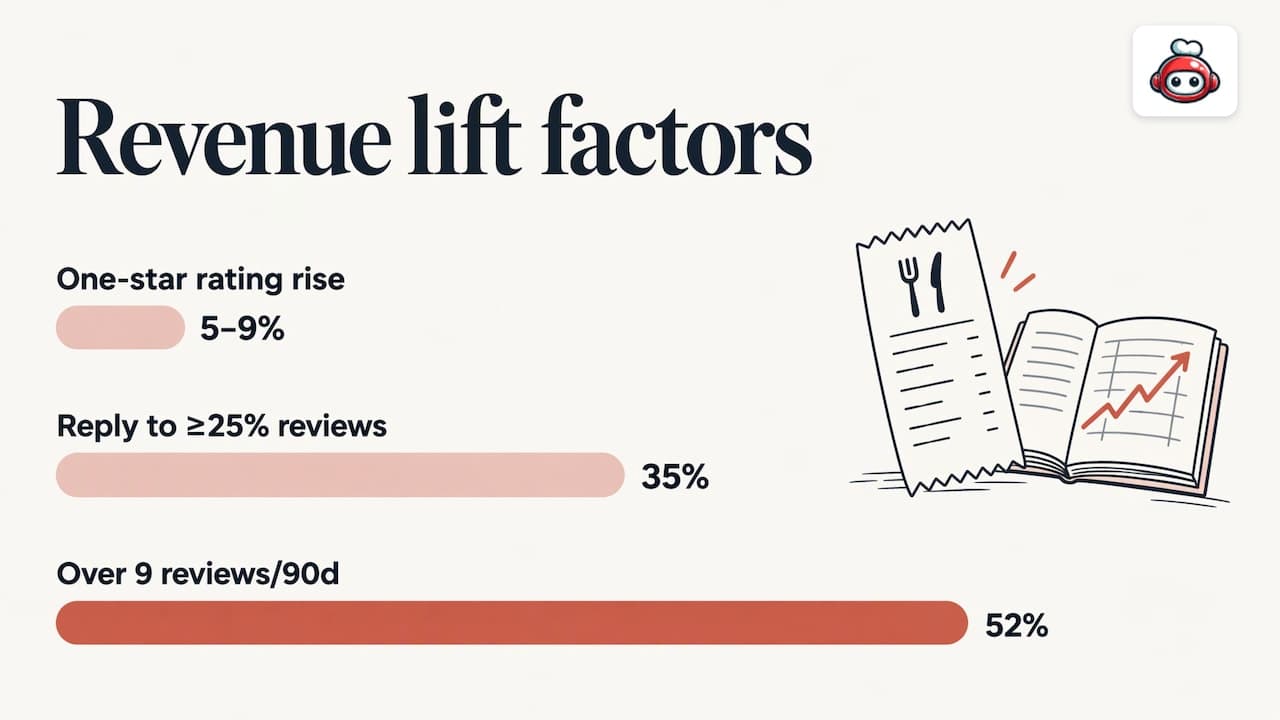
Replying matters too. A Womply analysis of more than 200,000 small businesses, reported by Martech Series, found that businesses answering at least a quarter of their reviews earned 35% more revenue than average. Those with more than nine reviews posted in the previous 90 days earned 52% more. The same study put the revenue sweet spot at 3.5 to 4.5 stars, so a believable mix of reviews beats a spotless 5.0. For a wider view of how online reviews and revenue growth connect for small businesses, that guide is a helpful starting point.
Two takeaways for a restaurant: fresh reviews count as much as old ones, and a reply habit costs little compared with what it can return.
The main types of review software
Search results for this keyword mix very different products. Sorting them by who they are built for saves a lot of demo calls.
| Type | Typical examples | Built for | Fit for a single restaurant |
|---|---|---|---|
| All-in-one restaurant platform | RESTOBOT | Restaurants and cafés that want ordering, bookings, loyalty and reviews in one place | Strong: reviews sit alongside the systems you already use |
| Multi-site aggregator | Birdeye, ReviewTrackers, Reputation | Chains and franchises tracking dozens of review sites | Often more than you need |
| Messaging-led tool | Podium | Local service businesses that sell through text conversations | Useful for texting, but not restaurant-specific |
| Public review platform | Trustpilot | Online brands collecting reviews on their own branded page | A different job: restaurants live on Google and TripAdvisor |
| Agency and SEO suites | Tools listed in agency roundups | Agencies managing many client accounts | Rarely suited to an owner running one kitchen |
Pricing for the enterprise tools is generally per location and often sales-led, so check each vendor's own page for current terms. Those tools are strong at pulling hundreds of review sources into one dashboard. A restaurant mostly cares about two or three: Google, TripAdvisor and perhaps Facebook.
What to compare before you choose
Cut the feature lists down to six questions:
- Does it ask for reviews automatically? Manual asking dies after two busy weekends. Look for a request that fires after an order, booking or visit.
- Does it cover the sites your guests use? For most UK venues that means Google first, then TripAdvisor.
- Does it keep you inside Google's rules? More on this below. It is the question most buyers forget.
- Can you answer reviews quickly? Alerts for low ratings and a clear way to reply are the minimum.
- What else does it do? A tool that also takes orders, books tables and runs loyalty gives you more for the same monthly spend and one login instead of five.
- How is it priced? Per-location pricing climbs fast. A flat subscription is easier to budget, and commission-based tools take a cut of revenue you could keep.
RESTOBOT: review boosting inside an all-in-one platform
RESTOBOT is a platform for restaurants and foodservice businesses. It combines a website builder with an embedded menu, online ordering through the website and a Telegram bot, reservations, digital loyalty cards for Apple and Google Wallet, a management dashboard, and automated review and rating boosting for Google and TripAdvisor.
For review management specifically, that has three practical consequences:
- Reviews are part of the guest journey. Guests already order, book and collect loyalty points through RESTOBOT, so a review prompt belongs to the same flow rather than a separate tool.
- One subscription, no commission. RESTOBOT charges a monthly subscription only and takes 0% of your orders. Marketplaces such as Uber Eats, Glovo, Bolt Food, Wolt and Just Eat charge 30% of the net order value plus VAT, almost 40% in total, so guests who order directly through your own channels leave more of each sale with you.
- Fast start. The site is created instantly and launches within one day.
If you want the how-to behind the tactics, the RESTOBOT blog covers automating review requests, building a Google review link for SMS, receipts and QR codes, and how to get 100 Google reviews a month automatically.
Staying inside Google's review rules
This is the part that decides whether review software helps or harms you. Google's prohibited and restricted content policy bans reviews that are paid for, directly or in kind, and bans offering incentives such as discounts or free goods in exchange for a review.
In practice, according to a guide to automating Google reviews, Google permits automating the ask, a single reminder, the direct link, alerts and human-approved reply drafts. It prohibits incentives, "gating" (sending the review link only to guests who seem happy), staff quotas and scripts that name employees. A report on the April 2026 policy update says Google now explicitly forbids asking staff to collect a set number of reviews, and asking for reviews that name a particular team member.
So your checklist for any tool is simple:
- Everyone gets the same request, not only the satisfied guests.
- No discount, free dessert or loyalty points in return for a review.
- No targets for waiters.
- No fake or family reviews.
RESTOBOT's own guide, What Google's reviews policy means for your business, walks through these points for restaurants.
Replying to reviews
Software can speed up replies, but the tone is yours. A good reply thanks the guest, refers to something specific, and for a complaint offers a way to put things right offline. Short, calm replies to negative reviews are read by every future guest, not just the writer. RESTOBOT's guide to responding to Google reviews sets out three reply paths with scripts you can adapt.
Once you have good reviews, show them off. The blog explains how to embed Google reviews on your website so visitors see them before they book.
Perspective: why a restaurant should not buy reviews tools in isolation
We build RESTOBOT for restaurants, so we look at reviews as one step in a guest's journey rather than a separate project.
A guest orders on your site, books a table or collects loyalty points. That is the moment you know they had an experience worth asking about. A review tool that sits apart from those systems has to guess when to ask. A platform that already knows about the order or the booking does not.
There is also the matter of cost. A restaurant should not need an enterprise contract to ask guests for a review. Our model is a flat monthly subscription with zero commission on orders, so more of what guests spend stays with you, and review boosting for Google and TripAdvisor is part of the same platform as your website, menu, reservations and loyalty cards.
Our advice is to pick the tool that fits how you work today, start asking every guest consistently and fairly, and answer what comes back.
the author
Plans and prices
RESTOBOT publishes its plans on the pricing page. Monthly prices start at €39 for LOYALTY, €69 for MENU and €119 for FULL. Annual pricing is listed at €29, €59 and €99 a year respectively. Prices were read from the site in October 2026, so check the page for the current figures.
FULL is the plan with the complete feature set. Whichever plan you choose, there are no commissions on orders and no per-location surcharge listed.
Not only for restaurants: reviews for individual workers
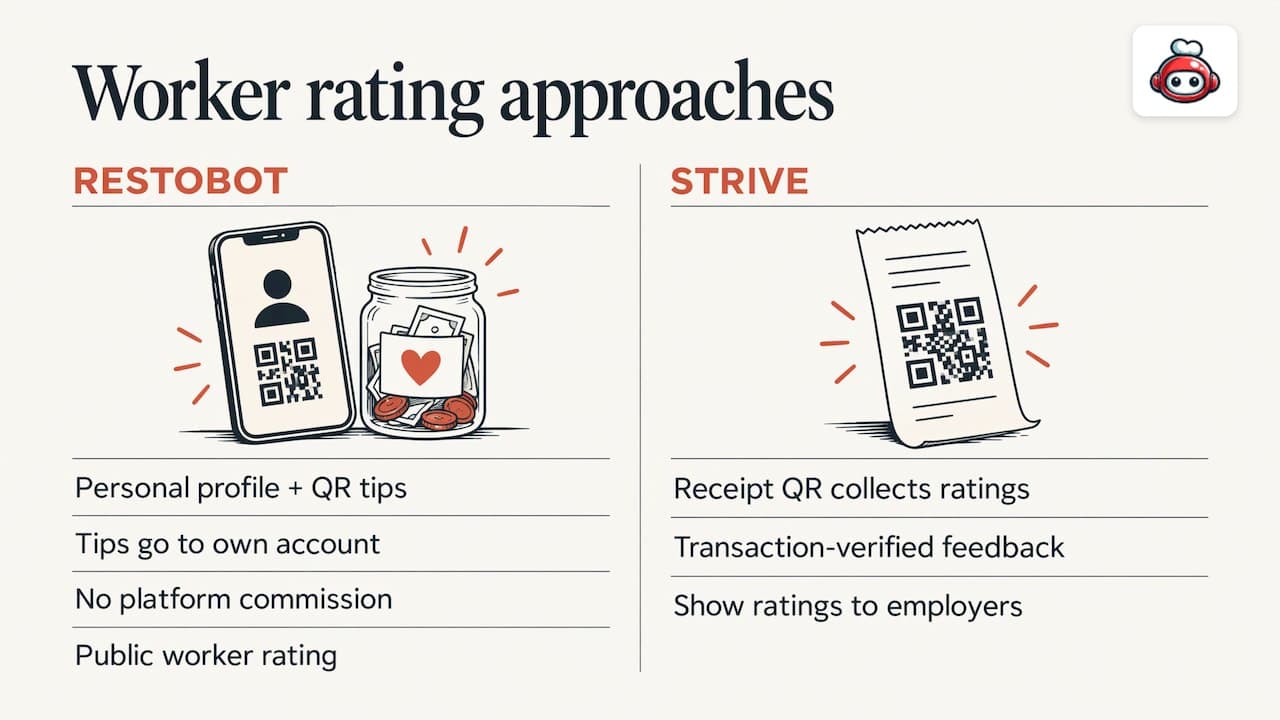
Venue reviews describe the place. Many waiters, bartenders and baristas also want their own service recognised. RESTOBOT's online tips feature lets a worker create a personal profile and receive voluntary tips from guests via a QR code. The money goes straight to the worker's own account with no platform commission. Guests can rate the worker, leave a comment and choose an amount, which builds a public rating tied to the person rather than the venue.
A worker can register alone, even if the venue is not on RESTOBOT, and sets their own payout schedule in the payment provider. Tips are available on all RESTOBOT plans for venues too. Taxes on tips are the worker's own responsibility.
Other approaches exist. One example is STRIVE, which uses receipt QR codes to collect transaction-verified ratings so staff can show verified feedback to future employers. The idea is the same: a rating that follows the person.
Remember Google's rule on staff quotas and named-employee scripts applies to Google reviews. Worker ratings collected through a worker's own profile are a separate matter from asking guests to mention staff on Google.
A simple way to decide
- One venue or a small group, wanting reviews plus orders, bookings and loyalty: choose an all-in-one restaurant platform. RESTOBOT is built for exactly this.
- Dozens of sites and a dedicated reputation team: an enterprise aggregator may be justified, but expect per-location pricing and sales calls.
- An online brand with no physical guests: a public review platform fits better.
- A worker wanting a personal rating and direct tips: a free RESTOBOT tips profile.
Whatever you pick, start with a Google review link on receipts and tables, send every guest the same request and set aside ten minutes a day to reply. The RESTOBOT guide to increasing Google reviews has more ideas for the first month.
Get started with RESTOBOT
If you want review boosting, a website with an embedded menu, direct ordering, reservations and loyalty cards on one subscription, see the MENU and FULL plans on the RESTOBOT pricing page. The site is created instantly and goes live within a day. Your guests never pay for the platform, and RESTOBOT takes no commission on orders.
FAQ
What does review management software do?
It helps you ask guests for reviews, collect new reviews from Google and other sites in one place, reply to them and report on how your rating changes. A good restaurant tool does this without breaking Google's rules on incentives and gating.
Is a 5.0 rating the goal?
Not necessarily. A Womply study of US small businesses found revenue peaked between 3.5 and 4.5 stars. A large number of recent, genuine reviews and consistent replies matter more than a perfect score.
Can I offer a discount for leaving a review?
No. Google's policy prohibits incentives such as payment, discounts or free goods in exchange for a review. Ask every guest the same way, and thank them whatever they write.
Do I need an enterprise tool for several restaurants?
Not always. Enterprise aggregators are designed for large chains tracking many review sites. A small group can run reviews, reservations, menus and loyalty from one platform, and RESTOBOT's blog covers multi-location reservations and multi-location menu management.
Can a waiter collect their own ratings and tips?
Yes. A worker can create a free profile on RESTOBOT's tips feature, even if their venue does not use RESTOBOT, and receive tips by QR code with no platform commission. Guests can leave a rating and comment, which builds a public profile.
Sources
- Review Management Software: Buyer's Guide, Locus Intelligence
- Not All "Review Bombing" Is Bad for Business, Rutgers University
- Economists find Yelp significant to restaurants, Phys.org
- Womply study on Google reviews and small businesses, Martech Series
- Prohibited and restricted content, Google Business Profile Help
- How to Automate Google Reviews (the Legal Way), Cursivemedia
- Google updates reviews policy, GBP Promote
- STRIVE, Elevating Service Through Recognition
- How Online Reviews Drive 35% More Revenue for SMBs in 2026