

The fastest production route is a deep-link "send order" flow for a same-day launch, or a Telegram Mini-App if you want a real checkout experience inside the chat. Most restaurants shouldn't build either from scratch: a turnkey platform like RESTOBOT gets Telegram ordering live in a day with zero commission, while developers who need custom logic can still reach for the open-source bot and mini-app routes covered below.
***
TL;DR:
>
- Deep-link send flows offer near-instant setup with no automated payment or order tracking capabilities, suitable for basic testing of demand. - Reusing open-source solutions like Telegram bots saves development time but requires effort for hosting, payment integration, and order management. - Subscribing to ready-made platforms like RESTOBOT enables rapid, supported, non-technical deployment with real-time analytics and no commission fees. - Essential features include an interactive menu, cart preview, contact capture, payment options, staff notifications, and basic analytics to prevent abandoned or confused orders. - Setting up secure webhooks, payment callbacks, menu synchronization, and delivery integration is crucial for reliable, scalable restaurant operations on Telegram.
***
Table of Contents
- How Telegram Food Ordering Actually Works
- Build, Reuse Open-Source, Or Subscribe: How Do You Choose?
- What Features Does A Telegram Ordering Bot Need?
- Technical Checklist: Webhooks, Hosting, And Integrations
- How Do You Prevent Scams On Telegram Ordering?
- What Does It Cost And How Long Does It Take?
- Why RESTOBOT Is A Production-Ready Choice For Telegram Ordering
- The Real Trade-Off Nobody Talks About
- Get Telegram Ordering Live Without Writing A Line Of Code
- Sources
- FAQ
How Telegram Food Ordering Actually Works
Three technical models cover almost every restaurant use case, and they differ mostly in setup time versus checkout quality.
A chat-based bot runs commands and inline keyboards inside Telegram's native chat interface, using the Telegram Bot API to display menu items as buttons and collect selections as text or callback data. It's quick to build and familiar to anyone who has used a Telegram bot before, but menus with a lot of modifiers get clunky fast.
A Mini-App (Web App) opens a proper web interface inside the Telegram window: a real menu grid, a cart, a checkout screen. Projects like the restaurant-mini-app on GitHub show what this looks like in production, with hosted checkout callbacks and live order status baked into the flow.
A deep-link send skips bots and webhooks entirely. The customer builds a cart on a website, taps "Send via Telegram," and a pre-filled order message opens in a chat with the restaurant's account, as NEMENU's implementation demonstrates.
- Bot: fast to launch, weak on complex menus, no payment UI by default
- Mini-App: best UX and checkout, but needs frontend and backend work
- Deep-link send: near zero setup, but no automated payment or order tracking
Build, Reuse Open-Source, Or Subscribe: How Do You Choose?
The decision usually comes down to how unusual your requirements are and how much developer time you have on hand.
Build from scratch when you need a proprietary POS integration, a loyalty system tied to internal data, or workflows no off-the-shelf tool supports. This route demands ongoing engineering resources, not just a launch sprint.
Reuse open-source when you want to prototype fast without reinventing the wheel. A project like hihabibiiii's Telegram Food Ordering Bot already handles interactive menus, cart flows, and customer data capture. The gap is almost always hosting, payment callbacks, and retry logic, which the repository leaves to the implementer.
Subscribe to an integrated platform when speed to production matters more than customization. This is the right call for most independent restaurants and small chains that want multi-channel ordering live without hiring a developer.
- Build: best for unique integrations, worst for time-to-live
- Open-source: best for prototyping, needs dev time for payments and monitoring
- Subscribe: best for fast, supported, non-technical rollout
Pro Tip: *If you're testing demand before committing budget, start with a deep-link send flow for two weeks. It tells you whether Telegram traffic justifies a fuller build before you write a line of code.*
What Features Does A Telegram Ordering Bot Need?
A minimum viable setup needs to cover six things before it's ready for real customers, not just a demo.
- Interactive menu with modifiers, portion sizes, and visible prices so customers know the total before checkout.
- Cart preview showing itemized totals plus delivery fees and taxes, not just a subtotal.
- Contact capture that grabs name, phone, and address (or table number) with a confirmation step.
- Payment options covering at minimum cash on delivery and one online method, with callback verification for anything digital.
- Staff notifications that ping the kitchen or front desk the moment an order lands, plus a status update the customer can see.
- Basic analytics and a digital receipt, so owners can track volume without exporting spreadsheets by hand.
Skip any of these and you'll see it in abandoned carts or confused customers messaging "did my order go through?"
Technical Checklist: Webhooks, Hosting, And Integrations
Before launch, work through this list in order.
- Webhook vs. long polling: webhooks scale better for production traffic; long polling is fine for testing but open-source bot projects generally recommend switching to webhooks once you go live.
- Secure endpoints: TLS on every callback URL, plus token verification on incoming requests.
- Payment callbacks: signed verification and retry logic so a dropped network call doesn't silently lose an order. Mini-App architectures typically pair a FastAPI backend with PostgreSQL and JWT auth to handle this reliably.
- Menu sync: connect to your POS via API or a dedicated connector, and make sure stop-list (sold-out item) updates propagate in near real time.
- Delivery integration: either hook into a courier API or fall back to manual confirmation, with the delivery fee charged to the customer, not absorbed by the restaurant. RESTOBOT's own delivery management approach covers this pattern in more depth.
- Session persistence and monitoring: keep cart state across app restarts and run health checks so a dead webhook doesn't go unnoticed for a day.
How Do You Prevent Scams On Telegram Ordering?
Fraud on Telegram ordering channels usually targets one of two things: stolen bot tokens or customers tricked into paying off-platform.
Protect your side first. Store bot tokens and API secrets in environment variables, never in code, and rotate them if a token is ever exposed in a public repository or shared screenshot.
- Never accept payment requests that route customers off Telegram to an unfamiliar payment link
- Treat any manually confirmed payment as provisional until the provider's callback actually verifies it
- Watch for chats and channels impersonating known restaurants with slightly altered usernames
- Advise customers to check for an official verified username before sending money
Scam channels impersonating food deals and delivery offers are common enough that Telegram itself publishes guidance on spotting fake accounts and reporting them directly in the app, which is worth pointing customers to if they ask how to verify a business is real.
What Does It Cost And How Long Does It Take?
Timeline and budget depend almost entirely on which of the three models you picked earlier.
- Deep-link send or a SaaS platform: hours to a few days, minimal developer involvement, low or no upfront fee.
- Open-source starter: days to a few weeks, plus real developer hours for hosting, payments, and testing.
- Full custom integration with POS, courier APIs, and payment providers: several weeks, meaningfully higher development cost.
Ongoing costs split into hosting and payment processing fees regardless of route. The bigger fork is subscription versus commission: marketplace apps typically take a cut of every order, while RESTOBOT runs on a flat subscription with no per-order commission, which changes the math fast once volume grows.
Why RESTOBOT Is A Production-Ready Choice For Telegram Ordering
RESTOBOT was built around the exact gap most of the routes above leave open: a working Telegram channel without months of engineering.
- Website and Telegram ordering both go live automatically once your application is confirmed, not days later
- Zero commission on every order, ever, under RESTOBOT's subscription model
- Delivery coordination through third-party couriers like Wolt Drive, with the fee charged to the customer
- A standalone Tips feature letting individual staff collect commission-free tips via QR code, independent of whether the restaurant itself subscribes
- Real-time order dashboard and analytics from day one
Onboarding runs through application, confirmation, and instant deployment, typically same day. From there you're customizing menus, photos, and branding rather than waiting on a build. If you're weighing a Telegram bot against a full ordering app, RESTOBOT's comparison of the two approaches is worth reading before you commit engineering time either way.
The Real Trade-Off Nobody Talks About
Most guides to Telegram ordering treat "build vs. buy" as a technical decision. It isn't, really. It's a cash flow decision dressed up as a technical one.
A restaurant that builds its own bot or hires a developer to wire up a Mini-App is paying upfront in time and money for something a subscription platform hands over in a day. The open-source examples on GitHub are genuinely good, and I'd point any competent developer toward them for a prototype. But "the code exists" and "this is production-ready for a restaurant with 200 covers a night" are very different claims, and conflating them is where most DIY Telegram projects stall out somewhere between demo and launch.
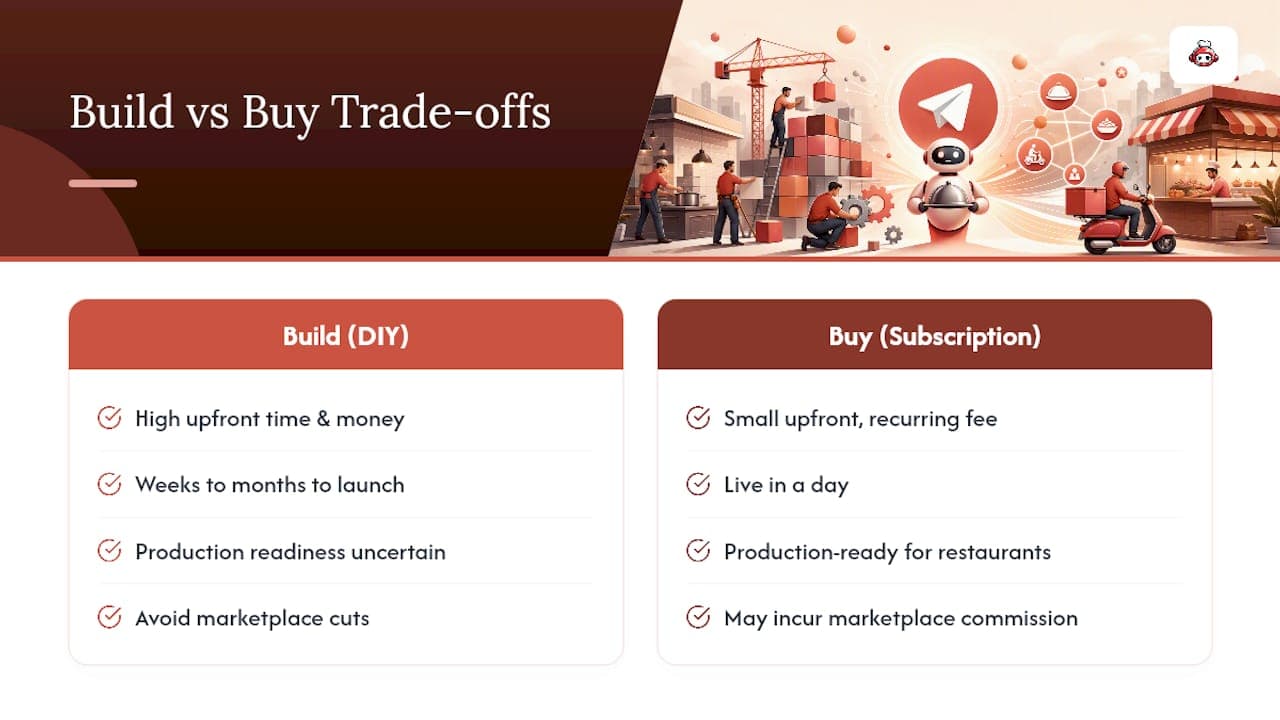
The commission math matters more than most owners realize until they run the numbers. A restaurant doing significant monthly revenue through a marketplace cut can lose more to commission each month than a full year of most subscription platforms would cost. That gap should be the first thing owners calculate, not the last.
Prioritize time-to-revenue over technical purity. A channel that's live and taking orders today beats a perfect architecture that ships in six weeks.
*— ADMIN*
Get Telegram Ordering Live Without Writing A Line Of Code
If you've read this far weighing bot frameworks against Mini-App architecture, there's a simpler path: RESTOBOT builds the whole thing for you, live the same day your application is confirmed. You get an omnichannel setup where Telegram and your website share one menu, one dashboard, and one order queue, with zero commission taken on any order, ever. That's the real advantage over both the DIY routes and the marketplace apps: you keep the full order value, and you're not stuck maintaining webhook code six months from now when Telegram updates its API.
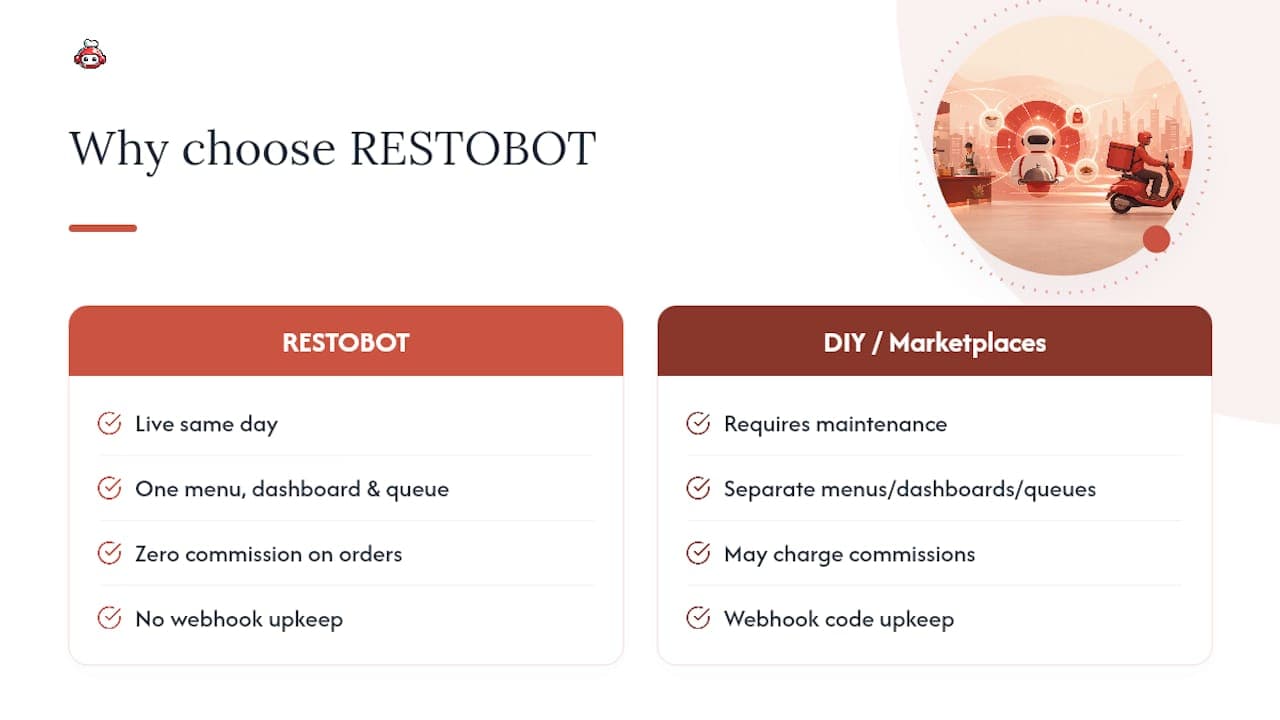
Restaurants that also want their servers collecting tips can add the standalone Tips feature separately, with no commission and no dependency on the restaurant's own subscription status. If you're ready to see your menu live on Telegram this week, start your application on the RESTOBOT platform and check what onboarding looks like for your restaurant's size and menu complexity.
Sources
FAQ
How Do I Order Food On Telegram?
Open the restaurant's Telegram bot or channel, browse the menu through inline buttons or a Mini-App interface, add items to a cart, and confirm your order with a delivery address or table number before paying.
How Can I Tell If A Telegram Seller Is A Scammer?
Check for an official, verified username matching the real business name, avoid any request to pay through an unfamiliar link outside Telegram, and report suspicious accounts directly through Telegram's built-in reporting tools.
Are There Good Telegram Channels For Food Deals?
Many restaurants and delivery services run dedicated Telegram channels for menu updates and promotions, but always verify the channel's username against the restaurant's official website before ordering or paying through it, like those featuring Rapini and Garlic Sausage offerings.
Do I Need A Developer To Add Telegram Ordering To My Restaurant?
Not necessarily. Open-source bots require development work for hosting and payments, but a platform like RESTOBOT sets up Telegram ordering automatically once your application is confirmed, with no coding required.
What's The Difference Between A Telegram Bot And A Mini-App For Ordering?
A bot uses text commands and inline buttons inside the chat, while a Mini-App opens a full web interface with a richer menu, cart, and checkout screen without leaving Telegram.