


A mandatory service charge is not a tip under IRS and Department of Labor rules. Tips are voluntary, chosen by the guest, and taxed as employee income. Service charges are set by the restaurant, belong to the business first, and get taxed as regular wages. If you see an automatic 18% or 20% added to your bill, you generally don't need to tip again, though extra cash for standout service is always welcome.
***
TL;DR:
>
- A mandatory 18% to 20% service charge usually counts as a service charge, not a tip, unless the customer has a real choice and sets the amount voluntarily. - Restaurants must distinguish between tips, which are voluntary and belong directly to employees, and service charges, which belong to the business and are taxed as wages. - Under IRS rules, a payment is classified as a tip only if it is made freely, at the customer’s discretion, without employer influence, and with the ability to choose the recipient. - Proper payroll procedures for service charges include separating revenue accounts, running distributions as wages, and offering POS options for zero-dollar tips to avoid misclassification. - Customers generally should not tip on top of a disclosed mandatory service charge, but an extra cash tip remains appropriate for exceptional service or delivery conditions.
***
Table of Contents
- Tipping vs Service Charge: The Core Difference
- The IRS Four-Factor Test and What It Costs You
- How Restaurants Should Record and Distribute the Money
- Should You Tip on Top of a Service Charge?
- Choosing a Model: Tips, Service Charges, or Both
- Why Transparency Beats Any Fee Structure
- A Commission-Free Way to Keep Voluntary Tips Voluntary
- Sources
- FAQ
Tipping vs Service Charge: The Core Difference
The line between the two comes down to one question: who decides the amount, and does the customer have a real choice? A tip is money the guest volunteers, in any amount, to whomever they choose. A service charge is a fee the restaurant builds into the bill, usually as a fixed percentage, that the guest cannot opt out of.
That distinction drives everything else, from who owns the money the moment it hits the register to how it shows up on a worker's paycheck. Here's the quick breakdown:
- Who sets the amount: guests set tip amounts; restaurants set service charge percentages, often 18% to 20%, sometimes listed as a "hospitality fee" or "kitchen fee."
- Is it optional: tips are always optional, even when a suggested percentage appears on a receipt or a POS screen; service charges are not optional once applied.
- Who owns it first: tips belong to the employee from the moment they're given; service charges belong to the restaurant, which then decides how (or whether) to share them with staff.
- How it's taxed: tips are reported as employee tip income; service charges are treated as restaurant revenue and, when distributed to staff, as regular wages subject to standard withholding.
- Where you'll see it: automatic gratuity for parties of six or more, banquet and catering fees, resort or venue "service fees," and delivery-app service fees are the most common real-world examples.
Digital ordering has muddied this further. A POS prompt that asks for 18%, 20%, or 25% with no zero option can look like a mandatory charge even when it's legally structured as a tip. That ambiguity is exactly why the IRS built a formal test.
The IRS Four-Factor Test and What It Costs You
The IRS four-factor test is the actual legal standard, and it's stricter than most restaurant owners assume. A payment counts as a tip only if all four conditions hold: the payment is made free from compulsion, the customer decides the amount, the payment isn't dictated by employer policy, and the customer generally has the right to decide who receives it.
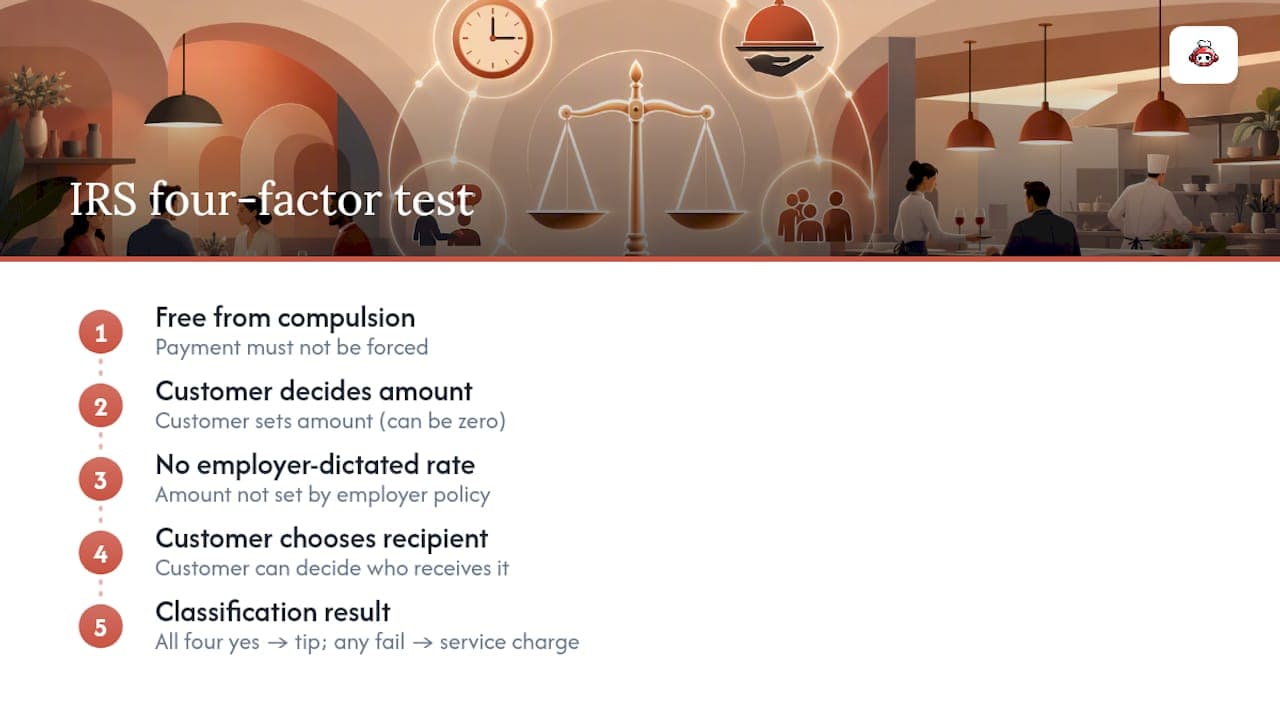
Fail any one of those four, and the payment is legally a service charge, no matter what the receipt calls it. The restaurant set the rate, the customer had no say, and there was no meaningful choice involved. Compare that to a suggested tip line at 20% with a blank space for the customer to write in any number, including zero. That structure passes.
The payroll consequences are where this gets expensive for operators. Tips reported by employees let the restaurant claim the Section 45B FICA tip credit, which offsets the employer's share of Social Security and Medicare tax on tip income above the minimum wage floor. Service charges get no such credit. When a restaurant distributes service-charge revenue to staff as wages, the full amount is subject to standard payroll tax, and the employer eats the FICA cost that a tip credit would have covered.
Overtime calculations shift too. Service-charge wages count toward the regular rate of pay used to calculate overtime; tip income handled correctly generally does not. And because state law varies on tipped-employee rules and tip credits, a restaurant operating in multiple states can't apply one payroll policy everywhere. Some states don't allow a tip credit at all, which changes the math on switching to a service-charge model.
How Restaurants Should Record and Distribute the Money
Getting this wrong on the books is how restaurants end up with a surprise reclassification and back taxes at year-end. A few practices keep things clean.
- Post service-charge revenue to its own general ledger account, separate from tip payables, so an auditor can see the distinction at a glance.
- When service-charge money is distributed to staff, run it through payroll as wages, with full withholding, not through a tip-pool cash-out process.
- Keep tip pools limited to employees who customarily receive tips; service-charge distributions can legally include back-of-house staff and managers in ways a tip pool often cannot.
- Configure the POS to always allow a zero or custom tip amount. Removing that option is one of the fastest ways to accidentally convert a voluntary tip into a service charge under the four-factor test, as IRS guidance on tip reporting makes clear.
- Reconcile weekly, not quarterly. Misclassified charges compound fast, and a quarterly catch-up often means amended payroll filings. A closer look at tip pooling rules is worth it before finalizing any pool structure.
Pro Tip: *If your POS vendor can't show you a setting for a true zero-dollar tip option, ask again before you sign. That single missing toggle can turn a compliant tipping system into a service charge overnight.*
Should You Tip on Top of a Service Charge?
Short answer: usually not, but read the receipt first.
- Check for disclosure. If the menu or receipt clearly states a mandatory service charge or gratuity, most etiquette guides agree you're not expected to tip again on top of it.
- Watch for exceptional service. A small additional cash tip for a server who went well beyond the baseline is a nice gesture, not an obligation. Standard sit-down tipping guidance puts baseline tips at 15% to 20% when no service charge applies.
- Ask if you're unsure where the money goes. Some "service fees" fund health insurance or fund back-of-house wages; others go straight into the restaurant's general revenue. A quick question to the manager clears this up fast.
- Adjust for delivery conditions. Bad weather, long distances, or heavy orders are reasonable reasons to tip above the baseline on a delivery order, service charge or not.
- Stay consistent rather than guilt-driven. Reporting on rising "tipflation" suggests diners do better sticking to a personal, budget-aligned tipping standard than reacting to every prompt a screen throws at them.
Choosing a Model: Tips, Service Charges, or Both
Owners weighing this decision should start with their state's labor rules, not their competitors' menus. States that allow a tip credit make voluntary tipping cheaper to run from a payroll standpoint. States that don't allow one narrow the cost gap between the two models considerably, per Department of Labor state guidance.
Three models dominate the industry right now. Straight voluntary tipping keeps the FICA tip credit and gives guests full control, but it creates income swings for staff and depends heavily on guest generosity. A flat mandatory service charge, often within a percentage range typical for the industry, smooths out pay and can fund back-of-house wages more fairly, but it forfeits the tip credit and adds to payroll tax exposure. A hybrid model, a small mandatory fee plus an optional tip line, is what many operators land on: it funds baseline equity while preserving upside for front-of-house staff.
Whichever model you pick, disclosure on the menu and at checkout matters more than the percentage itself, according to National Restaurant Association research on operator transparency practices. Configure the POS, code payroll correctly, and train staff to explain the charge if a guest asks.
Why Transparency Beats Any Fee Structure
Tipping fatigue is real, and rising menu prices haven't made digital tip screens any less annoying to guests. Some operators adopt mandatory fees for good reasons: pay equity across the kitchen and floor, and income predictability for staff who used to live on unpredictable tip swings. But no fee structure earns trust on its own.
Clear disclosure and a little empathy for both sides of the counter do more than any percentage choice ever will.
*— ADMIN*
A Commission-Free Way to Keep Voluntary Tips Voluntary
There's another wrinkle worth knowing about: even restaurants that adopt a mandatory service charge often still want a clean, separate channel for guests who want to tip a specific server directly. Mixing that into the same POS prompt as the service charge risks blurring the line the IRS test depends on.
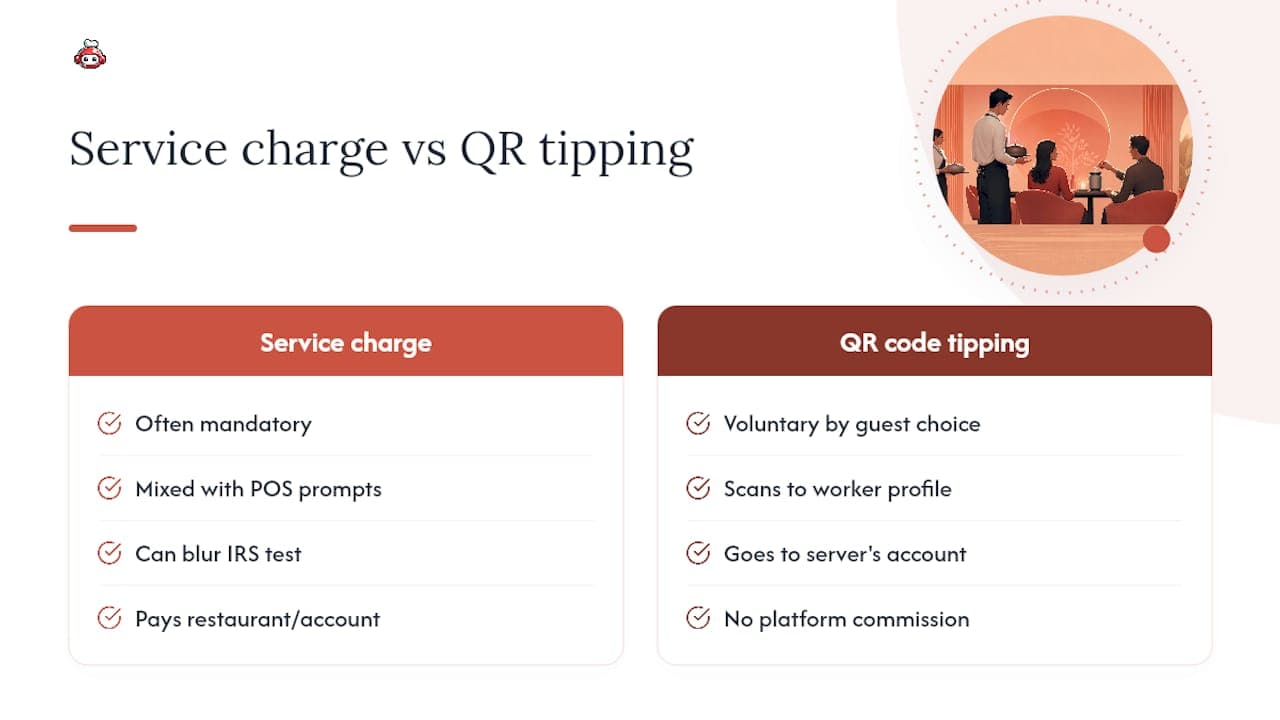
A tip feature can keep the two completely apart by allowing individual staff to set up a QR code profile and collect voluntary tips directly to their own account, without any commission taken by the platform. Guests scan, rate the worker, leave a comment, and pick any amount, including nothing at all, which keeps that money cleanly on the "voluntary" side of the tax line. It works whether or not the restaurant itself runs on RESTOBOT, so a server can start collecting digital tips even at a venue with no plans to change its POS system. Explore how QR code tipping works and set up a staff profile in minutes at RESTOBOT.
Sources
FAQ
Should I still tip if there's a service charge?
Usually not on top of a disclosed mandatory service charge, though a small extra tip for exceptional service is always appreciated and never wrong.
Is a 20% service charge the same as a tip?
No. A restaurant-set 20% charge fails the IRS four-factor test because the customer has no choice in the amount, which makes it a service charge, not a tip.
Is a 10% tip disrespectful?
Not automatically. It's below the typical 15% to 20% baseline for full-service dining, but tip amounts should reflect service quality and personal budget, not a fixed social rule.
Is a service charge the same as tipping?
No. A service charge is mandatory and owned by the restaurant first; a tip is voluntary and owned by the employee the moment it's given, per IRS guidance.