


Raise your TripAdvisor rank by prioritizing three things: steady recent reviews, timely owner responses, and a complete, photo-rich listing. TripAdvisor's own Popularity Index weighs review quality, recency, and volume above almost everything else, and owners who audit their listing and reply within 72 hours typically see movement inside 30 to 90 days. A tool like RESTOBOT can automate the review requests and QR follow-ups that make this cadence sustainable instead of a one-time scramble.
***
TL;DR:
>
- Regularly generating new reviews within 30 to 90 days significantly improves your ranking, especially when reviews are recent and high quality. - Responding to reviews within 72 hours and using specific, personalized replies maximizes engagement and signals active management to TripAdvisor. - Maintaining a complete, accurate profile with current hours, menus, and at least 20 varied photos enhances user trust and clicks, indirectly boosting your ranking. - A steady review cadence, tracked weekly, outweighs sporadic efforts, and benchmarking against nearby competitors reveals actionable gaps in reviews and response times. - Automating review requests and profile updates with tools like RESTOBOT streamlines the process, helping sustain momentum and avoid ranking dips.
***
Table of Contents
- Weekly Checklist to Start Improving Your Ranking
- How Does TripAdvisor Rank Restaurants?
- What's the Best Way to Ask for Reviews?
- How Fast Should You Reply to Reviews?
- Which Listing Details Actually Move the Needle?
- Your 30/60/90-Day Plan for Steady Ranking Gains
- How RESTOBOT Fits Into This Playbook
- Does TripAdvisor Punish Negative Reviews Harder Than It Rewards Positive Ones?
- Does Replying to Reviews and Answering Questions Really Affect Ranking?
- Do Bookings and Clicks Factor Into TripAdvisor Ranking?
- Why Do TripAdvisor Rankings Suddenly Drop?
- How Should You Benchmark Against Nearby Restaurants?
- A Founder's Take: Start With the Audit, Not the Hack
- Put This Playbook on Autopilot With RESTOBOT
- Where to Read More on TripAdvisor Ranking Strategy
- Sources
- FAQ
Weekly Checklist to Start Improving Your Ranking
Small, consistent actions beat any single big push. Work through this list in order, starting this week:
- Claim and audit your TripAdvisor listing. Fix hours, category, cuisine type, menu link, and contact details. A 30-minute audit is usually enough to catch the errors that quietly hurt visibility.
- Roll out a post-meal "satisfaction check." Train staff to ask one simple question after the main course, before the check arrives.
- Add QR cards to tables and receipts that link straight to your TripAdvisor review page.
- Start replying to every recent review within 24 to 72 hours, oldest unanswered ones first.
- Run a photo sprint to get your listing past 20 images this week, mixing dishes, staff, and the dining room.
- Set a weekly review target (even two or three) and track it on a simple spreadsheet or your management dashboard.
How Does TripAdvisor Rank Restaurants?
TripAdvisor's Popularity Index runs on three pillars: review quality, review recency, and review quantity. Quality means your star average, but recency is the multiplier most owners underestimate. A restaurant with 400 reviews from three years ago and one from last week ranks worse than a newer spot with 80 reviews arriving steadily, because fresh feedback signals an actively managed, currently good experience.
Quantity still matters, but it's the weakest of the three pillars on its own. A pile of old five-star reviews with no recent activity reads to the algorithm as a business that peaked and stalled. That's the misconception that trips up a lot of owners: they assume a strong historical rating is a permanent asset. It isn't. TripAdvisor's ranking logic rewards momentum, not history.
Two things to keep in mind on the compliance side. First, Sponsored Placements are paid, labeled slots, and they don't touch your organic Popularity Index position. Paying for visibility doesn't fix an underlying reviews problem. Second, buying reviews or offering incentives for them violates TripAdvisor's policies and puts your listing at risk of moderation flags or penalties. The platform's fraud detection has gotten sharper, and a sudden unnatural spike in five-star reviews is exactly the pattern it's built to catch.
What's the Best Way to Ask for Reviews?
Timing decides whether a review request works or gets ignored. The strongest moment is right after a guest has a genuinely good experience, before they've left the building or hung up the phone. The post-main-course "satisfaction check" outperforms asking during ordering or at the very start of the meal, because the guest hasn't fully evaluated the food yet, at that point.
Use more than one channel so the ask doesn't rely on any single touchpoint:
- In-person scripts at the table, delivered by a server trained to phrase it naturally.
- QR table tents placed near the check or dessert menu, not at the entrance.
- Receipt links for guests who prefer to leave a review later, from home.
- Email or Review Express follow-ups for delivery and reservation guests, sent within a day of the visit.
Two scripts cover most situations. For a clearly happy table: "Glad you enjoyed it. If you have thirty seconds, a TripAdvisor review helps other diners find us." For a neutral or unclear experience: "Thanks for coming in. We'd love your honest feedback on TripAdvisor, good or bad, so we know what to work on."
Ask every table, not just the ones that look thrilled. Selectively asking only happy guests, or offering a discount in exchange for a review, both violate TripAdvisor and FTC rules on incentivized reviews. It also skews your data, so you stop hearing about the problems that actually need fixing.
Pro Tip: *Assign the ask to one specific role, like a floor lead, rather than leaving it to "whoever remembers." Diffuse ownership is the number one reason review requests quietly stop happening after the first week.*
How Fast Should You Reply to Reviews?
Reply within 24 to 72 hours whenever possible. Response speed and specificity both correlate with better visibility and conversion, and a fast reply signals to TripAdvisor, and to future guests, that the business is actively managed.
Match the tone to the rating:
- 5-star reviews: Name something specific the guest mentioned. "So glad you loved the short rib and that Maria took care of you, we'll pass it along" beats "Thanks for the kind words!" every time.
- 3 to 4-star reviews: Acknowledge the specific gap they raised and note what you're doing about it, without getting defensive.
- 1 to 2-star reviews: Apologize plainly, address the specific complaint, and invite them to contact you directly to make it right.
Generic "thank you for your feedback" replies do almost nothing. Detail-rich responses that reference what the guest actually said act as a stronger platform signal and read as more trustworthy to anyone scrolling reviews before booking. If a review contains false claims or violates guidelines, document screenshots and specifics before requesting removal. TripAdvisor rarely acts on a removal request without evidence.
Which Listing Details Actually Move the Needle?
Your TripAdvisor profile is only as strong as its weakest field. Audit these first:
- Category and cuisine type, set precisely rather than a broad catch-all.
- Hours, checked against actual current hours, including holiday exceptions.
- Menu link, working and current, not a PDF from two menus ago.
- Contact info and amenities, filled in completely: parking, outdoor seating, accessibility, price range.
Photos deserve their own focus. Listings with 20 to 30 or more photos get noticeably more engagement than sparse profiles, and variety matters more than volume alone: signature dishes, the dining room, the exterior at night, and yes, your team. Guests book restaurants they can picture themselves in.
Small details help too. Use descriptive file names and captions instead of generic "IMG_2024" uploads, and keep your menu and price range consistent across TripAdvisor, Google, and your own website. Mismatched prices between platforms are a small but common trust killer.
Your 30/60/90-Day Plan for Steady Ranking Gains
Turning tactics into a habit is what separates owners who see lasting movement from owners who spike once and fade.
- Week 1: Audit the full listing, fix stale fields, upload your first batch of new photos, and put reply templates in place for all star levels.
- Weeks 2 through 4: Train staff on the satisfaction-check script, launch QR cards and email follow-ups, and start logging your weekly review count.
- Days 31 to 60: Run a second photo sprint to keep the profile fresh, hold your reply window to under 72 hours, and aim for a consistent weekly review pace rather than sporadic bursts.
- Days 61 to 90: Check whether your rank has moved, resolve any flagged or disputed reviews, and adjust your weekly target based on what actually worked.
Treat this less like a one-time project and less like a checklist you finish, and more like a recurring operational habit. TripAdvisor rewards momentum over time, and a small, repeatable weekly routine consistently beats an occasional big push followed by weeks of silence.
How RESTOBOT Fits Into This Playbook
Every task above gets easier with the right tools. Some platforms deploy a restaurant's own website, embedded menu, and QR ordering system rapidly after application confirmation, which gives you a ready channel for review-request QR cards and post-visit follow-ups without weeks of setup. Its omnichannel ordering, through the website and a Telegram bot, plus digital loyalty cards for Apple and Google Wallet, keep guests engaged between visits, and its dedicated review-boosting tools support the steady request cadence this playbook calls for.
Some platforms charge zero commission on orders, so review-driven repeat business goes straight to your bottom line, not to a marketplace's cut. Some platforms provide a dashboard for staff to log review activity and a standalone Tips feature that lets individual servers build their own public rating and collect guest feedback directly, reinforcing the same "ask right after a good experience" habit at the individual level.
Does TripAdvisor Punish Negative Reviews Harder Than It Rewards Positive Ones?
Not exactly, but the mechanics aren't symmetrical either. TripAdvisor's Popularity Index leans heavily on recency, which means a fresh negative review can drag your visible average down faster than an old positive one props it up. A single 2-star review posted this week carries more weight in the current ranking window than a 5-star review from eight months ago, simply because recency amplifies whatever comes in most recently, good or bad.
The practical effect is that owners often overreact to one bad review while underreacting to a slow drip of no new reviews at all. A quiet listing with a decent average but no recent activity tends to slide in visibility, even without a single negative comment, because the algorithm reads silence as stagnation. Meanwhile, a listing that gets occasional criticism but keeps generating fresh reviews overall, including plenty of positive ones, usually holds up better over time than a static, unresponsive profile.
This is why chasing a perfect star average is the wrong goal. A 4.4 average with reviews arriving every few days consistently outperforms a static 4.8 that hasn't moved in months. What actually protects you from a bad review's impact isn't hiding it. It's diluting it with a steady stream of new, mostly positive feedback and a prompt, specific response that shows you took the complaint seriously. Negative reviews that get a thoughtful public reply often do less damage to booking decisions than negative reviews left to sit unanswered.
Does Replying to Reviews and Answering Questions Really Affect Ranking?
Active engagement functions as a management signal, not just a courtesy. TripAdvisor's ranking system, and the guests reading your profile, both interpret prompt replies and answered questions as evidence that someone is actually running the business day to day. A listing with dozens of unanswered reviews from the past year looks abandoned even if the underlying restaurant is thriving.
The Q&A section on a listing gets overlooked by a lot of owners, but it works the same way reviews do. Answering a guest's question about parking, dress code, or dietary accommodations before they visit removes friction from their decision, and it adds another timestamped, recent piece of activity to your profile. An unanswered question sitting there for months signals the opposite.
Specificity is what separates engagement that helps from engagement that's just noise. A reply that says "Thanks, come again!" adds almost nothing. A reply that says "Thanks for mentioning the wait on a Friday night, we've since added a second host during peak hours" does two things at once: it answers the original guest and it tells every future reader that management actually acts on feedback. That second kind of reply is what practitioner guides mean when they talk about detail-rich responses acting as a platform signal.
The compounding effect matters here. One good reply is nice. Twenty good replies across a few months, paired with a handful of answered questions, build a visible pattern of active management that both the algorithm and human readers pick up on.
Do Bookings and Clicks Factor Into TripAdvisor Ranking?
Business metrics like booking conversions and click-throughs matter more for your own bottom line than as a direct input into the Popularity Index, but the two are connected in practice. A listing that converts well, meaning visitors who click through actually book a table or view the menu, tends to be the same listing that has current hours, a working menu link, and enough photos to make a decision easy. Those are the exact fields the ranking algorithm rewards for a different reason: complete, current information.
Think of it less as TripAdvisor directly tracking your conversion rate and more as both outcomes sharing the same root cause. A stale listing with dead links and three-year-old photos both ranks worse and converts worse, because the same neglect that hurts the algorithm's read of your business also stops a real diner from finishing the booking. Fix the listing completeness issue and you often see both numbers improve together.
Reservation integrations are worth paying attention to specifically. If your booking or reservation link is broken, slow, or redirects somewhere confusing, guests abandon before completing the action, and that lost conversion never shows up as a "problem" on the platform, it just shows up as fewer bookings and, indirectly, less momentum in reviews down the line since fewer diners means fewer chances to ask for one. Keeping your menu and contact details in sync across your website and your TripAdvisor profile closes that gap on both fronts at once.
The takeaway for owners: don't treat conversion optimization and ranking optimization as separate projects. A clean, accurate, fast-loading listing serves both goals simultaneously, and most of the fixes cost nothing but attention.

Why Do TripAdvisor Rankings Suddenly Drop?
Three patterns explain most sudden ranking drops. The first is a quiet gap in review activity. TripAdvisor's 2026 updates sharpened the penalty for stale listings, so a restaurant that was getting steady reviews and then stops for a month or two can see a real dip even without any negative feedback at all.
The second is a cluster of unanswered negative reviews. One bad review with no reply is a minor issue. Three or four in a row, all unanswered, reads as neglect and tends to coincide with visible rank slippage.
The third, and the most damaging, is a suspicious review pattern triggering TripAdvisor's fraud detection: a sudden burst of five-star reviews, reviews from accounts with no other activity, or reviews that read like they were incentivized. This can result in flagged reviews being removed or, in serious cases, the whole listing getting a moderation notice. Owners sometimes cause this by accident, running a well-meaning "leave us a review and get a free drink" promotion that technically violates the platform's rules.
Recovery follows the same order as prevention. Resume a steady weekly review pace immediately rather than trying to make up for lost time with a burst, since a sudden spike after a quiet period can itself look suspicious. Clear the backlog of unanswered reviews, oldest first, with specific and genuine replies. Audit the listing for anything that changed unnoticed, like an expired menu link or outdated hours. Most drops caused by neglect recover within a few weeks of consistent activity; drops caused by a fraud flag take longer and may require direct communication with TripAdvisor to resolve.
How Should You Benchmark Against Nearby Restaurants?
Competitor analysis on TripAdvisor works best as a diagnostic tool, not a scoreboard. Pull up two or three restaurants in your category and price range that consistently rank above you, and look specifically at three things: how many reviews they've gotten in the last 30 days, how quickly the owner or manager replies, and how many photos are on the listing.
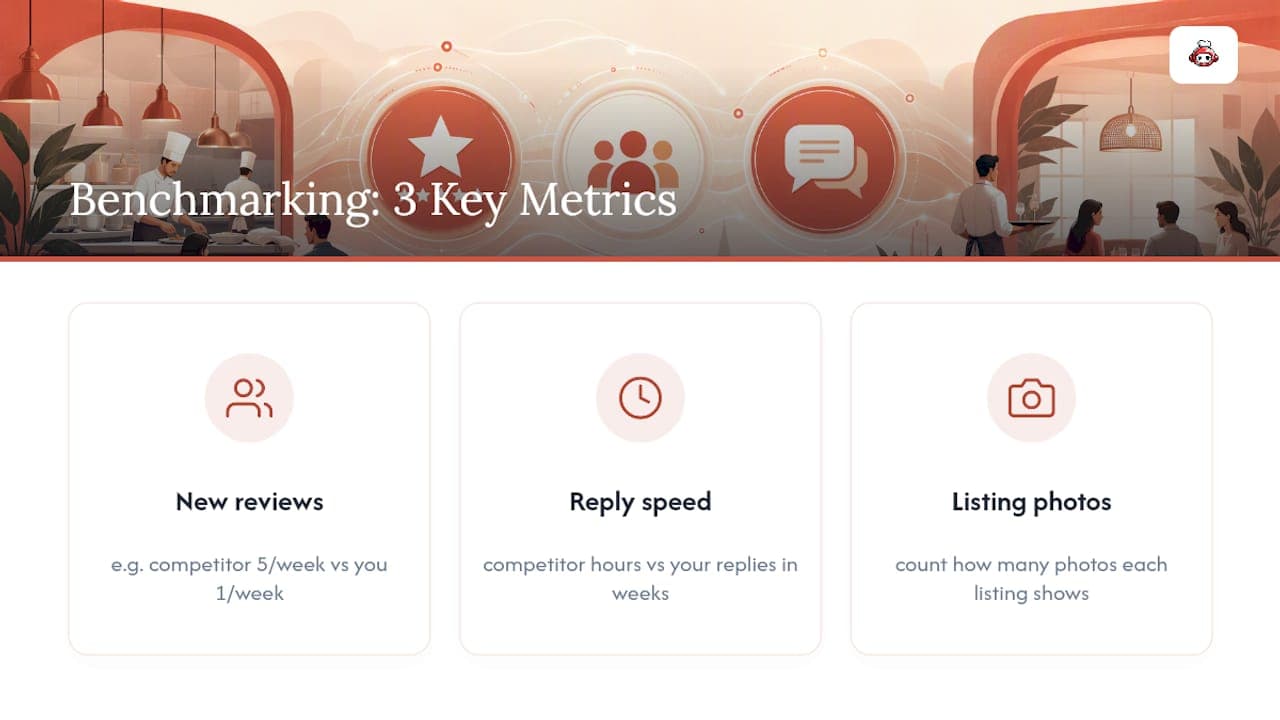
This comparison usually reveals the actual gap faster than guessing. If a competitor is getting five new reviews a week and you're getting one, that's your priority, not photos. If their reply times are measured in hours and yours stretch to weeks, that's the fix that matters most right now. Benchmarking against a moving target beats chasing an abstract "good" rating, because it shows you exactly what the algorithm is currently rewarding in your specific market and price segment.
Don't limit the comparison to star average alone. Two restaurants with identical 4.5 averages can be in very different ranking positions if one has reviews arriving weekly and the other's most recent review is from three months ago. Recency is often the hidden variable that explains why a seemingly "worse" restaurant with a lower average outranks a seemingly "better" one.
Revisit this benchmark monthly, not once. Competitor listings shift too, and a gap you closed last quarter can reopen if a rival restaurant ramps up their own review cadence while you plateau.
A Founder's Take: Start With the Audit, Not the Hack
Most owners want a shortcut, and TripAdvisor ranking doesn't really offer one that survives scrutiny. Start with the 30-minute audit: fix your listing fields, then roll out one staff script consistently instead of three half-implemented tactics.
Compliance matters as much as effort here. A steady, honest cadence of two or three reviews a week, replied to promptly, beats any shortcut that risks a moderation flag. Track your weekly review count and response time on a simple sheet. Those two numbers alone tell you if the plan is working before your actual rank moves.
*— ADMIN*
Put This Playbook on Autopilot With RESTOBOT
RESTOBOT is the practical alternative to running this playbook by hand across spreadsheets, sticky notes, and whatever a busy server remembers to say at table twelve. Every task in this guide, from QR review cards to post-visit follow-ups to keeping your menu and hours in sync across platforms, maps directly to a feature already built into the platform: instant website and menu setup, omnichannel ordering, automated review requests, and a dashboard that tracks it all in one place. Because some platforms charge zero commission on orders, the extra bookings a stronger TripAdvisor ranking brings in stay yours in full. If you want the audit-and-cadence approach in this article running automatically instead of managed by hand, set up your RESTOBOT website and start it this week.
Where to Read More on TripAdvisor Ranking Strategy
For owners who want to go deeper on any single piece of this playbook, a few sources back most of the claims above. ReviewGen.AI's TripAdvisor review guide breaks down the Popularity Index pillars and photo benchmarks in more detail. OrderBoosts' 2026 ranking guide covers review pacing and the risks of buying reviews. BGR Review's analysis of TripAdvisor's 2026 update explains the sharpened penalty for stale listings and response-time correlations. And Reviato's review operations playbook is the most useful starting point for the 30/60/90-day operational structure this article builds on.
Sources
FAQ
How Long Does It Take to See TripAdvisor Ranking Improvements?
Most owners see measurable movement within 30 to 90 days of consistent effort, though a fast listing audit can produce small gains in visibility within the first couple of weeks.
Can You Pay TripAdvisor to Rank Higher?
No. Sponsored Placements are paid, clearly labeled slots that sit separately from organic ranking and don't change your Popularity Index position.
Is It Safe to Offer a Discount for a Review?
No. Incentivizing reviews violates TripAdvisor's policies and FTC guidelines, and it puts your listing at risk of moderation flags or penalties.
How Many Photos Should a Restaurant Listing Have?
Aim for 20 to 30 or more photos, mixing signature dishes, the dining room, the exterior, and staff, since variety drives more engagement than volume alone.
What's the Fastest Way to Set Up Review-Request QR Codes?
A platform like RESTOBOT can generate a working restaurant website and QR-based ordering and review flow within a day of application confirmation, which removes the setup delay most owners run into.