

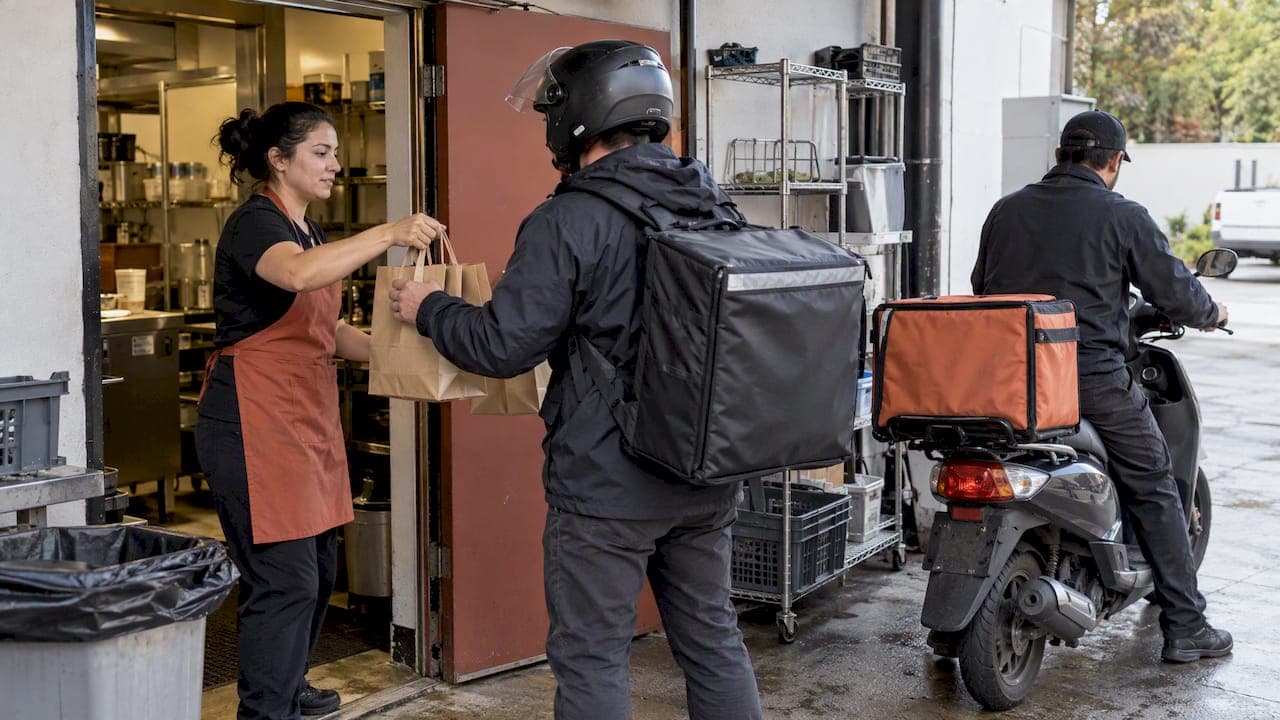
A hybrid delivery model in a restaurant means you do not choose between marketplaces and your own channel. You run both, and give each a different job. Marketplaces bring new customers who have never heard of you. Your own website and ordering channels serve everyone who already knows you, at a far lower cost per order. On top of that, you decide who carries the food: your own staff, a courier network, or either one depending on the hour.
A note on the term: "hybrid delivery model" also turns up in IT and project management, where it means blending onshore and offshore teams or Agile with waterfall. This article is about food delivery. If you run a restaurant, café or food business, read on.
TL;DR
- A hybrid model has two layers: where orders come from (marketplaces plus your own channels) and who delivers (your own team, a courier network, or a switchable mix of both).
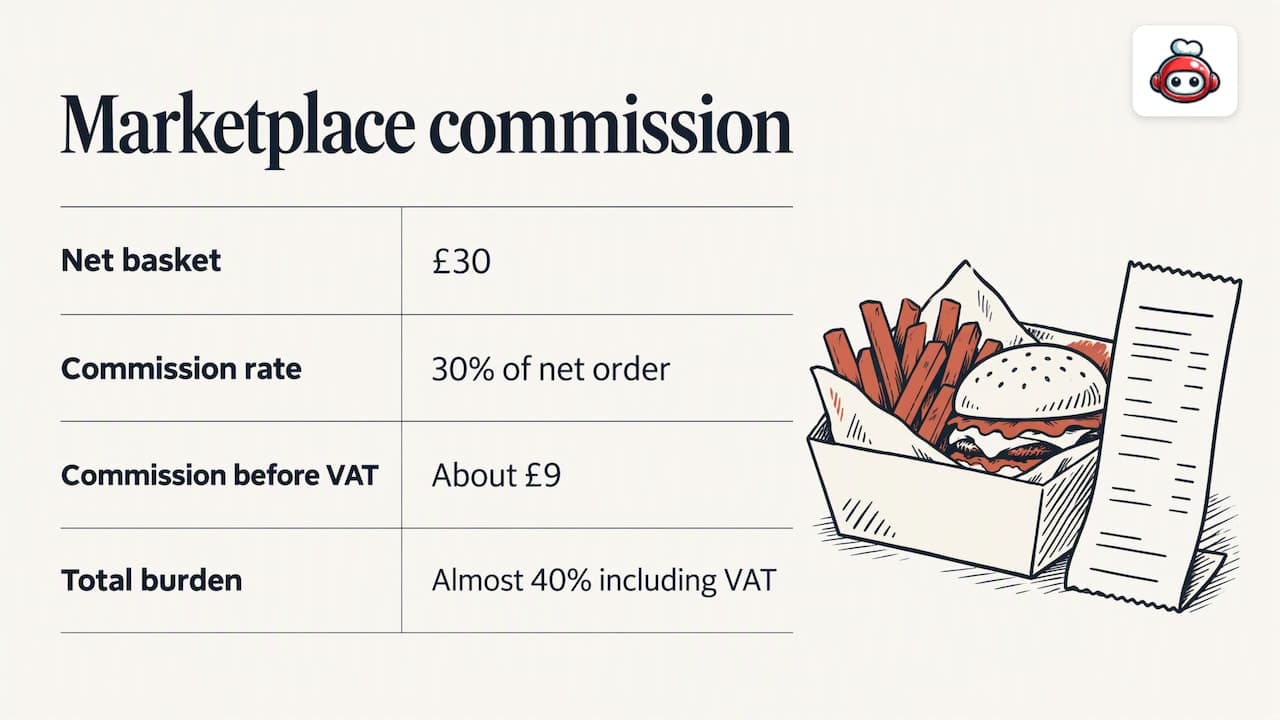
- Marketplaces charge 30% of the net order value plus VAT, almost 40% in total. Orders through your own channel on RESTOBOT carry 0% commission, only a monthly subscription.
- Use marketplaces for discovery and your own ordering for repeat custom, loyalty and margin.
- Couriers on demand cover surges and staff shortages, so you do not have to staff for your busiest hour all week.
- You can launch your own ordering site on RESTOBOT in a day, and the site itself is created instantly.
Table of Contents
- What a hybrid delivery model actually is
- Why the economics push restaurants towards it
- The two jobs: discovery and retention
- The fulfilment layer: your drivers, couriers, or both
- How to build a hybrid model, step by step
- Our perspective
- Pairing delivery with a wider channel strategy
- Running your own side of the model with RESTOBOT
- What can go wrong
- FAQ
- Sources
What a hybrid delivery model actually is
The phrase covers two separate decisions, and mixing them up is the most common source of confusion.
Decision one: the ordering channel. Where does the guest place the order? On a marketplace app such as Uber Eats, Deliveroo, Just Eat or Wolt, or on your own website, your own Telegram bot, or by phone? A hybrid operator uses several of these at once.
Decision two: the fulfilment. Who actually brings the food to the door? Your own drivers, a third-party courier network, or both. Marketplaces have started to formalise this: Deliveroo launched Marketplace+ in 2018, which lets restaurants with their own fleets appear on its platform and also tap its riders to extend their reach. Wolt did something similar in April 2024 when it added Wolt Hybrid Delivery as an option within Self-Delivery.
Put the two together and you get four basic set-ups:
| Set-up | Orders come from | Delivered by | Best for |
|---|---|---|---|
| Fully outsourced | Marketplace only | Marketplace couriers | Testing delivery with no investment |
| Own channel, own drivers | Your site or bot | Your staff | Tight local radius, strong regulars |
| Own channel, courier network | Your site or bot | Third-party couriers | Venues with no drivers but loyal guests |
| Hybrid | Marketplace and your own channels | Your staff and couriers, switchable | Venues that want reach and margin |
The last row is what most independent restaurants end up wanting, even if they begin in the first.
Why the economics push restaurants towards it
The reason is arithmetic. Marketplaces typically take 30% of the net order value, plus VAT on that commission, which brings the total burden to almost 40%. The Austrian competition authority's sector inquiry into online food delivery platforms examines how these platforms operate and why restaurants depend on them.
Here is a simple worked example with round numbers, not a forecast. Suppose a basket is £30 net of VAT. At 30% plus VAT, the marketplace's cut is about £9 plus VAT on that £9, so the commission alone approaches 40% of the order once the VAT is counted. On a food business with thin margins, that can wipe out the profit on the order, and if a guest orders weekly, you pay it again every single week.
The same guest ordering from your own channel costs you a monthly subscription, spread across all your orders, and no commission. RESTOBOT charges 0% on orders and only a monthly subscription. Our pricing page shows the current plans: MENU from €69 per month (€59 per year on the annual plan) and FULL from €119 per month (€99 per year).
That gap is why the sensible question is not "marketplace or not". It is "which orders should I be paying 30% for?" The honest answer: the orders you could not have won otherwise. A first-time customer who found you on an app is worth the fee. The same customer on their fifth order is not.
If you want the long version of the maths, our guide to how online ordering fees add up walks through the numbers, and direct ordering versus marketplaces compares the two side by side.
The two jobs: discovery and retention
Think of the model as dividing the customer journey in two.
Marketplaces: discovery
Marketplace apps are good at one thing: putting you in front of people searching "near me" who do not know you. For a new restaurant, a new neighbourhood or a quiet weekday, that visibility has real value. Treat the commission as a marketing cost and judge it as one.
Your own channel: retention and margin
Once a guest has tried you, the goal is to move them to a channel you own. That is where you hold the customer relationship, the contact details, the order history and the margin. Practical ways to do this:
- Put a card or QR code in every marketplace bag pointing to your own ordering page.
- Offer a small reason to switch, such as a loyalty stamp or a free side on the first direct order. Loyalty cards that sit in Apple Wallet and Google Wallet make the reward easy to find again.
- Keep your own menu and prices current, and make ordering take less effort than the app.
- Make sure your Google Maps and website link to direct ordering.
There is evidence that this is worth the effort. Market researchers cited by the trade outlet GV-Praxis report that guests using digital ordering and payment channels often spend more per order and come back more often than those using purely traditional methods. Circana data reported by Food Service shows that digital ordering frequency in foodservice roughly doubled between 2019 and 2023.
And the gap is still open. The Gastro Availability Index 2026, which analysed 1,602 venues in the DACH region, found that online menus are common but integrated reservation and ordering systems remain rare, with fewer than one venue in ten using an integrated reservation system. That data is from German-speaking markets, not the UK, but it shows how far even digitally active venues are from a joined-up set-up.
The fulfilment layer: your drivers, couriers, or both
The second half of a hybrid model is flexibility in who delivers. Running only your own drivers is cheap per order but fragile: one sick driver or one rainy Friday and you are turning orders away. Running only couriers is robust but costs you on every drop.
The hybrid answer is to switch. According to Wolt's announcement, restaurants using a hybrid set-up can turn on an external courier network during unexpected surges or staff shortages and turn it off again to go back to their own delivery staff. That protects service at the peak and margin the rest of the time.
A sensible rule of thumb:
- Quiet hours: your own staff deliver nearby orders, or guests collect.
- Peak hours: couriers take the overflow or longer-distance drops.
- Bad days: couriers take everything, so your kitchen and front of house are not stretched.
You do not need to be on a marketplace to use this. RESTOBOT coordinates delivery through third-party couriers such as Wolt Drive, so orders placed on your own website or Telegram bot can be handed to a courier network when you need it. Our guide to delivery management software for restaurants covers what to look for in the tools that do the dispatching.
How to build a hybrid model, step by step
- Work out your real cost per marketplace order. Take the commission, the VAT on it, any promotion you fund and refunds. Compare it with the contribution margin on that dish. Many menus have items that only work on a direct order.
- Set up your own ordering channel. You need a site with an embedded menu, online payment and an order dashboard. On RESTOBOT the website is created instantly and you can launch in a day. Orders come in from your website and the Telegram bot, and guests can pay by several methods, including cryptocurrency.
- Decide the delivery rule. Pick a radius your own staff can serve, and decide when couriers take over.
- Keep marketplaces for reach. Stay on one or two apps, not five. More listings mean more commission without much more demand.
- Move regulars across. Bag inserts, QR codes, loyalty cards and reminders do the work. Track how many orders move from marketplace to direct each month.
- Review monthly. Look at the split of orders by channel, the average basket and the repeat rate. Adjust the radius, the offers and the delivery rule.
For a more detailed rollout, see our walkthrough on how to promote online ordering to your existing guests, and our overview of commission-free online ordering.
Our perspective
We built RESTOBOT for restaurants that want the money they earn to stay with them. We see the hybrid model as the realistic middle path: few independents can walk away from marketplaces overnight, and few should want to stay entirely dependent on them either.
The mistake we see in the way owners discuss this is treating marketplaces as either the enemy or the answer. Industry experts make a similar point: legacy catering habits persist because of long-standing "industry recipes", and digital platforms are better seen as tools to diversify revenue than as mere competitors. We agree. Use the platforms for what they are good at, and build the asset you own in parallel.
Three principles guide how we design for it:
- One place to run it. Website, menu, online ordering, reservations, loyalty cards, reviews and delivery in one dashboard, so the hybrid model does not mean five logins.
- No commission on your own orders. We charge a subscription and nothing on orders, so growth in direct orders improves your margin instead of ours.
- Fast to start. A model you can test this week is better than a plan you postpone. The site is created instantly and you can go live in a day.
If your direct channel is still a phone number and a PDF menu, that is the first thing to fix, before adding more marketplaces.
*— ADMIN*
Pairing delivery with a wider channel strategy
A hybrid delivery model is one example of a wider idea: spread demand across channels, but keep the strongest relationships on your own. The same logic applies to how you get found online, and this guide to building cross-channel strategies for growth is a useful read if you are thinking about how marketing channels work together.
Running your own side of the model with RESTOBOT
If you want the owned half of a hybrid model without building it yourself, RESTOBOT gives you a customisable website with an embedded menu and reservations, ordering via your website and Telegram bot, online payments, loyalty cards in Apple and Google Wallet, courier coordination such as Wolt Drive, and real-time order control. There is no commission on orders. Plans are MENU from €69 per month and FULL from €119 per month, or €59 and €99 per year on annual billing. See the plans and pricing to choose one.
What can go wrong
- Cannibalising yourself. If your direct prices are higher than the app, guests will not switch. Many operators price the same or slightly better direct.
- Too many marketplaces. Each one adds commission and admin. Choose the one or two with the best reach in your area.
- No plan for peaks. A direct channel that cannot deliver on a Saturday night frustrates the very regulars you want to keep. Set up courier overflow before you promote it.
- Ignoring the data. If you do not track the channel split, you cannot tell whether the model is working.
FAQ
What is a hybrid delivery model for a restaurant?
It is a set-up where you take orders through both marketplaces and your own channels, and deliver using a mix of your own staff and third-party couriers. Each channel has a clear job: marketplaces for finding new guests, your own channel for repeat orders and margin.
Is a hybrid delivery model cheaper than using only marketplaces?
Usually, yes, once a share of your orders moves to your own channel. Marketplaces take 30% of the net order value plus VAT, almost 40% in total, while orders on RESTOBOT carry 0% commission and you pay only the monthly subscription. The saving depends on how many orders you move across.
Do I need my own drivers?
No. You can use your own staff, a courier network, or switch between them. RESTOBOT coordinates delivery through third-party couriers such as Wolt Drive, so you can start without hiring drivers.
How quickly can I launch my own ordering channel?
With RESTOBOT the website is created instantly and you can launch in a day. Marketplaces can then stay in place while you move regulars across.
Does "hybrid delivery model" mean something different in IT?
Yes. In IT and project management it usually means combining onshore and offshore teams, or Agile and waterfall methods. The restaurant meaning is about channels and couriers.
Sources
- Wolt introduces Wolt Hybrid Delivery, Wolt Newsroom
- Deliveroo, Wikipedia
- Branchenuntersuchung Online-Plattformen für die Lieferung von Speisen, BWB
- Digital Talk: Wie Technologie Ihr Business voranbringen kann, GV-Praxis
- Digitalisierung: Gäste lieben digitales Bestellen, Food Service
- Digitale Verfügbarkeit DACH-Gastronomie 2026, Gastroinsider
- Digitale Plattformen: Ein neues Rezept für die Gastronomiebranche?, Momentum Kongress