

A restaurant minimum order is the smallest basket a customer must reach before you will deliver (or sometimes accept the order at all). Set it by working out what a delivery actually costs you, then choosing a figure that leaves a sensible margin on the smallest order you are willing to take. Show it before checkout, keep it tied to the food total, and never let it push guests into buying things they do not want.
Below you will find a worked formula, example thresholds by type of venue, the transparency rules to respect in the UK, and the alternatives that often work better than a hard floor.
TL;DR
- A minimum order exists to stop small baskets from losing money once packaging, courier time and handling are counted.
- Start from your real cost per delivery and your average margin, not from what the restaurant down the road does.
- Display the minimum before the guest starts to build a basket. Surprise charges at the last step are what get venues into trouble.
- A free-delivery threshold often works better than a hard minimum because it nudges guests upwards instead of turning them away.
- On marketplaces you pay 30% of the net order value plus VAT, almost 40% in total. On your own ordering channel, that commission is gone, and a minimum order only has to cover your own delivery costs.
Table of Contents
- What a minimum order is, and what it is not
- Work out your real cost per delivery
- Example thresholds by type of venue
- Why a minimum matters more on marketplaces
- Show it clearly: transparency and fair pricing
- Avoid forcing guests to buy what they do not want
- Alternatives and companions to a hard minimum
- Our perspective: set it from your costs, not from your competitors
- Setting it up on your own ordering channel
- A short checklist before you publish your minimum
- FAQ
- Sources
What a minimum order is, and what it is not
A minimum order value (MOV) is the smallest amount a customer must spend to qualify for delivery. You set it so that every delivery covers your time, fuel and packaging and still earns a reasonable margin. The idea is older than delivery apps: restaurants have applied it to phone and WhatsApp orders for years, as iFood's explainer on the concept notes.
It helps to separate three things that readers often mix up:
- Minimum order for delivery. A basket threshold for orders that leave the building. This is what most of this article covers.
- Minimum order for collection. Rarer, and usually a sign that the kitchen is too busy to bother with a single coffee. Most venues skip it.
- Minimum spend in the dining room. A per-head spend or a table minimum, typical for peak evenings, private rooms or large groups. It belongs to your booking policy, and it should be stated on the booking page and in the confirmation message.
The rest of the article focuses on delivery, because that is where the arithmetic is tightest.
Work out your real cost per delivery
Guessing is how venues end up with a £10 minimum that loses money on every order. Add up what one delivery really costs you:
- Courier cost. Your own driver's time for a typical round trip, or the fee your third-party courier charges per drop.
- Packaging. Containers, bags, cutlery, napkins, sauce pots. Count the full set for a typical order.
- Handling. Kitchen time to pack, plus staff time to hand over and check the order.
- Payment processing. Card fees on the basket.
- Platform costs. On your own channel this is your subscription divided by the number of orders. On a marketplace it is the commission.
Then compare that total with the gross margin on the food. If a basket has a food margin of £6 and the delivery costs you £5, the order earns you £1. A basket that earns you nothing is a favour to the customer, not a sale.
A simple formula
Minimum order = cost per delivery ÷ food margin rate, then round up to a number guests find natural.
Worked example (the figures are illustrative, so replace them with your own):
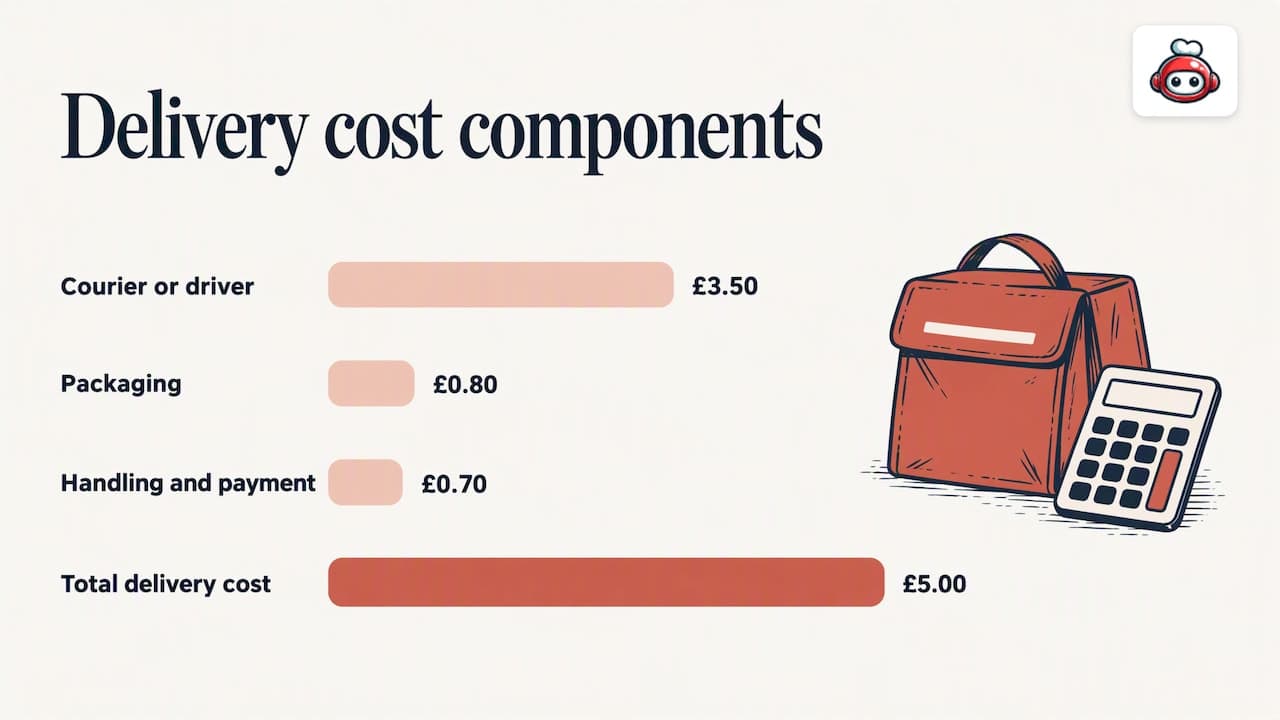
- Courier or driver: £3.50
- Packaging: £0.80
- Handling and payment fees: £0.70
- Total cost per delivery: £5.00
- Gross margin on food: 65 pence in the pound
Divide £5.00 by 0.65 and you get about £7.70. That is the basket at which the delivery merely breaks even. To earn something, add a cushion: a £15 or £18 minimum leaves you a clear profit on the smallest order you accept. The cushion matters because real orders are not tidy: an extra rider wait, a remade dish or a refund quickly swallows a thin margin.
If you have a few months of order data, check your average order value first. A minimum set far below it does little, while one set far above it will cut a large share of your orders. Aim for a figure that is comfortably above your cost floor and slightly below what a typical customer already spends.
Example thresholds by type of venue
These are starting points to test, not rules. They show how the logic changes with the menu.
| Venue type | Typical basket | Sensible starting minimum | Why |
|---|---|---|---|
| Coffee shop or bakery | £6 to £10 | None for collection; £12 for delivery | Low prices, so delivery only works once several items are added |
| Burger or street-food kitchen | £14 to £20 | £15 | Packaging-heavy, so small baskets lose out fast |
| Indian or Chinese takeaway | £20 to £30 | £18 to £20 | Shared dishes make larger baskets natural |
| Pizzeria | £18 to £28 | £15 to £18 | Bulky boxes, strong appetite for add-ons |
| Restaurant with a sit-down menu | £25 to £40 | £25 | Delivery is an extra channel, so protect the kitchen from one-dish orders |
Set different minimums for different delivery zones if you can. A nearby postcode costs you less to serve than one at the edge of your range, so a lower minimum close by and a higher one further out is fair and easy to explain. We cover how to draw those zones in our guide to delivery rings and zones.
Why a minimum matters more on marketplaces
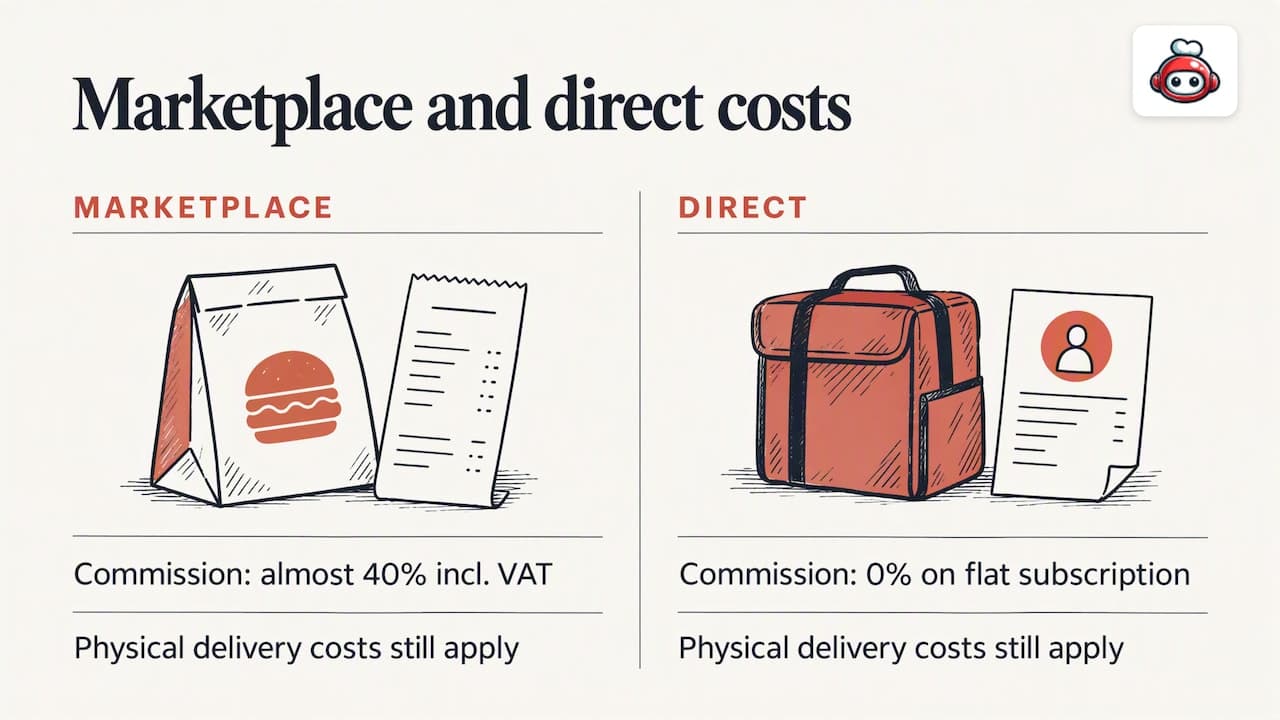
On Uber Eats, Glovo, Bolt Food, Wolt, Just Eat, Pyszne and similar platforms, the commission is 30% of the net order value plus VAT, which comes to almost 40% in total. That sits on top of your food cost, packaging and labour. On a small basket, those costs leave almost nothing.
This is why many restaurants set a higher minimum on marketplaces than on their own channel, or raise menu prices there. It is also why moving repeat customers to your own ordering page changes the maths. With a direct channel and a flat subscription, there is no commission to recover, so the minimum only has to cover the physical cost of the delivery. Our breakdown of how online ordering fees add up shows the effect on a monthly P&L.
Show it clearly: transparency and fair pricing
The most common complaint about minimum orders is not the number. It is finding out about it, or about a small-order surcharge, late in the process.
In the UK, the Competition and Markets Authority has published draft guidance on price transparency. It describes drip pricing as showing a headline price and then adding mandatory charges as the customer moves through the purchase. Check the final version of that guidance before you rely on it, and ask your local Trading Standards office if you are unsure how it applies to you. This article is not legal advice.
What good practice looks like in practice, whatever the final wording:
- State the minimum on the menu page, before any item is added.
- Show a running progress message in the basket, such as: *Add £4.20 more to order delivery*.
- If you charge a delivery fee or a small-order fee, show it in the basket total as soon as the address is known, not at the payment step.
- Make the final button say clearly that the guest is placing an order with an obligation to pay.
Other regulators take the same line. Poland's consumer authority UOKiK objected to Glovo's fee display because customers could not tell what the total would be, with small-order and service fees added late. That is a Polish case, not UK law, but it shows where regulators look when delivery charges appear at the last step.
Avoid forcing guests to buy what they do not want
A minimum becomes unfair when the only way to reach it is to take things the guest never wanted. Consumer authorities distinguish a fair threshold from tied selling, where a purchase is conditional on buying something else. The UOKiK material cited above makes the point that guests should be able to choose from the menu at fair prices.
In practice:
- Offer a range of low-cost items such as sides, drinks and desserts so guests can top up with something they like.
- Do not auto-add items to the basket.
- Do not hide the cheapest items in the menu.
- Suggest add-ons, but make them optional and easy to remove.
A well-organised digital menu does most of this work for you. Categories, photos, clear prices and sensible add-on suggestions let guests fill the gap themselves. If you are rebuilding your site at the same time, this guide to restaurant website design covers how layout and local search visibility affect whether guests find and trust your menu. For menu structure specifically, see our piece on online menu optimisation.
Alternatives and companions to a hard minimum
A hard minimum says no. There are gentler ways to get the same result.
Free delivery over a threshold
Industry guidance suggests that free delivery above a set amount works as a positive nudge: the guest is rewarded for adding one more item rather than blocked. Pair it with a modest delivery fee below the threshold and you keep small orders profitable without refusing them.
Example: delivery costs £3.50 under £25 and is free above it. If your typical basket is £21, a guest will often add a drink or dessert to cross the line.
A graduated delivery fee
Charge a fixed fee that reflects your actual cost rather than a percentage. A guide on transparent delivery pricing points out the flaw in flat fees: small orders lose money while large ones earn extra. Combining a fixed fee with a lower minimum, or tiering the fee by distance, evens this out.
Time-based or channel-based minimums
A higher minimum on Friday and Saturday evenings, when the kitchen and couriers are stretched, is reasonable if you state it up front. You can also keep a lower minimum for collection or for guests who order direct, which gives people a reason to leave the marketplaces. Our 30-day plan for promoting direct ordering covers how to tell regulars about it.
Letting someone else deliver
If you do not run your own drivers, a courier integration lets you charge the guest a delivery fee that mirrors what the courier bills you. Read more in our overview of delivery management software and the on-demand delivery plan.
Our perspective: set it from your costs, not from your competitors
We build ordering tools for restaurants, and the minimum-order question comes up in almost every conversation. Our view is simple.
Most venues copy a number from the nearest competitor, usually a marketplace listing. But marketplace minimums are built around a commission of 30% of the net order value plus VAT, almost 40% in total. Your own channel has a different cost structure. At RESTOBOT we charge only a monthly subscription and take 0% on orders, so the minimum on your own site is about physical delivery costs and nothing else. That usually means you can set it lower than a marketplace does, or replace it with a free-delivery threshold, and still protect your margin.
The second thing we see is guests dropping out because a fee appeared at the last step. Showing the minimum and any fees early costs you nothing and builds trust. We would rather see a venue lose the occasional £8 order than gain a reputation for surprises.
Third, review the number. Check it every quarter against courier prices, packaging costs and your average basket. A figure that was right last spring may be wrong now.
*— ADMIN*
Setting it up on your own ordering channel
When you run ordering on your own site, the minimum is a setting, not a negotiation with a platform. RESTOBOT gives you a website with an embedded menu, omnichannel ordering through your site and a Telegram bot, and delivery coordination through third-party couriers such as Wolt Drive. Your site can be created instantly and launched within one day.
The plans are billed monthly or yearly, with no commission on orders:
| Plan | Monthly | Yearly |
|---|---|---|
| LOYALTY | from €39 per month | €29 per year |
| MENU | from €69 per month | €59 per year |
| FULL | from €119 per month | €99 per year |
See what each plan includes on the RESTOBOT pricing page. If you want to compare the cost of direct ordering with marketplace fees first, our guide to online ordering pricing for restaurants walks through it, and the article on online payments explains how to collect money without a commission.
One more thing for your front-of-house team: guests who are happy with the service often want to say thanks. Staff can receive digital tips by QR code, paid straight to their own account with no commission taken by the platform. This is available on all plans, and a worker can register alone even if the venue is not on RESTOBOT.
A short checklist before you publish your minimum
- Calculate your cost per delivery with real figures.
- Check your average order value from the last few months.
- Pick a minimum above your break-even and below your typical basket.
- Decide whether free delivery above a threshold would work better.
- Show the minimum on the menu page and in the basket progress message.
- Show every fee before the payment step.
- Offer low-cost items so guests can reach the minimum with things they like.
- Review the number every quarter.
FAQ
What is a good minimum order for a restaurant?
There is no universal figure. Divide your real cost per delivery by your food margin rate, add a cushion, and then compare the result with your average basket. For many UK takeaways this lands somewhere between £15 and £25, but your own numbers should decide.
Can a restaurant refuse a delivery order below the minimum?
Yes, as long as the minimum is displayed clearly before the guest builds a basket and the rule applies to everyone. Hiding it until checkout is what causes complaints. If you are unsure about your obligations, ask your local Trading Standards service.
Should I charge a small-order fee instead of a minimum?
It can work, but the fee must be visible as soon as the basket is built. Many venues find a free-delivery threshold gentler, because guests see a reward for adding an item rather than a penalty for ordering less.
Do I need a different minimum for collection?
Usually not. Collection avoids the courier cost, so most venues set none or a very small one. If you do set one, say so on the menu page in the same way.
Does a minimum order apply to tips left for staff?
No. A minimum applies to the food basket. Gratuities for staff are voluntary and separate, and workers can collect them through RESTOBOT tips.