

To respond to a Tripadvisor review, log in to the Management Center, open the review and post a public management response. Thank the guest, name the specific thing they raised, say what you will do about it, and keep it short, calm and free of promotion. The wording matters more than the button, because the reply is read by every future diner who opens your listing.
This guide covers the structure that works, ready-to-adapt examples for the reviews you will actually receive, the rules Tripadvisor enforces on responses, and a routine that keeps replies from eating your week.
TL;DR
- Treat every reply as a public message to future guests, not a private note to one reviewer. Tripadvisor's own research found that a thoughtful response to a negative review improved the impression of the business for most travellers.
- For complaints use four moves: thank, apologise for the specific issue, give your side briefly, say what changes.
- Aim to reply within 24 hours. If you cannot, answer the negative reviews first.
- Never argue, never offer refunds in public, never add promotional content. Report blackmail through the Management Center instead.
- Make replying a fixed 10-minute routine and your review volume stays manageable.
Table of Contents
- Why replying is worth your time
- Before you reply: the practical steps
- The four-step structure for complaints
- Examples you can adapt
- Rules Tripadvisor applies to your response
- Speed and priority
- What not to do
- Build a reply routine that lasts
- Our perspective: replies are only half the work
- Where RESTOBOT fits
- FAQ
- Sources
Why replying is worth your time
A management response sits directly under the traveller's review and is visible to anyone looking at your page, as Tripadvisor's management response guidelines explain. That placement is the point. The person who wrote the review has probably already left. The people reading your answer are choosing where to eat on Saturday.
The numbers from Tripadvisor back this up. A study published by Tripadvisor reported that 77% of travellers are more likely to book a business whose owners give personalised responses, and that 63% of diners are more likely to choose a restaurant where the owner responds to the majority of reviews. It also found that 89% of travellers said a thoughtful response to a negative review improved their impression of the business. Note that this is survey data on stated intent, not a guarantee of bookings, and it dates from 2019. Treat it as a strong indication, not a promise.
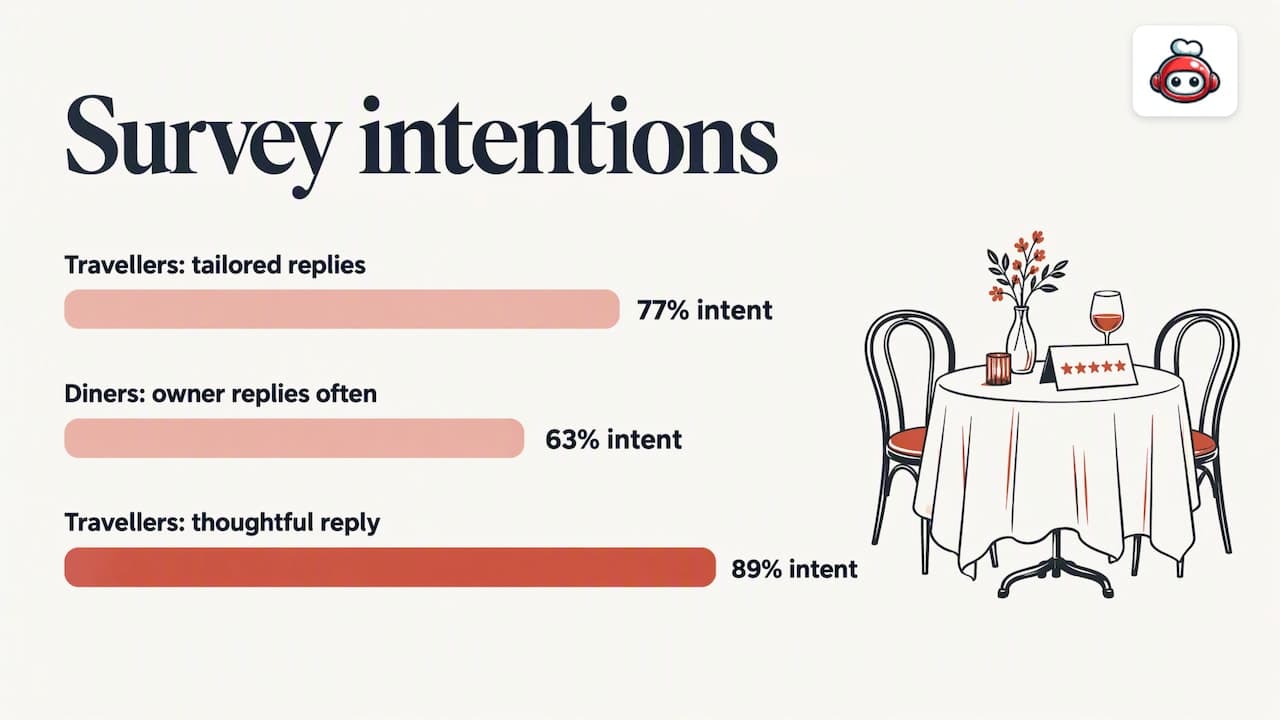
Tripadvisor's restaurant guidance adds that up to 94% of respondents read a management response and that most found it helpful.
There is academic support too. A study of managerial responses in hotels found that replying is particularly effective with low-satisfaction customers, where it helps limit rating decreases, while replies to frequent, loyal visitors had a statistically limited effect on their numerical ratings. The practical reading: spend your best effort on the new and the unhappy.
Before you reply: the practical steps
- Claim your listing. You need access to the Tripadvisor Management Center for your restaurant. Without it you cannot post responses.
- Open the review from the Management Center, or from your public page while logged in, and choose the option to respond.
- Read the full review twice. Note the date of the visit, the dish or member of staff mentioned, and the one thing the guest most wants acknowledged.
- Check the facts internally. Ask the shift manager or chef what happened. A reply that gets the detail wrong is worse than a late reply.
- Draft, then read it aloud. If it sounds defensive aloud, it will read as defensive on screen.
- Post and move on. Do not keep editing and re-posting.
The four-step structure for complaints
Tripadvisor's expert tips on handling online reviews describe a simple pattern for negative reviews: thank the guest for the feedback, apologise for the specific issue, explain the situation from your perspective, and outline the steps you are taking to fix or prevent it. It works because it covers what research on complaint handling calls fairness. A thesis from the University of Central Florida points to two ingredients: explaining the process or rules behind what happened, and treating the customer with dignity. Together they build trust among future readers of the thread.
In plain terms:
- Thank. One sentence, sincere, no corporate phrasing.
- Apologise for the specific thing. "Sorry the lamb was overcooked" lands better than "sorry you were disappointed".
- Give context, briefly. One or two sentences, never an excuse. If the kitchen was short-staffed, say what you have changed, not who was off sick.
- State the fix. A concrete step: a new pass check, extra staff on Friday evenings, a revised booking system.
- Invite them back or offer an offline route. An email address for the manager is enough. Do not offer compensation in the public thread.
Examples you can adapt
These are templates written for this guide, not real reviews. Change the names and details so each reply is genuinely personal. Copy-pasted replies are easy for readers to spot.
A complaint about slow service
Hello Priya, thank you for taking the time to tell us about your evening. You waited far too long for your main courses on Friday, and we are sorry. We had a large party booked in at the same time as your table and our kitchen timings slipped. Since then we have capped the number of large bookings per sitting and added a second person on the pass at weekends. If you would like to tell us more, please email the manager at the address on our page. We would be glad to welcome you back.
A complaint about food quality
Dear Mr Hughes, thank you for the honest feedback. A steak that arrived colder than you ordered is not what we want to serve, and we apologise. We have spoken to the kitchen team about holding times on the pass and we now check plates before they leave. We hope you will give us another try.
An unfair or inaccurate review
This is the hardest one. Stay factual and courteous, correct only what is demonstrably wrong, and do not accuse the guest of lying.
Hello Sam, thank you for your review. We are sorry your visit fell short. We would like to clarify one point for other readers: our kitchen closes at 9.30pm on weekdays, which is stated on our booking page. We would welcome the chance to hear more about your experience, so please contact us directly.
Experts warn that emotional or confrontational replies can turn a single bad review into a reputational problem, even when the guest is plainly wrong. Your professional tone is what readers judge.
A glowing review
Thank you, Aisha, what a lovely message. We will pass your kind words on to Marco and the kitchen team, especially about the slow-braised short rib. We hope to see you and your family again soon.
Tripadvisor's restaurant guide recommends starting with a thank-you even for regulars, and mentioning something the guest actually said.
A mixed review
Thank you, Daniel. We are delighted you enjoyed the starters and the atmosphere, and sorry the dessert menu was limited when you visited. We have since restored our full dessert list. We hope you will return and try it.
Acknowledge the praise and the problem in equal measure. Readers trust balanced replies.
Rules Tripadvisor applies to your response
Responses can be rejected, so know the rules. The management response guidelines ask that responses be original, which means no pasted guest correspondence or snippets of the traveller's review, and non-commercial, which means no promotional content and no offers of personal gain. They also expect responses to be family friendly and to follow Tripadvisor's content policy.
In practice that means:
- No discount codes, no "come back for 20% off", no links to your own booking page.
- No quoting the guest's words back at them, or copying private emails into the thread.
- No swearing, sarcasm or personal remarks about the reviewer.
- No naming staff members in a way that blames them.
Speed and priority
Tripadvisor's expert tips recommend that managers aim to respond within 24 hours, and if volume makes that impossible, to respond to all negative reviews first. That is a sensible triage:
| Priority | Review type | Target |
|---|---|---|
| 1 | Negative (1 to 2 stars), especially with a safety or hygiene allegation | Same day, after checking facts |
| 2 | Mixed (3 stars) | Within 24 hours |
| 3 | Positive from first-time guests | Within a few days |
| 4 | Positive from regulars | When time allows |
If a review mentions illness or an allergic reaction, involve the owner before replying, and take the conversation offline quickly. Keep the public line to an apology and a contact route.
What not to do
- Do not argue. You may win the point and lose the next fifty readers.
- Do not offer refunds or compensation publicly. Tripadvisor warns against public arguments or refund offers in comments, which can be misconstrued or used against you.
- Do not use the same template every time. Personalisation is the thing the research rewards.
- Do not ignore the good reviews. A brief, warm thank-you costs little.
- Do not reply while angry. Draft it, wait an hour, and have a colleague read it.
When a review looks like blackmail
Sometimes a guest threatens a bad review unless you give a refund or upgrade. Tripadvisor says to report it through the Management Center, ideally before the review is posted if you have forewarning, or immediately after if it is already live. Do not negotiate in the comments. Keep the messages as evidence and use the official reporting route.
Build a reply routine that lasts
One-off heroics do not work. A routine does.
- Set a daily slot. Ten minutes at the same time each day, owned by one named person.
- Keep a short log. Note recurring complaints: slow starters, noise, cold plates. A reply says what you changed, so you need to actually change it.
- Collect a bank of phrases, not scripts. Reusable openings and closings, with the middle always written fresh.
- Review monthly. Count how many reviews were answered and how many themes you fixed.
Tools can help with the drafting, as long as a human sends the final text. Some free tools for replying to reviews can suggest wording that you then edit so it keeps your own voice. For multi-site operators, a step-by-step guide to managing online reputation is useful for setting up one place where all review platforms are watched and prioritised.
Our perspective: replies are only half the work
We build software for restaurants, and the pattern we see is this: owners treat reviews as a problem to answer rather than a system to run. A good reply to a bad review limits damage. It does not create more good reviews, and it does not fix the cause.
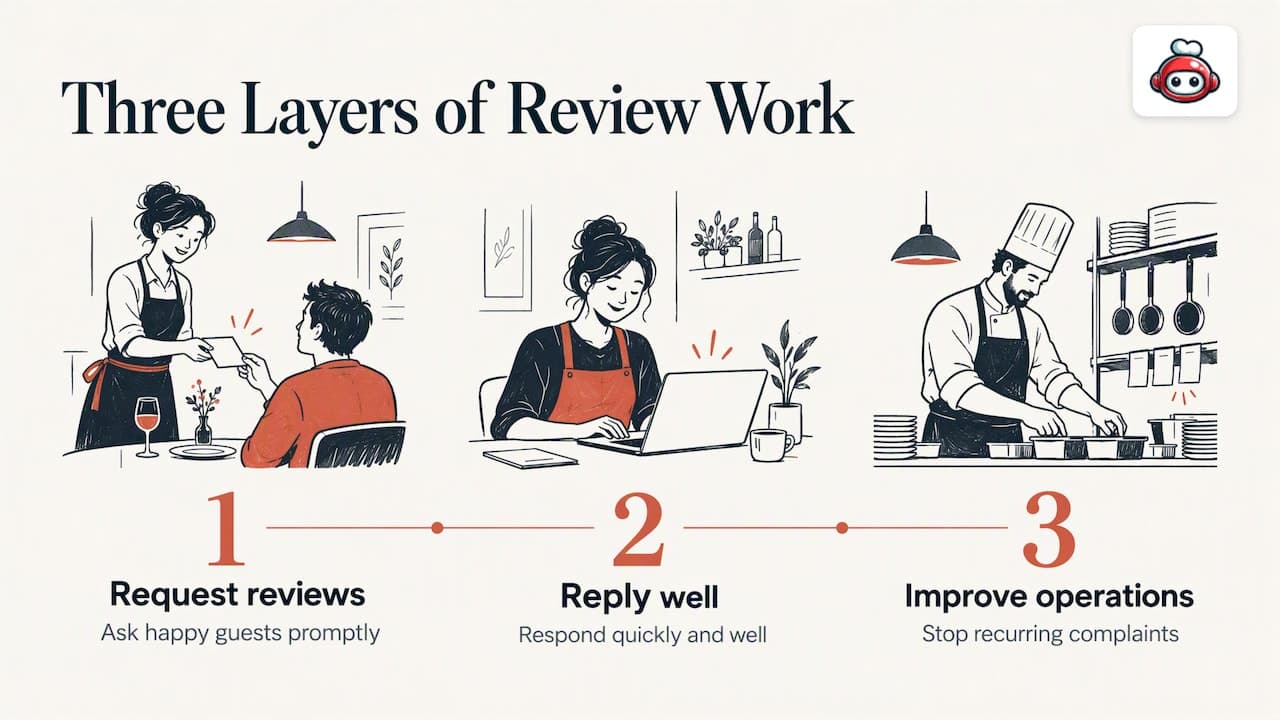
So we think about it in three layers. First, ask happy guests at the right moment, which is why we built automated review requests aimed at Google and TripAdvisor into RESTOBOT. Second, reply fast and well, using the structure above. Third, feed what you learn back into operations, so the same complaint stops arriving.
If you want the practical side of the first layer, our posts on automating review requests and on a 30/60/90 day plan to raise your TripAdvisor ranking go step by step. If Google is your bigger channel, see how to respond to Google reviews, where the reply paths differ slightly.
One last point: feedback about individual staff belongs to the staff. That is why we also built public ratings for individual workers, so praise for a great waiter reaches them directly instead of getting lost in a venue-level review.
*— ADMIN*
Where RESTOBOT fits
RESTOBOT is an all-in-one platform for restaurants: website with embedded menu and reservations, online ordering through your site and a Telegram bot, digital loyalty cards in Apple and Google Wallet, and automated review boosting for Google and TripAdvisor. We charge a monthly subscription and take no commission on orders. You can set up a site instantly and launch within a day.
Plans start from 69 EUR per month for MENU and from 119 EUR per month for FULL, with annual options of 59 EUR and 99 EUR per year respectively. Details are on the RESTOBOT pricing page.
FAQ
How do I respond to a Tripadvisor review as a restaurant owner?
Log in to the Tripadvisor Management Center, find the review and post a management response. It appears directly beneath the guest's review for everyone to see. Keep it original and non-promotional, as Tripadvisor's guidelines require.
What should a good Tripadvisor response to a negative review include?
Thank the guest, apologise for the specific issue, explain your side briefly and state what you are doing to prevent it happening again. Tripadvisor's own expert tips recommend that pattern. Avoid blaming the guest or staff.
How quickly should I reply?
Tripadvisor's guidance is to aim for within 24 hours. If you cannot manage every review, answer the negative ones first.
Can I offer a refund or discount in my reply?
No. Tripadvisor's rules ask for non-commercial responses with no offers of personal gain, and public offers can be misread or used against you. Invite the guest to contact you directly and resolve it privately.
What if a review is fake or a blackmail attempt?
Do not argue in public. Report it through the Management Center, as Tripadvisor advises, ideally before posting if you had a warning and straight away if the review is already live.
Sources
- Tripadvisor: management response guidelines
- Tripadvisor: 6 best practices when responding to restaurant reviews
- Tripadvisor study: 77% of travellers more likely to book when owners respond
- Tripadvisor: Expert tips on handling online reviews
- Tripadvisor: reporting potential blackmail
- Managerial responses to online reviews: a text analytics approach
- University of Central Florida thesis on responses to reviews
- Proto.pl on professional tone in review replies
- Launch & Found free tools
- Guide to managing online reputation for SMBs