

For most restaurants that want to protect margins and keep control, a fixed subscription, ideally a zero-commission subscription with customer-paid delivery, beats a per-order commission model. Monthly plans typically range from a low to a high fixed fee, offering far more predictable costs than marketplace commissions that can significantly reduce your revenue per order. RESTOBOT is one example of this subscription approach, charging no per-order commission at all.
***
TL;DR:
>
- A fixed subscription with no commission charges a predictable monthly fee, making it more cost-effective for steady-volume restaurants aiming to protect margins. - Per-order commission models can become costly as order volume increases, especially when marketplace fees and VAT stack on top of the listed prices. - Additional fees like payment processing, integration charges, and minimums can quietly inflate the actual cost per order beyond headline rates. - Zero-commission subscriptions like RESTOBOT offer quick setup, directly passing tips to staff, and eliminate fees based on order volume, improving profit stability. - When evaluating vendors, ask about hidden fees, data ownership, and support response times, and run short-term tests to verify net revenue impacts.
***
Table of Contents
- Which online ordering pricing model fits your restaurant?
- What restaurants typically pay for online ordering
- Fees that quietly inflate your online ordering costs
- How online ordering pricing changes your actual profit
- Which features are worth paying extra for?
- How long setup takes and what it really costs you
- What a zero-commission subscription changes about your math
- What I'd ask before signing any online ordering contract
- A subscription worth comparing against your current setup
- Sources
- FAQ
Which online ordering pricing model fits your restaurant?
Vendors pitch online ordering in three main shapes, and knowing which one you are looking at changes the entire conversation.
A subscription model charges a flat monthly or annual fee regardless of order volume. It suits restaurants that already have steady foot traffic or a loyal following and want predictable costs as orders scale.
A per-order commission model takes a percentage of each sale, often with no upfront fee, which appeals to brand-new restaurants testing demand but becomes expensive once volume grows.
A hybrid model blends a smaller subscription with a reduced commission, and this is where vendors sometimes disguise real costs behind a lower headline number.
Use this quick checklist when a vendor calls:
- If your goal is margin protection at steady volume, favor subscription or zero-commission pricing.
- If you need to test a new concept with minimal upfront risk, a commission-only trial can make sense temporarily.
- If a vendor quotes a "low commission" hybrid, ask what the commission applies to (gross sale or net after tax) before comparing numbers.
What restaurants typically pay for online ordering
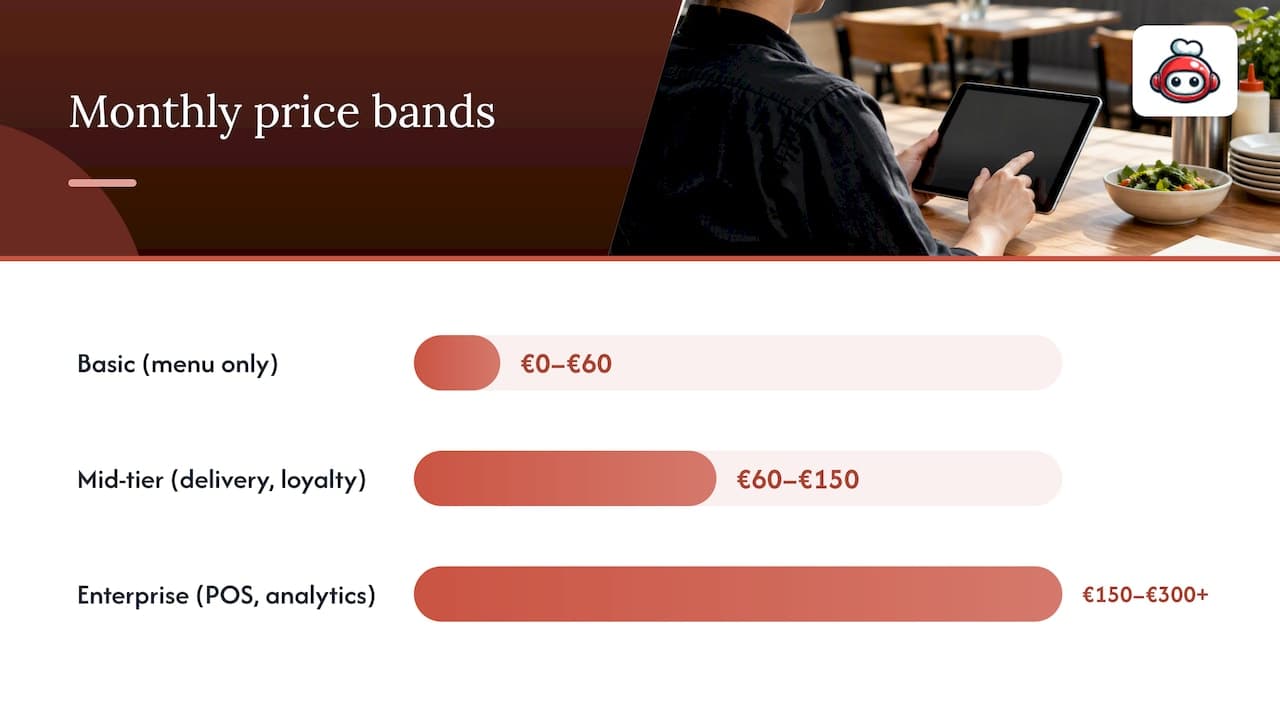
Expect three rough price bands. Basic or starter plans, often €0 to €60 per month, cover a simple online menu and order notifications. Mid-tier plans, roughly €60 to €150 per month, add delivery coordination, loyalty tools, and sometimes a custom domain. Enterprise or multi-location plans can run €150 to €300 or more per month, layering in POS integration and advanced analytics.
Setup or onboarding fees vary by vendor and sometimes cover training or data migration rather than the technical build itself, which can often happen automatically once an account is approved.
Per-order commissions from marketplaces often constitute a noticeable percentage of the order value before tax, with VAT applied on top of that commission increasing the overall cost.
- A single counter-service café might pick a basic plan focused on a clean online menu and simple checkout.
- A mid-size sit-down restaurant often needs a mid-tier plan with loyalty and delivery coordination built in.
- A multi-location group typically needs an enterprise-grade plan with centralized reporting across sites.
Fees that quietly inflate your online ordering costs
Beyond the headline subscription or commission rate, several line items change your real cost per order. Payment processing is usually billed separately, and who absorbs that fee (you or the customer) should be spelled out in the contract.
Watch for these before signing anything:
- Payment gateway or processor fees charged per transaction, on top of the platform's own pricing.
- API or integration fees for connecting your POS, plus any per-user or per-terminal charges.
- Monthly minimums that kick in if your order volume dips below a threshold.
- Onboarding, training, or support fees that are billed separately from the advertised plan price.
- Cancellation or data-export fees that only surface when you try to leave.
Marketplaces also layer service fees directly onto the customer's checkout total, which can make your menu look more expensive than it is in person, as shown on typical merchant listings on delivery marketplaces, where delivery fees and percentage-based service fees stack on top of the item price.
Pro Tip: *Ask every vendor to show you a sample invoice from an existing customer, not just the pricing page, before you sign.*
How online ordering pricing changes your actual profit
A simple formula clarifies what any pricing model really costs you: net revenue per order equals the order's sale price, minus the platform fee or commission, minus payment processing, minus any delivery cost you absorb.
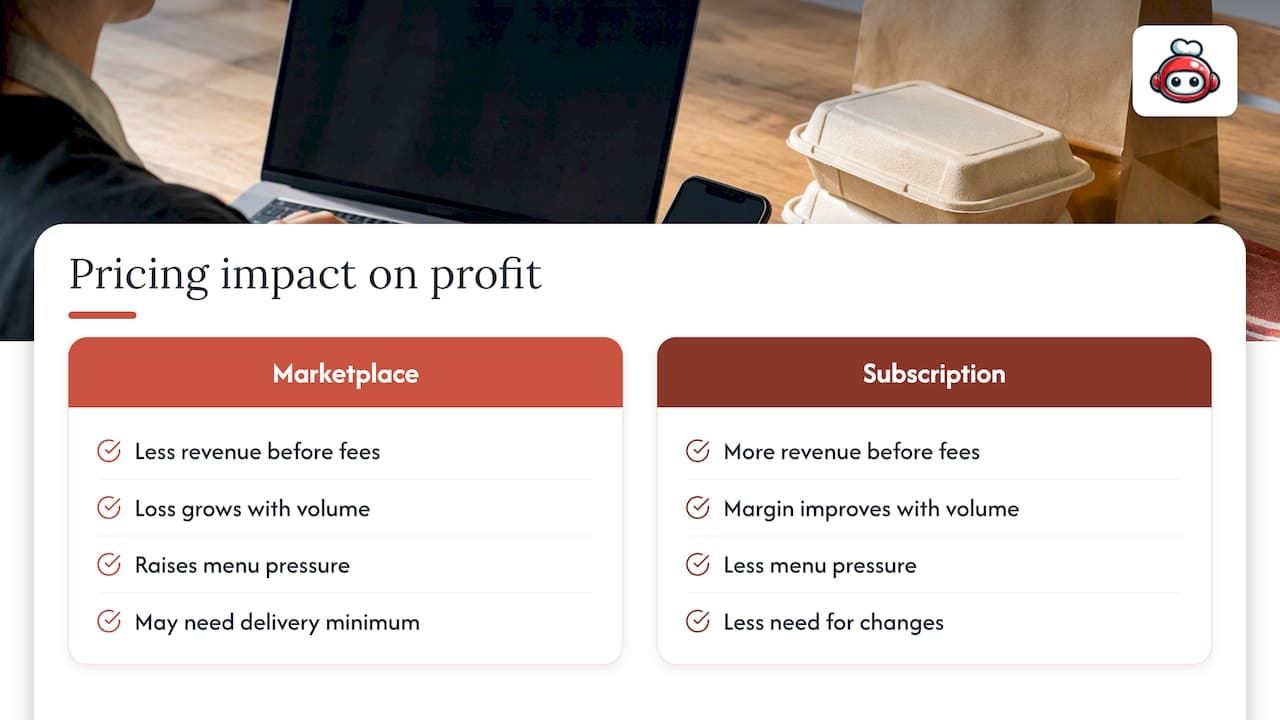
Say a restaurant does 1,000 orders a month at an average ticket of $25, for $25,000 in gross sales. A marketplace commission can significantly reduce your gross sales before processing fees, whereas a monthly subscription with no commission retains more of your revenue before those fees, with the difference increasing as order volume grows.
The 30/30/30 rule is a quick sanity check some operators use to flag menu pricing that cannot absorb marketplace commissions on top of ingredient and labor costs. When your commission and cost structure start eating that deeply into a ticket, raising delivery-specific menu prices or setting a delivery minimum protects margin without alienating in-house diners.
The growing scale of online food delivery means platform fees are only becoming a bigger factor in restaurant economics, not a smaller one.
Which features are worth paying extra for?
Not every add-on moves the needle on revenue or labor, so prioritize based on what your operation actually needs.
- POS integration saves staff time by syncing orders automatically instead of manual re-entry.
- Delivery orchestration matters most if you run your own drivers or coordinate multiple courier services.
- Loyalty and CRM tools pay off when repeat customers make up a meaningful share of your revenue.
- A custom domain or white-label storefront matters more for brand-building than for day-to-day operations.
- API access and multibranch management are usually enterprise-tier needs, not single-location ones.
A single-location counter-service spot rarely needs multibranch dashboards, while a growing group benefits from them immediately. When negotiating, ask for a staged rollout, a trial window before committing annually, and a written support SLA. For context on how EPOS integration specifically affects cost and order flow, see this breakdown of EPOS with online ordering.
How long setup takes and what it really costs you
Some platforms launch a basic ordering site the same day an account is approved, while full POS and delivery integration can take longer depending on how much syncing is involved.
- Budget for hardware or tablet costs if your current POS cannot handle online order volume.
- Factor in staff time for menu entry, photo uploads, and training on the new workflow.
- Calculate a 6- to 12-month total cost of ownership by adding subscription fees, processing fees, and any onboarding charges together, not just the advertised monthly price.
A detailed look at realistic launch budgets is available in this restaurant website cost guide.
What a zero-commission subscription changes about your math
RESTOBOT runs on a fixed monthly subscription (LOYALTY at €49, MENU at €99, FULL at €199) with no commission taken on orders or on tips through its Online tips feature. Sites may be built automatically once an application is confirmed, often within a short time, with ordering, payments, loyalty, and tipping included depending on plan.
- Zero commission means your break-even math stops depending on order volume to outpace a percentage cut.
- Rapid, automated site setup reduces the labor cost normally spent waiting on a developer.
- Tips go directly to staff accounts with no platform commission taken.
Before comparing quotes, check any vendor's pricing page for onboarding fees, custom domain rules, and which plan tier unlocks which features, the same questions worth asking about commission-free ordering generally.
What I'd ask before signing any online ordering contract
Ask three questions before signing: what fees are not on the pricing page, what happens to your data and menu if you cancel, and what support response time is guaranteed in writing. Run a 30 to 60 day pilot and track net revenue per order, not just order count. Rank priorities in this order: margin first, control second, extra features last.
*— ADMIN*
A subscription worth comparing against your current setup
If protecting margin matters more than chasing marketplace traffic, a flat-fee model worth putting next to your current numbers is RESTOBOT, which charges no commission on orders or tips and builds your ordering site automatically rather than over weeks of back-and-forth.
- Compare your current commission costs against RESTOBOT's flat LOYALTY, MENU, or FULL plans on the pricing page.
- Check which plan tier includes the custom domain or loyalty features your restaurant actually uses.
- Review the Online tips feature if your staff currently loses a cut of tips to another processor.
Review the plans and reach out to see which tier fits your order volume.
Sources
FAQ
What is the 30/30/30 rule for restaurants?
It is a rough sanity check some operators use to flag whether food cost, labor, and overhead together leave enough margin once a marketplace commission is layered on top. It is a guideline, not a fixed law, so treat it as a starting point for your own menu math rather than an exact target.
Why don't restaurants put prices online?
Some restaurants avoid posting prices online because delivery and in-store prices can differ, and marketplace service fees get added on top of the listed item price, as seen on typical marketplace merchant pages. Posting a price that does not match what the customer actually pays at checkout can create confusion or complaints.
Is a 32.8% food cost acceptable?
Food cost targets vary by cuisine type, pricing strategy, and whether delivery commissions are also eating into the same ticket, so there is no single acceptable number that applies to every restaurant. Compare your own food cost against your total fee burden, including any marketplace commission, before judging whether the ratio works for your margins.
Is it more expensive to order food online?
A flat-fee subscription model with no per-order commission generally keeps delivery pricing closer to in-store pricing.