

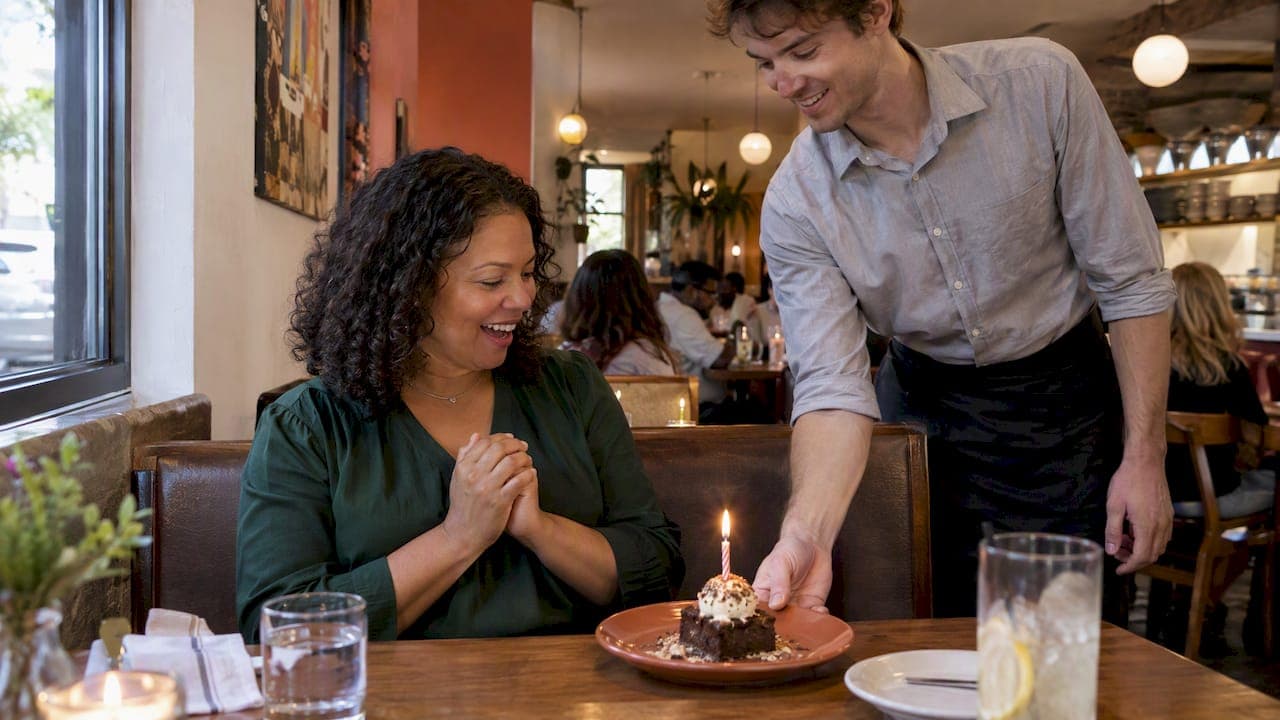
A good birthday reward is small, easy to claim and tied to a table booked for more than one person. Guests rarely come alone on their birthday, so a free dessert or a drink on the house is not a giveaway. It is a reason to book your restaurant over the one next door, with a party of four ordering mains and drinks around the freebie. This guide covers what UK chains already offer, which reward ideas work for an independent, how to build simple loyalty tiers around birthdays, and how to run the whole thing without paper cards or marketplace fees.
TL;DR
- Offer one clear, low-cost birthday reward (a dessert, a starter or a drink) and make the guest's group the real source of revenue.
- Collect the birthday at sign-up, with consent for marketing messages, then send the reward before the date, not after it.
- Give the reward a short validity window, such as the birthday week or month, so it fills quiet days rather than only Saturdays.
- Put birthdays inside a wider loyalty scheme with two or three tiers, so the reward is also a reason to join.
- Use a digital card in Apple Wallet or Google Wallet instead of paper, and keep your own guest list rather than renting it from a marketplace.
Table of Contents
- What UK restaurants already offer
- Why birthdays are worth the effort
- Nine birthday reward ideas that work
- How to choose the reward and set its cost
- Loyalty tiers built around the birthday
- Collecting birthdays without annoying guests
- Timing and messages
- Paper, plastic or wallet?
- Our perspective
- Run birthday rewards on your own platform
- A 30-day plan to launch
- Common mistakes
- FAQ
- Sources
What UK restaurants already offer
Search for this topic in Britain and you get lists of freebies written for diners: doughnuts, cake, a cookie, a pot of gyoza. That tells you what your guests compare you with. A 2026 round-up of UK birthday schemes says casual dining and pub groups are where the real birthday rewards sit. It reports that PizzaExpress Club gives members a birthday treat from the entry tier, and that Wagamama's Soul Club puts a gift in the member's wallet on the first day of their birthday month. The same guide notes that several chains often listed as birthday freebie givers, Nando's among them, do not run a standing UK birthday reward.
Three lessons for an independent:
- The reward is tied to membership. The guest signs up, which gives the chain a name, an email address and a birthday date. The freebie is the price of that data.
- The reward is low-ticket. Dessert, a drink or a side. Nobody gives away a main course for free without conditions.
- Timing is flexible. A birthday month is easier to plan around than a single day, for the guest and for your kitchen.
You cannot out-give a chain with hundreds of sites, and you do not need to. A regular who feels known at your tables is worth more than a stranger chasing a free doughnut.
Why birthdays are worth the effort
A birthday is the one date every guest has and nearly every guest will celebrate somewhere. It is also a message people welcome, which is rare for restaurant marketing.
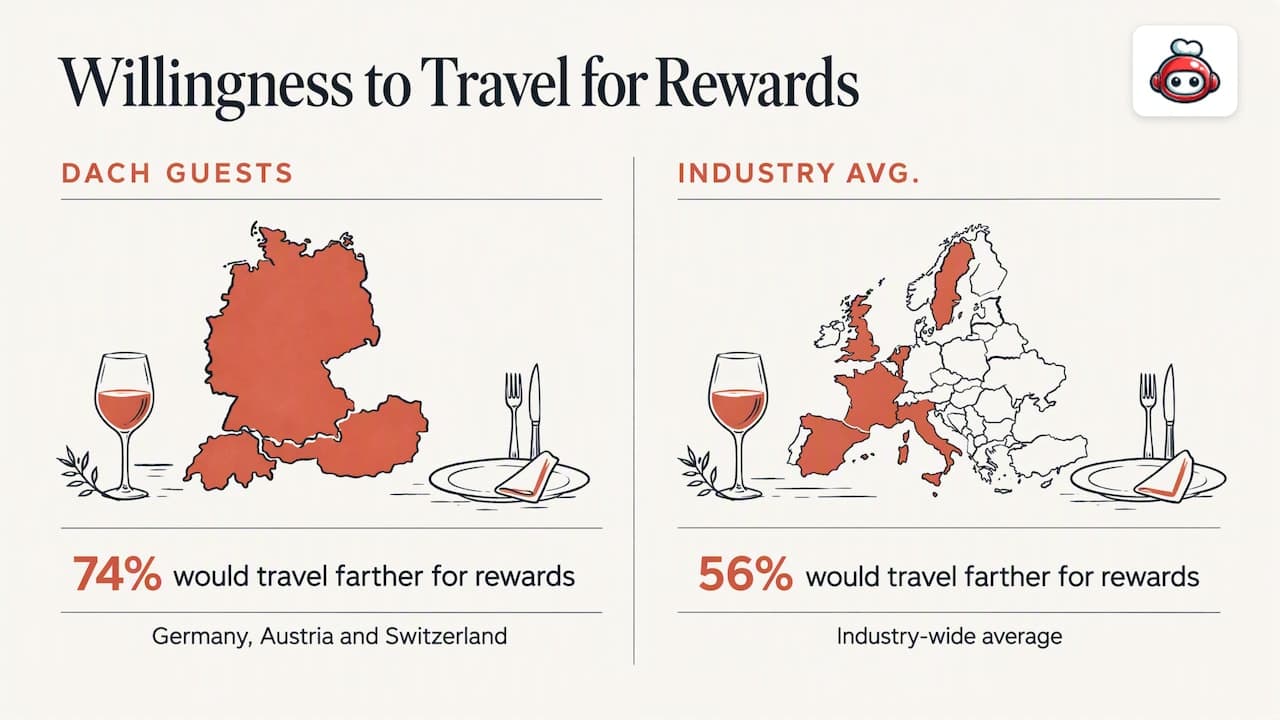
The numbers from the sector point the same way, though they come from German-speaking markets, so treat them as direction rather than a UK benchmark. A 2026 report cited by Gastrotel found that members of loyalty programmes spend on average 25% more per visit, and that 74% of guests in Germany, Austria and Switzerland would travel further to a restaurant that rewards their loyalty, against 56% as the industry average. A coaching business reports that its clients see 80 to 100 birthday celebrations a month, worth €25,000 to €35,000 in monthly revenue. That is one provider's claim about its own clients, and it will not hold for a ten-table café, but it shows why a birthday programme is seen as a predictable channel rather than a gimmick.
Nine birthday reward ideas that work
Pick one or two. A menu of ten birthday offers confuses guests and staff alike.
Free items
- Complimentary dessert with a candle. The classic. It costs you little, photographs well and prompts a social post.
- A welcome drink for the birthday guest when they book for two or more. Works well for bars, pizzerias and cafés.
- A free starter to share when the table orders mains. It lifts the group's order while the guest feels spoiled.
- A birthday-month coffee or pastry for cafés and bakeries. Low cost, high frequency, and it pulls in weekday visits.
Discounts and vouchers
- Birthday coupon for a set amount off the bill, valid for a week or a month, with a minimum spend. Searches for birthday coupons for restaurants are more common than for any other variation on this topic, so guests do look for them.
- Bring-a-friend voucher. The birthday guest gets a reward, and a friend gets a smaller one. This brings in new faces, not just known ones.
Experience rewards
- Priority booking or a favourite table on the birthday. It costs you nothing and feels personal, especially in a small dining room.
- A chef's taster for the highest loyalty tier. It suits restaurants with a menu that rewards a conversation with the kitchen.
- A birthday-week menu extra, such as a seasonal special reserved for members. It gives regulars something a walk-in cannot get.
How to choose the reward and set its cost
Work backwards from the food cost, not from what feels generous.
- Cost the reward at what it costs you, not its menu price. A £7 dessert may cost you well under that to produce. Know the number before you advertise it.
- Attach a condition that brings revenue. A minimum of two main courses, or a booking in advance, keeps the reward from becoming a sit-alone freebie.
- Limit the window. A birthday week or birthday month is easier to manage than "any time this year".
- Use quiet days. If Monday to Wednesday is slow, offer the upgraded reward on those days only.
- Make it one redemption. Digital codes or wallet cards make this simple; a paper voucher is easy to photocopy or lose.
Track three things for the first three months: how many rewards were issued, how many were redeemed, and the average spend of the parties who redeemed. If redemption is below a third, the reward or the message is wrong. If spend is no higher than a normal table, tighten the condition.
Loyalty tiers built around the birthday
A birthday reward alone is a one-off. Placed inside a small loyalty scheme, it becomes the reason to join and a milestone for staying. Keep it to two or three tiers, because more than that and neither staff nor guests will remember them.
| Tier | How a guest gets there | Birthday reward example |
|---|---|---|
| Member | Signs up with name, email and birthday | A dessert or coffee in the birthday month |
| Regular | A set number of visits in the year | The same, plus a welcome drink for the table |
| Favourite | A higher number of visits or a higher spend | A chef's taster and priority booking on the birthday |
Some principles for the ladder:
- Reward visits, not only spend. A guest who comes six times for coffee is as valuable as one who comes once for a large dinner.
- Give a first reward quickly. A stamp card where the first reward is twelve visits away loses people. Make the first prize reachable on the second or third visit.
- Let the birthday reward grow with the tier. That gives the member a reason to climb.
- Skip points that need a calculator. If a guest cannot say how close they are to the next reward, the scheme is too complicated.
For more examples of schemes that run well, see our guide to what actually works with digital loyalty cards.
Collecting birthdays without annoying guests
You need the date, and you need permission to message the guest. Both can be asked for in one short step.
- Online booking form: an optional birthday field, with a clear tick box for marketing messages.
- Loyalty sign-up: ask for day and month only. You do not need the year, and fewer fields mean more sign-ups.
- At the table: a QR code on the bill or the menu that leads to the sign-up page, with the reward named on it.
- Online orders: a prompt after the first order.
There is more than one place your guest data starts, as a German restaurant-marketing guide shows: reservations, ordering and loyalty sign-ups all feed the same list, and the skill is joining them up and getting consent for marketing. If you are unsure what the rules require for your venue, check with a data protection adviser rather than relying on a blog post.
Timing and messages
Send the first message before the birthday. Seven to ten days ahead gives the guest time to book for a group, which is where the value is. A message on the day itself tends to arrive too late for the table to be planned.
A simple sequence:
- Ten days before: "Your birthday reward is waiting, book a table and show this card."
- On the day or first day of the month: a short greeting and a reminder of the expiry date.
- Three days before the reward expires: one reminder, no more.
Keep the wording human. Use the guest's first name, name the actual reward and give the date it expires. Nothing else is needed.
The same logic applies to other segments. Research from a German restaurant consultancy warns against the scattergun approach: target regulars, lapsed guests and birthday celebrants with messages that fit each group, rather than sending identical content to the whole database. If you want to automate such sequences, a marketing automation checklist helps you set up triggers and test them before they go live.
Paper, plastic or wallet?
The birthday reward needs a place to live. Paper vouchers get lost. Plastic cards are expensive to print and forgotten at home. A digital card in the guest's phone wallet is always there, cannot be photocopied and updates without a reprint.
Guests are ready for it. The same Gastrotel report found that 85% of guests who use physical loyalty cards in the DACH region would switch to a digital version immediately if it were seamless and user-friendly. The lesson carries over: make joining take seconds, and the card does the rest. Our guide to Apple Wallet and Google Wallet loyalty cards shows how the switch away from paper stamps works in practice.
Our perspective
We build restaurant software, and we see the same pattern in venues that try birthday rewards. The ones that struggle treat it as a coupon campaign. The ones that succeed treat it as a guest list that belongs to them.
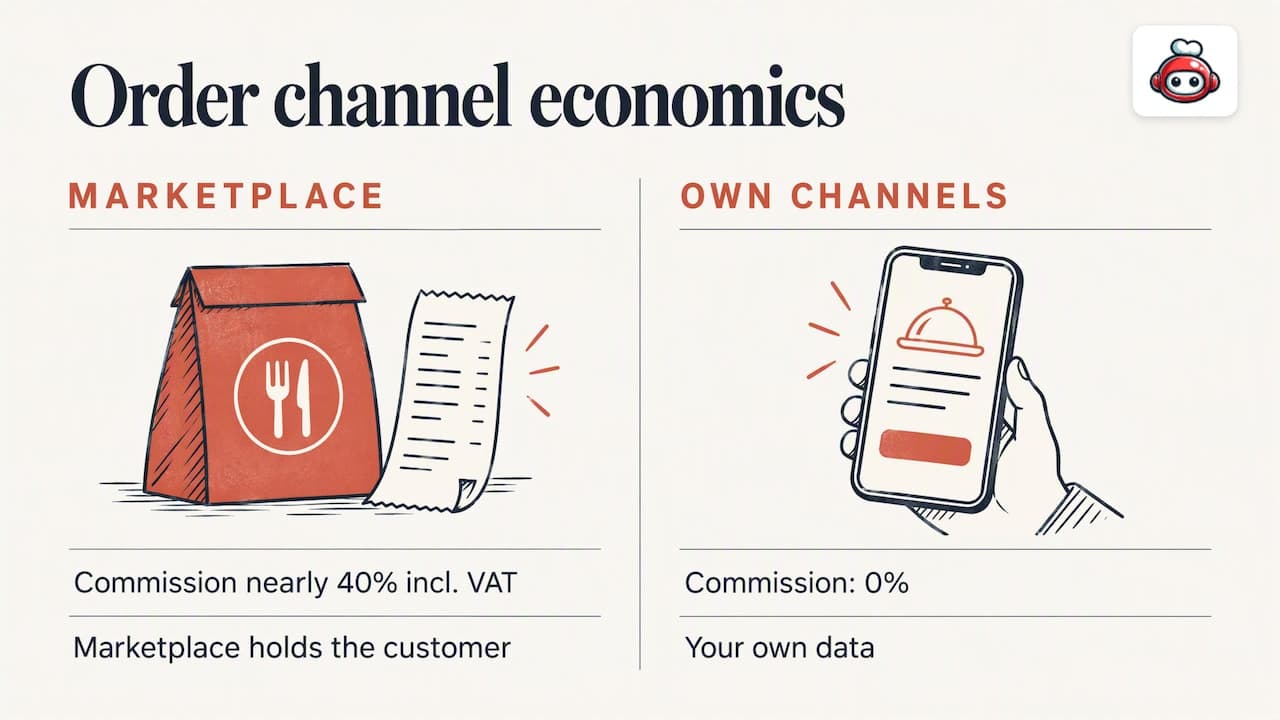
That is why we argue for owning the relationship. When a guest orders through a marketplace such as Uber Eats, Glovo, Bolt Food, Wolt, Just Eat or Pyszne, the marketplace holds the customer, and it charges 30% of the net order value plus VAT, almost 40% in total. You cannot give a generous birthday reward out of a margin that thin. When the guest orders through your own website, your own channels and your own loyalty card, the commission is 0% and the data is yours. RESTOBOT charges a monthly subscription and nothing on orders.
So our advice is plain: keep the reward modest, keep the card in the guest's wallet, keep the ordering on your own site, and let birthdays be one part of a loyalty scheme the guest can understand in ten seconds. If you run both dine-in and delivery, our note on direct orders against marketplace fees shows where the margin goes.
*— ADMIN*
Run birthday rewards on your own platform
RESTOBOT is an all-in-one platform for restaurants: a website with an embedded menu, ordering through your website and a Telegram bot, reservations, digital loyalty cards for Apple Wallet and Google Wallet, and review boosting for Google and TripAdvisor. A site can be created instantly and launched within one day.
The LOYALTY plan, for venues that want the loyalty card alone, starts from €39 per month, or €29 per year on the annual rate. MENU starts from €69 per month (€59 per year) and FULL from €119 per month (€99 per year). There is no commission on orders. See the plans and prices to choose the one that fits your venue.
A 30-day plan to launch
- Week 1: decide the reward and its cost. One reward, one condition, one validity window.
- Week 1: set the tiers. Member, Regular and Favourite, with the birthday reward growing at each step.
- Week 2: add the sign-up. A QR code on tables and bills, a field on your booking page and a prompt after online orders.
- Week 3: write three messages. Ten days before, on the day, and a final reminder.
- Week 3: brief the team. Every waiter should know the reward, how to check it and how to add the candle.
- Week 4: launch and measure. Count issues, redemptions and average spend per redeeming party.
After the first quarter, review. Keep what is redeemed and drop what is not. If your reviews are lagging, a birthday visit is also the best moment to ask for one, and you can automate review requests so the ask happens without anyone remembering.
Common mistakes
- Rewards that are too generous. A free main course attracts reward hunters, not regulars.
- No expiry. An open voucher is a liability on your books and an easy way to be taken advantage of.
- Asking for too much data. Name, email and birthday are enough.
- Messaging too late. If the message lands after the birthday, the table is already booked elsewhere.
- Forgetting staff. If the waiter does not know the reward exists, the guest feels foolish for asking.
- Ignoring the rest of the experience. A free dessert does not rescue slow service. Rewards amplify a good visit; they do not repair a bad one.
Staff matter on the guest's big day more than most owners assume. Where guests want to thank a particular waiter or bartender, digital tips let them do so by QR code, with the money going straight to the worker.
FAQ
Which restaurants have a birthday offer?
Many UK casual-dining groups do, usually through a free membership. One 2026 guide lists PizzaExpress Club and Wagamama's Soul Club among them. Offers change, so check the brand's own rewards page before you go.
What is a good birthday reward for a small restaurant?
A dessert with a candle or a welcome drink, offered when the guest books for two or more. It costs you little and brings in a group. Add a validity window of a week or a month.
When should I send the birthday message?
About ten days before, so the guest can plan a table for friends or family. Add a short reminder before the reward expires. A message sent after the date is wasted.
Do I need a loyalty app for birthday rewards?
No, but you need somewhere to store the birthday and the reward. A card in Apple Wallet or Google Wallet works without a separate app download, which keeps sign-up short.
Should birthday rewards be part of loyalty tiers?
Yes, if you can keep the tiers simple. Two or three levels, with the birthday reward getting better at each, gives guests a reason to return all year.