


If you want a restaurant promo code in the UK, the quickest routes are a delivery app voucher (Just Eat is the best known), a membership card such as tastecard, or a hospitality discount app such as CODE. If you run a restaurant, the more useful question is different: which codes are worth honouring, who pays for them, and how do you give guests a deal without handing a marketplace a third of every order?
This guide answers both sides. First, a comparison of the real options diners use. Then the owner's view: what a promo code actually costs you on each channel, and how to build offers on your own website and loyalty tools.
TL;DR
- Diners have three main routes to restaurant discounts: delivery app voucher codes, paid membership cards (tastecard, CODE) and voucher aggregator sites.
- Membership schemes usually cost between about £35 and £60 a year, and pay back only if you eat out regularly at participating venues.
- For venues, a code on a marketplace sits on top of a commission of 30% of the net order value plus VAT, almost 40% in total. A code on your own channel carries no such fee.
- Good codes are targeted: one code per channel, aimed at a slow period, so you can measure what worked.
- RESTOBOT charges a monthly subscription and 0% commission on orders, so the discount you choose is the only cost of the offer.
Table of Contents
- The main sources of restaurant promo codes compared
- Delivery app codes: how Just Eat vouchers work
- Membership cards and apps: tastecard and CODE
- Voucher aggregators: useful, but check the date
- What a promo code really costs a restaurant
- Principles for codes that make money
- Loyalty beats blanket discounting
- Our view: take the discount, keep the customer
- What RESTOBOT offers a venue running its own offers
- Comparing the options for a venue
- A simple 30-day plan for your first targeted offer
- FAQ
- Sources
The main sources of restaurant promo codes compared
Search results for this topic are dominated by five kinds of site. They work quite differently, and the right one depends on how often you eat out and whether you order in or dine in.
| Option | How the discount works | Cost to the diner | Best for |
|---|---|---|---|
| Just Eat voucher codes | A code entered at checkout on a delivery order | Free to use | Occasional takeaway orders |
| tastecard | 2 for 1 or percentage off the bill at partner restaurants | Around £35 to £80 a year, depending on the offer | Regular casual dining at chains |
| CODE Hospitality | Up to 50% off at independent restaurants, bars and hotels | Free trial, then a yearly or monthly fee | People who work in hospitality |
| Voucher aggregators (Wowcher, Playpennies, Magic Freebies) | Lists of brand codes and deals | Free | Hunting one-off deals at big chains |
| The restaurant's own code | Code on its website, social media or email | Free to the guest | Loyal local customers |
The last row is the one most articles skip, and it is the one that matters if you own a venue. We come back to it below.
Delivery app codes: how Just Eat vouchers work
Delivery marketplaces are where most people meet the phrase "promo code". On Just Eat, the process is simple: you sign in on the Just Eat site, choose your food and enter the code at checkout. Codes are tied to the account, so a code meant for new customers will usually not work for an existing one, and many have minimum order values or expiry dates.
Two practical points for diners:
- Read the terms before building your basket. A "20% off" code that only applies above a minimum spend is not a saving if it makes you order more than you wanted.
- Codes are often funded partly or wholly by the restaurant. That matters, because it is the restaurant that ends up paying twice: once for the discount and once for the marketplace's fee.
Membership cards and apps: tastecard and CODE
If you eat out often, a card can beat hunting for individual codes.
tastecard advertises 2 for 1 meals and 25% off the total bill at partner restaurants. Reseller listings show a 12-month membership at £34.99 against a £79.99 list price, though offers change, so check the current price before buying. The partner list leans towards chains such as Prezzo, Zizzi, Ask Italian and Bella Italia. If your habits are family meals at high street restaurants, the maths can work quickly. If you prefer independents, there is less in it for you.
CODE Hospitality is aimed at people who work in hospitality. It promotes up to 50% off at over 700 restaurants, bars and hotels, with a 7-day free trial and then £4.99 a month. Its offers page also lists a yearly price of £39.99 after the free trial and examples such as 25% off a tasting menu or 30% off the total bill at named venues. Because the scheme is for industry staff, it is not a general diner option.
A sensible test before paying for any card: list the five restaurants you actually visit, check how many are in the scheme, and work out whether a year of use would cover the fee.
Voucher aggregators: useful, but check the date
Sites such as Wowcher's discount code pages and Playpennies collect codes from hundreds of brands, and Magic Freebies lists free vouchers for chains. They are free and fine for a one-off saving at a big brand. The weak spot is freshness. Some pages that rank for this search are years old, and a code that no longer works wastes your time. Always check the expiry date, and be wary of any page that asks for payment details to "unlock" a code.
What a promo code really costs a restaurant
Here the picture changes. For the diner a code is a saving. For the restaurant it is a decision about margin.
On the big delivery marketplaces (Uber Eats, Glovo, Bolt Food, Wolt, Just Eat, Pyszne and others), the commission is 30% of the net order value plus VAT, almost 40% in total. Add a discount code on top, and a single order can leave the kitchen with very little profit. Imagine a hypothetical £20 order (net of VAT) with a 20% discount code: the restaurant has already given up £4 before the marketplace takes its 30% of the net value plus VAT. The numbers will vary by contract and by who funds the code, but the principle holds: the more you discount on a high-fee channel, the thinner the margin.
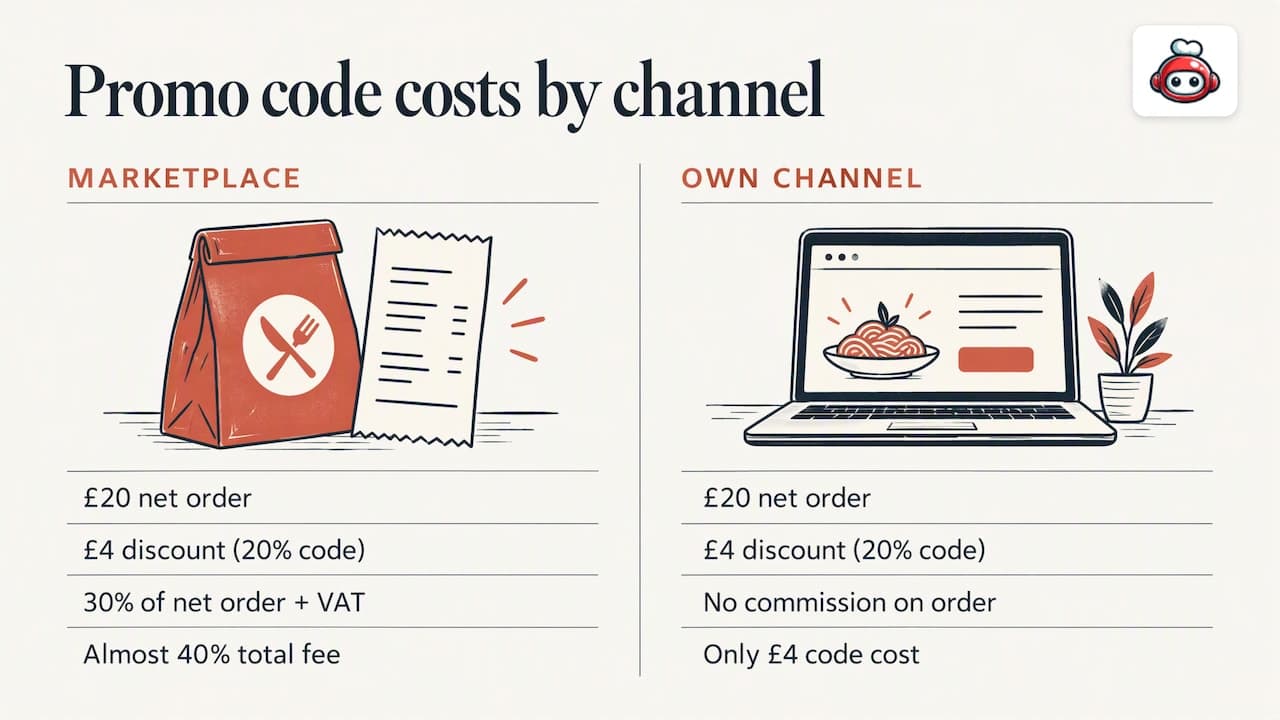
On your own channels the same code costs only the discount itself. That is the central argument for moving repeat customers away from marketplaces, and it is covered in more detail in our guide to commission-free online ordering.
Principles for codes that make money
Practitioners who write about restaurant marketing keep returning to the same advice: discounts work when they are targeted, and fail when they are scattered. A Polish restaurant marketing guide notes that campaigns with themed evenings or targeted social codes can lift reservations by over 40% within two weeks. That is a case study, not a guarantee, but its logic is sound and it is worth borrowing.
- Aim at a gap. Use codes for the quiet slots, such as weekday lunch, or for perishable stock you need to move. Do not discount the Saturday night you already fill.
- One code, one channel. A code like INSTAGRAM15 or NEWSLETTER10 tells you exactly where each booking or order came from. The same source recommends assigning unique codes to channels so you can judge each one.
- Ask for something back. The best codes buy data or behaviour: an email address, a completed feedback form, a first direct order. That is worth more than the discount.
- Set an end date and a limit. Open-ended codes become the new price.
- Measure margin, not just redemptions. A code used 500 times can still lose money.
If you want a structure for planning this around customer behaviour, a marketing automation checklist for small businesses walks through the setup steps.
Loyalty beats blanket discounting
A code gets a guest through the door once. A loyalty scheme brings them back. In a 2024 survey reported by the German industry body Bitkom, 30% of people said online reviews were decisive when choosing a restaurant or café. That is a German sample, so treat it as an indicator rather than a UK figure, but it points the same way as what most owners see: guests check you online before they book, and returning guests are the cheapest to win.
Digital cards in Apple Wallet and Google Wallet remove the friction of paper stamps. We cover what works and what does not in digital loyalty cards for restaurants. The short version: reward the second and third visit, keep the reward simple, and make sure the guest can find the card on their phone in two taps.
Our view: take the discount, keep the customer
We build RESTOBOT for restaurant owners, and the same pattern shows up in what owners ask us. They are not short of ways to give a discount. They are short of ways to keep the relationship, and the money, once the guest has come in.
A marketplace code delivers a customer who belongs to the marketplace. The guest sees its app, its branding and its next set of codes from your competitors. A code on your own website or Telegram bot delivers a customer you can reach again, with an order history you control and no commission taken from the order.
So our advice is plain. Use marketplaces if they bring you guests you would not otherwise meet, but treat that as acquisition, and budget for the 30% plus VAT. Then move those guests to your own channel with a reason to switch: a loyalty card, a direct-order offer, a reservation perk. Run every offer with an end date, a channel label and a margin you have worked out in advance. We explain the shift in more detail in how to promote online ordering and cut 30% fees.
*— ADMIN*
What RESTOBOT offers a venue running its own offers
RESTOBOT is an all-in-one platform for restaurants: a website builder with an embedded menu and reservations, ordering through your site and a Telegram bot, digital loyalty cards for Apple and Google Wallet, delivery coordination through third-party couriers such as Wolt Drive, and a dashboard with real-time orders and analytics. Sites are created instantly and can launch within a day.
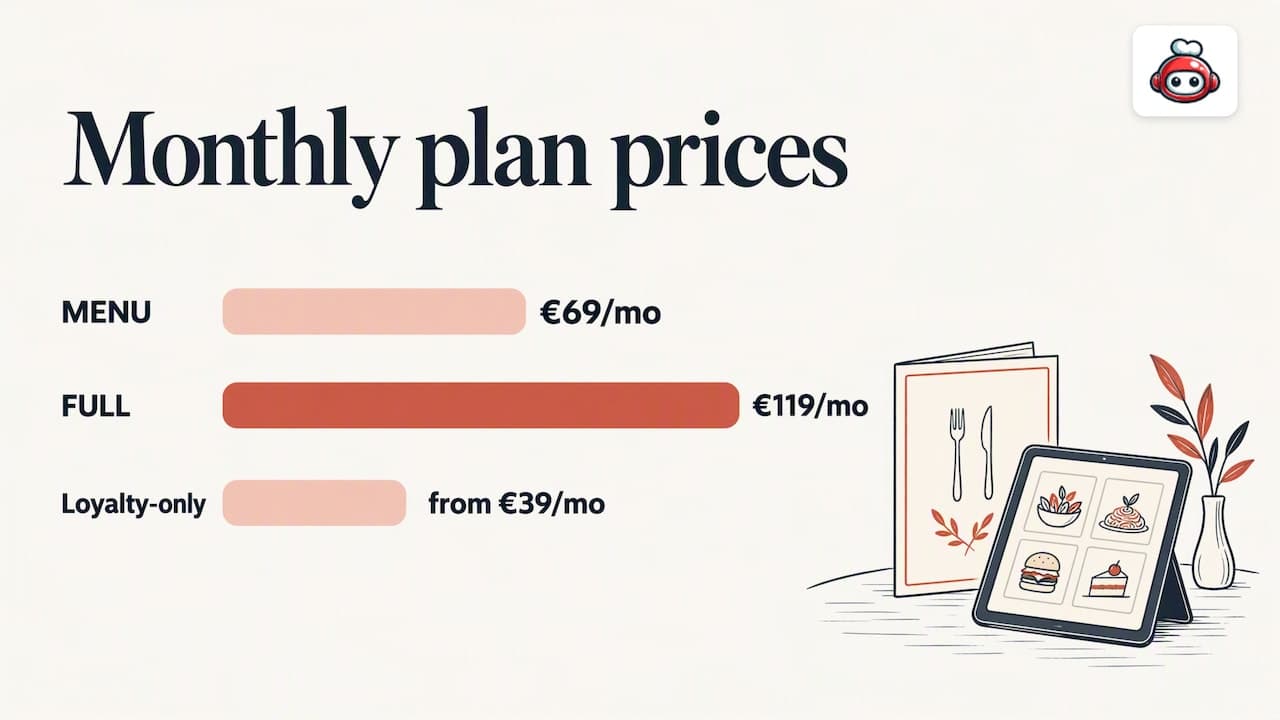
We take 0% commission on orders. You pay a monthly subscription, and plans start at €69 a month for MENU and €119 a month for FULL, with a loyalty-only plan from €39 a month. Details are on the pricing page.
The platform also covers guest gratuities. Waiters, bartenders and baristas can receive tips directly through a QR code, with no commission from us, on all plans. A worker can register alone even if the venue is not on RESTOBOT. It is a small thing, but a team that earns more directly is a team that stays.
Comparing the options for a venue
If you are an owner choosing where to put your offers, this is how the channels compare.
| Channel | Who owns the customer | Fee on orders | Control of the offer |
|---|---|---|---|
| Delivery marketplace | The marketplace | 30% of net order value plus VAT | Limited by platform rules |
| Membership scheme (tastecard, CODE) | The scheme | Varies by scheme; check the contract | You set the deal, they set the terms |
| Aggregator listing | The aggregator | Varies | Low |
| Your own site and bot with RESTOBOT | You | 0% commission, monthly subscription only | Full |
There is no rule against using several. The point is to know what each one costs per guest and to steer the guests you want to keep towards the channel you own. For a wider look at the economics, see our breakdown of online ordering pricing for restaurants, and for payments, online payments without marketplace commissions.
A simple 30-day plan for your first targeted offer
You do not need a campaign calendar to start. Try this:
- Week 1: find the gap. Look at your last month of orders and bookings. Pick the weakest two-hour window.
- Week 1: choose the offer. A free coffee with a weekday lunch order, or 10% off a direct order, is easier to afford than a deep cut. Calculate the margin after the discount.
- Week 2: label the channels. Give each channel its own code word so you can see which one pulls.
- Week 2 to 3: promote. Post the code on social media, put it on the table cards, add a link in your newsletter. Table QR codes make this easy, as we explain in the table ordering QR playbook.
- Week 4: review. Count redemptions per code, compare margin per order, and keep only the codes that earned their cost.
Repeat with the best code, and drop the rest.
FAQ
How do I find a promo code for a restaurant?
Start with the restaurant's own website and social media, because direct offers are often better than the ones on aggregator sites. Then check the delivery apps, voucher sites and any membership card you hold. Always check the expiry date and the terms before you rely on a code.
Are there Just Eat discount codes for existing customers?
Sometimes. Many codes are for new customers only, but the company issues others by email or inside the app. The Just Eat voucher guide explains where to enter a code at checkout, and the terms on each code say who can use it.
Is a restaurant discount card worth paying for?
Only if you will use it often. Compare the yearly fee with what you would save at the venues you actually visit. A card with mostly chain restaurants suits a family that eats out at them monthly, and does little for someone who prefers independents.
Can a restaurant run promo codes without paying marketplace commission?
Yes. Codes on your own website, social channels and loyalty programme cost you only the discount. With RESTOBOT you pay a monthly subscription and 0% commission on orders, whereas marketplace commission is 30% of the net order value plus VAT.