


A restaurant referral programme rewards existing guests for bringing in new ones. The version that works is small and simple. It gives a clear reward to the newcomer, a modest thank-you to the person who recommended you, a unique code or link so you can see what happened, and a cap so the cost stays predictable. This guide covers the offer, the mechanics, the staff side and the numbers, so you can launch one in a week and judge it within a quarter.
TL;DR
- Give the new guest the stronger reward and the referrer a smaller thank-you. It reads as hospitality rather than payment.
- Every referral needs a trackable code or link, or you are guessing about results.
- Cap rewards per person so the cost never surprises you.
- Staff prompts at the right moment (after a good meal, never at the start) do more than any poster.
- Pair referrals with a loyalty card so new guests have a reason to return after the first visit.
Table of Contents
- Why referrals suit restaurants
- What a referral programme looks like in practice
- Choosing rewards that feel generous but stay sustainable
- Setting up the programme step by step
- The staff side: asking without being awkward
- A worked example: what results can look like
- Tracking: what to measure and how
- Connect referrals to retention
- Our perspective
- Run referrals and loyalty from one place
- Common mistakes to avoid
- FAQ
- Sources
Why referrals suit restaurants
A restaurant is a trust purchase. Nobody can sample your food before booking, so a friend's recommendation carries weight that an advert cannot. Research summarised by the American Marketing Association points to two reasons referred customers tend to be valuable: they fit what a firm offers better, and the relationship with the person who referred them adds trust and loyalty. For a restaurant that translates simply. A guest who brings a friend with similar tastes sends you someone likely to enjoy the menu and likely to come back.
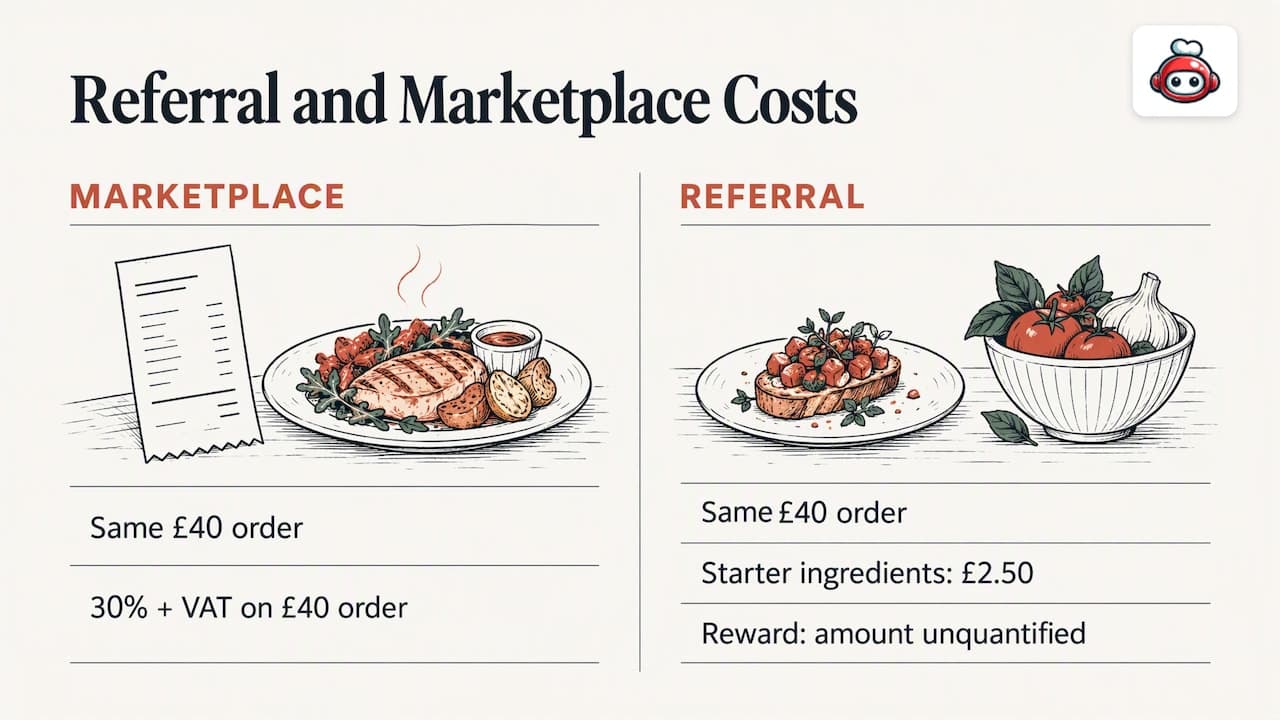
There is also a cost argument. Delivery marketplaces such as Uber Eats, Deliveroo-style apps and Just Eat take 30% of the net order value plus VAT, close to 40% in total, to put a new customer in front of you. A referral reward, paid only when a guest actually turns up and spends, is usually a fraction of that, and the customer relationship stays with you.
That is the real prize: new guests who belong to you, not to a platform.
What a referral programme looks like in practice
There are four moving parts, and every programme you see is a variation on them.
- The referrer. An existing guest who is happy to recommend you.
- The invitation. A code, a link, a card or a simple "mention Anna's name" prompt.
- The trigger. What the newcomer must do before anyone is rewarded: book, visit, spend a minimum.
- The reward. What each side receives, and when.
The decisions that matter are the trigger and the reward. Reward at sign-up and you will pay for people who never come. Reward after the first completed visit and you pay only for tables filled.
Choosing rewards that feel generous but stay sustainable
The most common mistake is to make the referrer's prize the headline. One restaurant-industry guide recommends the opposite: favour the new guest in the reward structure, because it signals that you value the connection, whereas a very large prize for the referrer can start to look like a bribe. That fits how people behave. Few of us want to be seen pushing a friend towards a restaurant for a payout, but we are happy to say "they'll look after you, and you get a free starter".
A general framework from Referral Rock's reward guide asks three questions: who receives the reward, when it is paid, and what it is worth. It also stresses that the incentive must be relevant and sustainable without hurting your margin. Apply those to a restaurant and the options are straightforward.
| Reward type | Best for | Watch out for |
|---|---|---|
| Free starter or dessert for the new guest | Dinner-led venues with healthy food margins | Make sure it is a dish you can produce cheaply and quickly |
| Percentage off first visit, both sides | Cafes and casual dining | Discounts can attract bargain hunters, so set a minimum spend |
| Signature dish or drink | Venues with a known "hero" item | The dish must genuinely show you off |
| Points or stamps on a loyalty card for the referrer | Venues already running a loyalty scheme | Needs a working digital card, not paper |
| Surprise upgrade or shared experience (chef's table, tasting flight) | Higher-end venues | Limited capacity, so cap the number |
A simple default for most independents: the newcomer gets a free starter or dessert on a first visit with a minimum spend, and the referrer gets a reward on their loyalty card, such as extra points or a free coffee, once that visit is complete.
Work out the maths before you launch
Take a typical party of two. If the average spend is £40 and a free starter costs you £2.50 in ingredients, your cost per referred table is the cost of the starter plus the referrer's small reward. Compare it with the 30% plus VAT a marketplace would charge on the same £40 order, and the saving is easy to see. Use your own food costs and your own average spend, and check the margin on whatever you choose to give away.
Setting up the programme step by step
1. Decide the rules in one sentence each
Write them so a waiter could explain them in ten seconds:
- Who can take part (any guest, or members of your loyalty scheme only).
- What the new guest must do (book through the website, show the code, spend a minimum).
- When each reward is issued (after the first completed visit).
- The cap (for example, a maximum number of rewarded referrals per person per month).
That last rule matters more than it seems. One case study from a marketing agency suggests capping rewards at a fixed number per person each month keeps the cost of the programme predictable. Decide your own limit, then stick to it.
2. Give every referral an identity
Without a code or link, you cannot tell a referral from a coincidence. You have three realistic choices:
- Printed cards with unique codes. Cheap and tactile. The same case study notes that a card system with unique codes can be tracked in a spreadsheet, which works for a single venue with modest volume.
- A personal link or code in a message. Guests can forward it in a chat or email in seconds.
- A code tied to the guest's digital loyalty card. The best long-term option, because the referrer's reward lands where they already look. Our guide to digital loyalty cards for restaurants explains how this works, and the piece on Apple Wallet and Google Wallet loyalty cards shows why guests prefer them to paper stamps.
3. Make the redemption path obvious
The newcomer should be able to use the code on the way they already book or order: your website, your reservation form or your Telegram bot if you use one. If redeeming means a phone call or a screenshot shown to a busy host, you will lose most of them. A promo code entered at online checkout or booking is the lowest-friction version, and it records itself.
4. Promote it where guests already are
Online:
- A short banner and a dedicated page on your website.
- An email or message to past guests: one line about the offer, one button.
- Your Instagram stories and Google Business Profile posts. One practical idea from content guides is a small contest: guests post a photo of their meal and tag a friend.
- The confirmation message after a booking, which is read and arrives at the moment of goodwill.
In person:
- A card tucked into the bill folder or handed over with the card machine.
- A small sign by the till or a QR code on the table.
- A line on the receipt or the pay-at-table screen.
Keep it to two or three channels at first. Measure which one produces codes, then do more of that.
The staff side: asking without being awkward
Your team is the most effective channel you have, and the one most programmes ignore. Guests rarely refer on their own initiative. They need a prompt, delivered by a person they already like.
A few principles keep it natural:
- Ask after the good moment. The best time is when a guest has just complimented the food or said they will be back. Not at the door, not mid-course.
- Make it about the friend. "If you know someone who would like this, here's something for them" lands better than "refer us".
- Hand over something physical or scannable. A card or QR code removes any need to explain the mechanics.
- Say thank you, whether or not they use it. Gratitude is part of the service.
Staff also respond to good incentives. A short team brief on the rules, plus a little recognition for the person whose guests redeem the most codes, keeps it alive. If your staff receive gratuities through a QR code, the same moment at the end of the meal works for both: a guest who has just left a tip through the QR code is clearly pleased with the service and is the right person to ask. Our walkthrough on QR code tipping shows how that end-of-meal flow is set up.
Never tie a referral to a review. Asking guests to recommend you to friends is fine. Rewarding public reviews is a different matter with its own platform rules, so keep review requests separate and ask for honest feedback only. For a clean way to do that, see how to collect Google reviews automatically.
A worked example: what results can look like
It helps to see what a focused programme can do, with the caveat that this is one business's own account. A marketing agency reported that a bar in Hoboken, New Jersey, spent about $800 over 90 days on a card-based referral system and attributed $28,200 in extra Friday sales and a rise in Friday capacity from 52% to 100% to it. Treat those numbers as a vendor's case study, not a forecast. The useful lesson is in the design: the programme targeted quiet nights, used a physical card with a unique code, and was cheap enough to test.
Copy the thinking, not the figures. Pick your emptiest service, aim the offer at it ("valid Tuesday to Thursday"), and see what happens.
Tracking: what to measure and how
A referral programme you do not measure is a discount you cannot defend. Track five numbers each month:
| Metric | How to calculate | What it tells you |
|---|---|---|
| Codes issued | Count of cards, links or codes handed out | Whether staff and channels are promoting it |
| Redemptions | Codes used at booking or at the till | How many invitations became visits |
| Redemption rate | Redemptions divided by codes issued | Whether the offer is attractive |
| Repeat visits from referred guests | Referred guests who return within 60 days | Whether you gained customers or one-off bargain hunters |
| Cost per referred guest | Reward cost divided by redemptions | Whether it beats your other marketing |
Compare cost per referred guest with what you spend elsewhere. If you want a broader view of how to link marketing spend to revenue, this piece on analytics and marketing ROI is a helpful companion. For restaurant-specific measures, our guide to six restaurant analytics metrics that predict profit covers what to watch on the operations side.
When you have a quarter of data, ask three questions:
- Did referred guests spend as much as other new guests?
- Did they come back?
- Did the programme fill quiet sessions rather than cannibalise busy ones?
If the answers are yes, extend it. If not, change the reward or the trigger before you change anything else.
Connect referrals to retention
A referral gets someone through the door once. Whether they become a regular depends on what happens next. That is why referral programmes work best alongside a loyalty scheme: the new guest should leave the first visit with a card already in their phone wallet and a reason to return. Our article on what actually fixes restaurant customer retention argues this in detail, and a birthday reward is a simple second touchpoint that brings a referred guest back within the year.
It is also worth automating the repetitive parts: issuing codes, sending thank-you messages, crediting rewards. The guide on what to automate first in restaurant operations helps you decide the order.
Our perspective
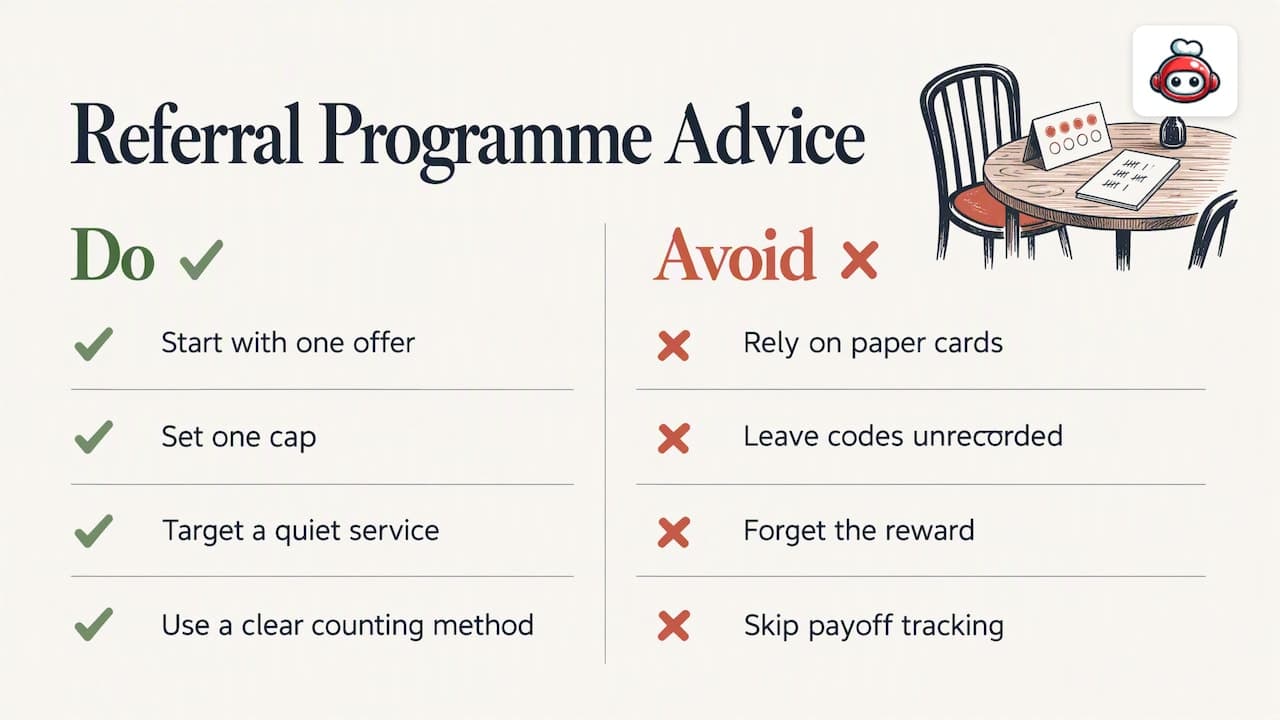
We build tools for restaurants, and the pattern we see is consistent: referral programmes fail less because of the idea and more because of friction. A paper card gets lost, a code is never recorded, the reward is forgotten, the manager cannot say whether it paid off. Each of those problems is a data problem.
That is why we think of referrals as an extension of loyalty and direct ordering, not a separate campaign. When the guest has a digital loyalty card, books on your own website and orders through your own channels, the referral has somewhere to live. You see who came, what they spent and whether they returned. And because RESTOBOT charges a monthly subscription and 0% commission on orders, the money from a referred guest's orders stays with you, instead of 30% plus VAT going to a marketplace for the same customer.
Our advice is to start small. One offer, one cap, one quiet service to fill, and a clear way to count. Add complexity only when the numbers justify it.
*— the author*
Run referrals and loyalty from one place
If you want the pieces connected, RESTOBOT combines a website with embedded menu and reservations, online ordering through your site and Telegram bot, and digital loyalty cards for Apple Wallet and Google Wallet. Sites can be created instantly and launched in a day. Plans start from €69 per month for MENU and from €119 per month for FULL, or €59 and €99 per year on the annual rates, with a LOYALTY plan from €39 per month if a loyalty card is all you need. Tips for your team are included on all plans. See the plans and pricing to find the fit.
Common mistakes to avoid
- Rewarding sign-ups instead of visits. Pay out only after a completed, qualifying visit.
- No cap. One enthusiastic guest or a shared code on a deals forum can blow the budget.
- Rewards that do not suit the venue. A free dessert is a good fit for a restaurant with a strong pudding list and a poor one for a coffee shop with a thin dessert range.
- Complex rules. If staff cannot explain it quickly, guests will not use it.
- Forgetting the thank you. A short message after a referred guest visits keeps the referrer engaged.
- No review after 90 days. Check results, adjust the offer, repeat.
FAQ
How much should a restaurant spend on a referral reward?
Keep the reward well below what you would pay to acquire the same guest elsewhere. Work from your own food cost and average spend, and favour the new guest with the larger share. Marketplaces take 30% of net order value plus VAT, so a modest dish or discount per referred table is a useful benchmark to beat.
Should both the referrer and the new guest get a reward?
Usually yes, but not equally. Guidance for restaurant operators suggests favouring the new guest, with the referrer receiving a smaller thank-you. A two-sided reward feels fair and gives both people a reason to act, while keeping the referrer's prize modest avoids it looking like a payment.
How do I track referrals without special software?
Print cards with unique codes, record each code when it is redeemed and keep a simple spreadsheet of code, date, spend and whether the guest returned. It works for one venue with modest volume. As soon as you handle many codes, a digital loyalty card or booking system that records redemptions saves a lot of time.
Can restaurant staff ask for referrals without being pushy?
Yes, if the ask follows a good moment, such as a compliment on the meal, and is framed around the guest's friends. Hand over a card or QR code so there is nothing to explain. Brief the team on the rules and thank guests either way.
Is a referral programme worth it for a small restaurant?
It often is, because the cost is only incurred when a new guest arrives and spends. Start with one offer aimed at your quietest service, cap the number of rewards and review the results after a quarter. If the redemption rate and repeat visits are healthy, keep it and widen it.