

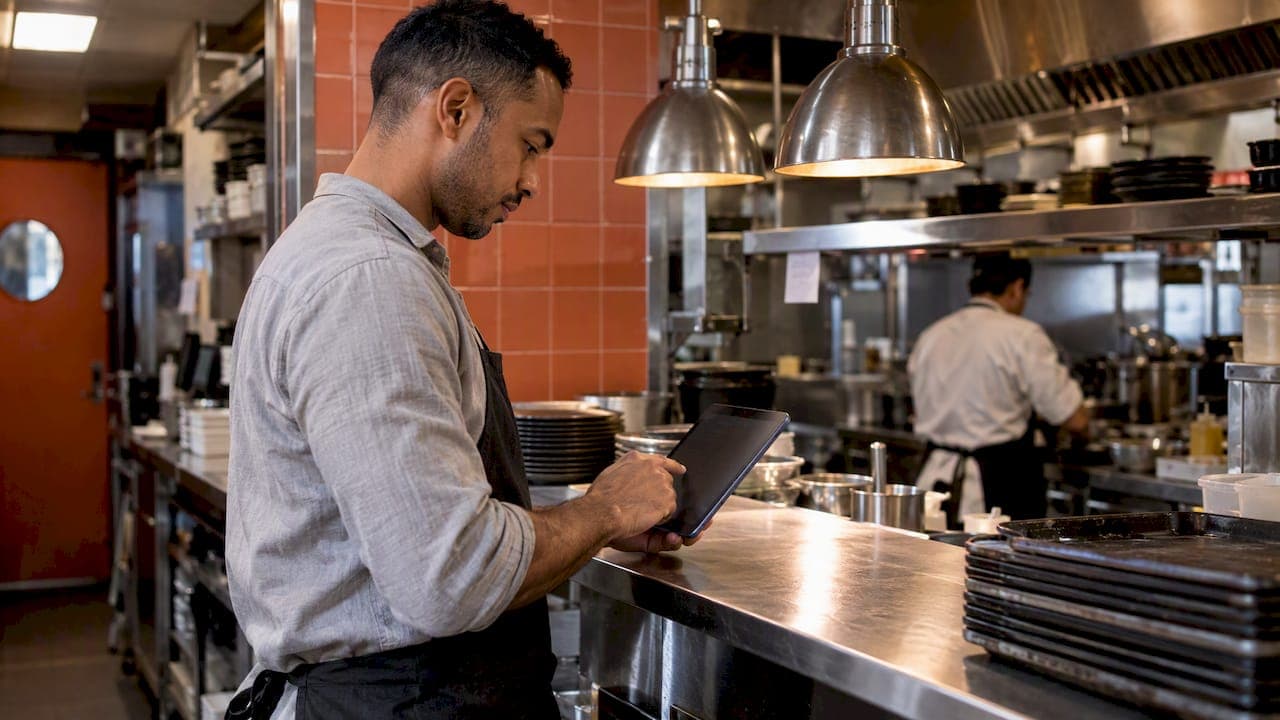
A delivery time slot is a window, such as 7:00pm to 7:30pm, that a guest picks when ordering so the food arrives when they want it and the kitchen knows what is coming. For a restaurant, getting slots right comes down to four settings: which days and hours you deliver, how long each slot lasts, how long before a slot the guest must order (the cut-off), and how many orders each slot can take. This guide walks through each one, with worked examples you can adapt to your own kitchen.
TL;DR
- A slot is a promise to the guest and a planning tool for you. It only works if the kitchen and the courier can both keep it.
- Set four things: days and hours, slot length, cut-off before the slot, and a maximum number of orders per slot.
- Capacity is the setting most restaurants forget. Without it, a Friday 7:30pm slot fills with more orders than the pass can plate.
- Decide in advance what happens when you pause orders or run late, and tell guests early, in plain words.
- Taking orders directly on your own channels means you keep control of slots and you avoid the 30% of net order value plus VAT that marketplaces charge.
Table of Contents
- What a delivery time slot actually is
- Why restaurants use slots
- The four settings that matter
- Delivery areas and slots work together
- Setting slots up step by step
- When you pause orders or change the schedule
- What to tell guests when a window changes
- Perspective: why slots belong on your own channel
- Taking orders with RESTOBOT
- Common mistakes to avoid
- FAQ
- Sources
What a delivery time slot actually is
A delivery time slot, also called a scheduled delivery window, is a predefined interval the customer chooses when they place an order. It does two jobs at once. For the guest, it is a convenience: they know when to be home and can plan around it. For the business, it is an operational tool for managing labour, routing and delivery capacity, a point made in ORTEC's guide to time slot booking, written for grocery but equally true of a kitchen.
It helps to separate a slot from the two other times a guest sees:
| Term | What it means | Who sets it |
|---|---|---|
| Preparation time | How long the kitchen needs to cook and pack an order | You |
| Estimated ready or arrival time | A running estimate shown for "order now" delivery | You, based on current load |
| Delivery slot | A window the guest picks in advance | Guest, from the options you offer |
"Order now" delivery says "about 40 minutes". A slot says "between 7:30pm and 8:00pm". The first is a forecast that moves with the queue. The second is a commitment, so the kitchen has to plan backwards from it: if the window opens at 7:30pm and the dish takes 15 minutes to cook and pack, plus the courier's pickup time, the ticket needs to fire well before 7:30pm.
Slots can be used the same day or booked ahead. Large delivery services let customers choose a slot for the same day or up to five days into the future, as the Instacart documentation describes. Restaurants usually offer a shorter horizon, from later today to a few days out, depending on how far ahead they can plan stock and staff.
Why restaurants use slots
Most restaurants start with "order now" and add slots when problems appear. The common triggers are:
- Peak crush. Everyone orders at 7:15pm on a Friday. Slots spread that demand across the evening instead of letting it hit the kitchen at once.
- Larger and planned orders. Office lunches, family dinners and catering orders need a fixed time, not a guess.
- Pre-ordering. Guests who order at 3pm for 8pm are easier to plan for than walk-in demand, and the kitchen can prep ahead.
- Fewer apologies. A guest who chose 8:00pm to 8:30pm and received food at 8:15pm is happy. A guest told "40 minutes" who waited 70 is not.
The flip side is that a slot you cannot keep is worse than no slot. A promise of a window carries more weight than a vague estimate, so build the system around what your kitchen can deliver on a bad night, not a good one.
The four settings that matter
Whatever software you use, scheduling comes down to the same four controls. Platforms that offer scheduling let you set schedules by day, choose start and end times, define the slot length and set a cut-off before a slot starts or ends, so that orders placed later only see later slots, as shown in one platform's help centre.
1. Days and hours
Start with the hours you can genuinely deliver, not the hours you are open. A restaurant open from 12pm to 11pm might deliver only from 12pm to 2:30pm and 5:30pm to 9:30pm, because the gap between services is prep time and the last half hour is clean-down. Different days can carry different windows: a quiet Tuesday lunch might need two slots, a Saturday evening twelve.
Check the rest of your week too. Do you have fewer staff on Sundays? Does your courier partner work shorter hours? The slot calendar should reflect the weakest link in the chain.
2. Slot length
The slot length is the width of the window the guest sees. Shorter windows feel more precise but are harder to meet. Longer windows are forgiving but less useful to the guest.
A practical way to choose:
- 15 minutes works for a short-radius, own-rider operation where you control the whole route.
- 30 minutes is a sensible default for most restaurants using a mix of own and third-party couriers.
- 45 to 60 minutes suits larger orders, catering drop-offs and wide delivery areas.
Start wider than you think you need. Narrowing a window later is an easy improvement. Widening one after you have missed it a few dozen times is a reputation problem.
3. Cut-off time
The cut-off is how long before a slot's start (or end) a guest must order to qualify for that slot. Once the cut-off passes, the slot disappears from the options for new orders. This is the setting that protects the kitchen, because it stops a 7:30pm slot from being sold at 7:25pm.
Some examples:
| Situation | Suggested cut-off |
|---|---|
| Simple menu, short cooking time, own riders | 30 to 45 minutes before slot start |
| Full menu, third-party courier booking needed | 60 to 90 minutes before slot start |
| Large or catering orders | The previous day, at a fixed time |
These are starting points to test against your own ticket times, not rules. Look at your slowest dish and your slowest courier pickup, add the two, and set the cut-off above that.
4. Capacity per slot
Capacity is the maximum number of deliveries that can be made within a single slot, a definition used in delivery slot configuration guidance from a logistics platform. For a restaurant it should reflect two limits, and the lower one wins:
- Kitchen throughput. How many orders can the line cook and pack in the time before the slot, while still handling dine-in?
- Delivery throughput. How many drops can your riders or courier partner actually complete in that window, given distance and traffic?
A worked example. Your kitchen can comfortably produce 12 delivery orders per half hour on a busy night, and two riders can complete about 8 drops in the same half hour. The sensible capacity is 8, not 12. When a slot reaches 8 orders it closes, and the next guest is offered the following one. That is not lost revenue: most guests will pick another time, and the ones who do not would have been late deliveries anyway.
Review the figure monthly. Look at which slots hit the limit, and which never do. If every Friday 7:30pm slot sells out in an hour, you have a demand signal for more riders or more kitchen hours.
Delivery areas and slots work together
Slots do not exist in isolation from where you deliver. A 30-minute slot to an address two miles away is a different proposition from one a few streets away. Two common approaches:
- Zones with different slots. Near addresses get shorter windows and later cut-offs, farther ones get longer windows and earlier cut-offs.
- One calendar, tighter capacity. You keep a single set of slots but lower the capacity so that long runs do not stack up.
If you want to understand how scheduled orders feed into routing, this article on dispatch automation explains how scheduled jobs shape route planning in other service businesses, and the principle carries over: the more evenly work is spread across the day, the more efficiently a driver can be used.
For the courier side, see our guide to delivery management software for restaurants and our 60 to 90 day approach to outsourced delivery, which covers testing a courier partner before you rely on them for promised windows.
Setting slots up step by step
- Measure your real ticket times for a week: order accepted to food packed, on a quiet night and on a peak one.
- Add courier pickup and journey time for your furthest zone to get your realistic order-to-door time.
- Choose slot length. Begin with 30 minutes unless you have strong reasons otherwise.
- Set the cut-off above your slowest realistic order-to-ready time.
- Set capacity at the lower of kitchen and delivery throughput.
- Start with fewer slots. Open only the busiest two services and add more once you have hit the windows consistently.
- Review weekly for a month: late orders, slots that sell out, slots that sit empty.
When you pause orders or change the schedule
This is where slots catch restaurants out. A guest who booked 8:00pm to 8:30pm yesterday has a commitment from you today, whatever your kitchen is doing. Plan for three situations.
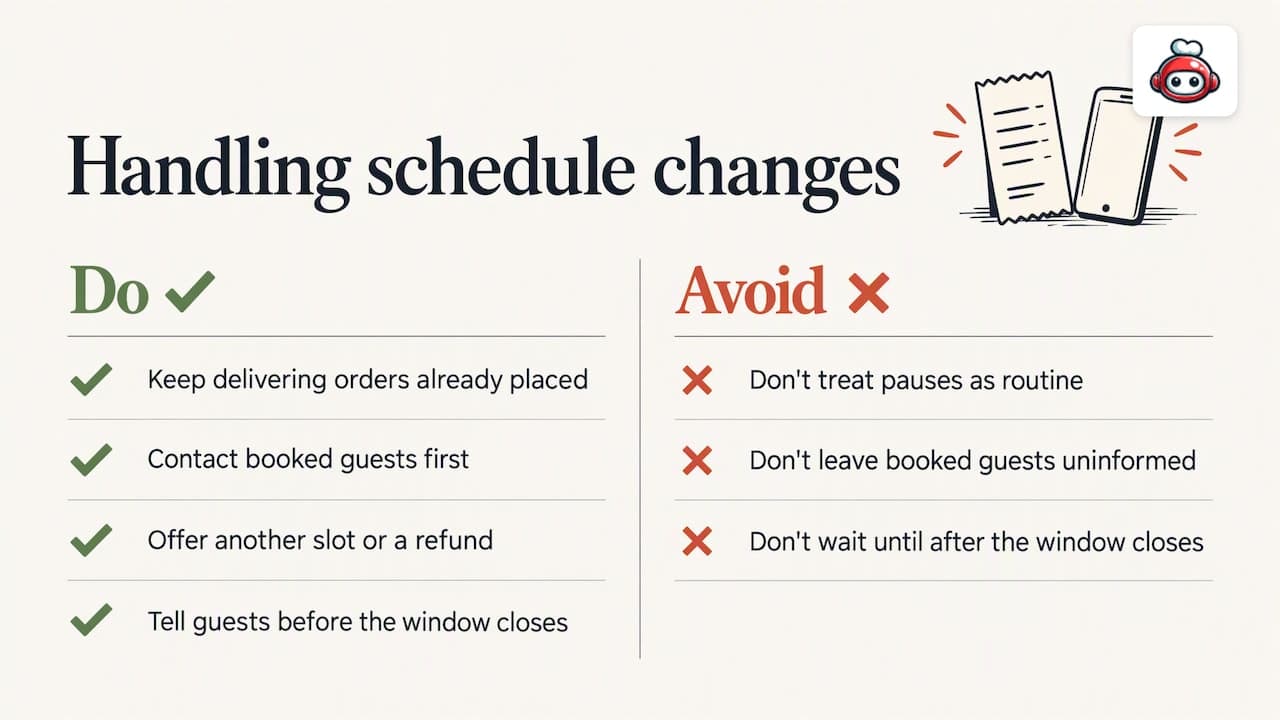
Pausing orders for a rush. Pausing stops new orders, but orders already placed still need delivering. Decide whether a pause applies to new slots only, and treat it as a signal to review capacity, not a routine tool. If you pause often, your capacity is set too high.
Changing hours. If you close early because of staff illness or a private event, contact guests with booked slots first, ideally by message with a clear option: a different slot or a refund. Do not let them find out when nobody arrives.
Running late. If the kitchen falls behind, tell the guest before the window closes, not after. A short message that gives a new realistic time and thanks them for their patience lands far better than silence.
The best practice is to write these rules down once so every shift handles them the same way. For menu changes that affect what is available in a slot, our POS menu sync playbook explains how to stop the online menu drifting from what the kitchen can actually make.
What to tell guests when a window changes
Guests forgive delay more readily than they forgive surprise. A few rules that work:
- Show the window clearly at checkout and again in the confirmation: day, date, start and end.
- Say what the window means. "Your order will arrive between 7:30pm and 8:00pm" is better than "Estimated 7:45pm".
- Message early. If you expect to miss a window, send the update as soon as you know, with a new time range.
- Offer a choice. A rebooked slot or a cancellation with refund is respectful, and it protects your ratings.
- Keep a contact route. A phone number or chat that someone actually answers during service.
It also helps to be honest on the menu page about what slots are for. Large orders and catering need earlier cut-offs, and guests accept that when they can see why.
Perspective: why slots belong on your own channel
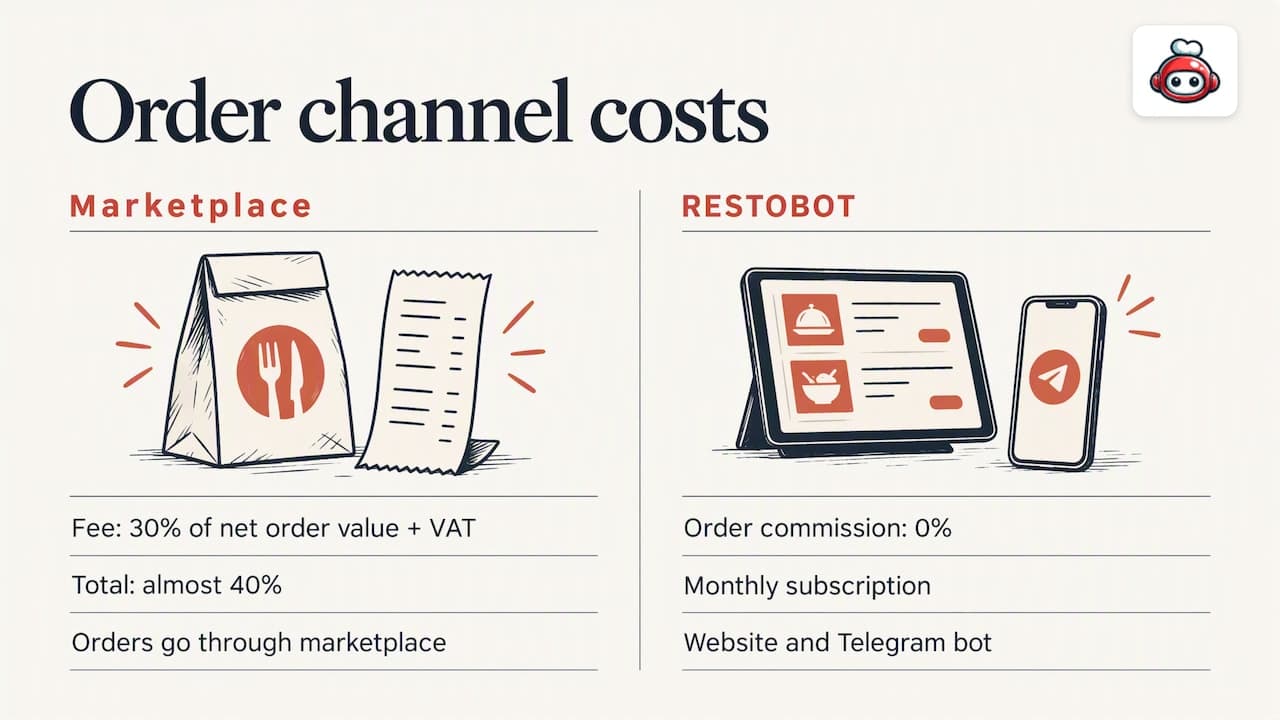
We built RESTOBOT around the idea that the restaurant should own the relationship with the guest and the money from the order. Marketplaces such as Uber Eats, Glovo, Bolt Food, Wolt, Just Eat and Pyszne charge 30% of the net order value plus VAT, which is almost 40% in total. RESTOBOT's commission on orders is 0%: you pay a monthly subscription and nothing else.
That matters for slots because scheduled orders are often your best orders. They are planned, larger and more predictable. Sending them through a marketplace means paying that cut on exactly the orders that are easiest to serve. Taking them through your own website and Telegram bot keeps the margin, and the guest data, with you.
Our view is that restaurants should start simple: a handful of well-chosen windows, honest capacity and clear messages, and expand only when the numbers justify it. A slot calendar is a promise you make to your own customers, and it is better to promise less and keep it.
We also see delivery as a team effort. Couriers, kitchen and front of house all affect whether a window is met, and guests who are happy with a well-timed delivery sometimes want to thank the person who made their evening. That is why we built online tips as a separate feature: any worker can register alone, even if their venue is not on RESTOBOT.
*— ADMIN*
Taking orders with RESTOBOT
RESTOBOT gives restaurants a website with an embedded menu and online ordering through the website and a Telegram bot, delivery coordination through third-party couriers such as Wolt Drive, real-time order control and a management dashboard. Site creation is instant and launch takes one day. Our MENU plan starts from €69 per month (or €59 per year), and the FULL plan from €119 per month (or €99 per year). See the plans and pricing to compare them, and our guide to online payments without marketplace commissions for the payment side.
If you are moving from a marketplace, the hour-by-hour migration checklist shows how to switch without losing a service.
Common mistakes to avoid
- Setting slots by opening hours, not by capacity. The restaurant is open at 10pm, but the kitchen may not want delivery tickets then.
- No cut-off. Without one, slots sell until the last minute and the kitchen is ambushed.
- No capacity limit. One popular slot absorbs far more than the line can produce.
- Copying a supermarket. Grocers can hold a window for hours because stock sits on a shelf. A hot meal cannot.
- Ignoring the courier. A slot is only as good as the weakest link: if the courier cannot pick up at that time, the window is fiction.
- Never reviewing. Demand shifts with seasons, local events and weather. A calendar set in January is probably wrong by June.
For wider kitchen efficiency before you add technology, our piece on fixing waste before buying tech is a useful companion.
FAQ
What is a delivery time slot?
It is a window of time, chosen by the customer at checkout, in which the order is expected to arrive. It gives the guest certainty and gives the restaurant a way to spread orders across the evening. It is different from an "order now" estimate, which moves with how busy the kitchen is.
How long should a delivery slot be?
Thirty minutes is a sensible default for most restaurants, because it is precise enough to be useful and loose enough to absorb normal variation. Use 15 minutes only if you control the whole route, and 45 to 60 minutes for larger orders or wide delivery areas. Begin wider and tighten the window once you are meeting it reliably.
How many orders should each slot accept?
Set the limit at the lower of what your kitchen can cook and what your couriers can deliver in that window. Capacity is the maximum number of deliveries possible within a single slot, so when it is reached the slot closes and guests see the next one. Review the figure monthly against late orders and sold-out slots.
What should I do if I cannot meet a booked window?
Message the guest as soon as you know, give a new realistic time range and offer a different slot or a refund. Contacting them before the window closes matters more than the exact wording. Write the rule down so every shift handles it the same way.